Interfacing

sales@interfacing.com
Most digital transformation programs fail because they optimize after deployment.
Business process simulation changes that by allowing organizations to test scenarios, predict outcomes, and expose bottlenecks before decisions become expensive mistakes.

Digital transformation without foresight is still guesswork


Most digital transformation programs promise efficiency, agility, and resilience. In practice, many stall after documenting processes or automating isolated workflows. The missing layer is not more dashboards or another AI buzzword. It is business process simulation.

Simulation answers the questions traditional BPM cannot. What happens if demand spikes? What if a regulatory step is added? What if a key role becomes unavailable? Without simulation, organizations react after problems appear instead of anticipating them.

This is where transformation efforts quietly fail.

Why traditional BPM stops short of real decision support


Business Process Management tools are excellent at describing how work flows today. BPMN diagrams, repositories, and governance frameworks create clarity and standardization. But clarity alone does not predict outcomes.

Most organizations assume that once processes are documented and automated, performance will improve automatically. That assumption rarely holds. Real-world operations are dynamic, constrained by resources, compliance requirements, and risk exposure.

Process simulation introduces a new capability. It allows organizations to test scenarios before they occur, using time, cost, capacity, and probability models tied directly to BPMN processes.

This is the difference between visibility and foresight.

The Illusion of Thoroughness


One of the most dangerous aspects of manual CAPA is that it can look rigorous while remaining shallow.

Templates are filled out. Fishbone diagrams are drawn. Five Whys are completed. Audit trails are maintained. On paper, everything appears compliant.

Yet when similar issues recur, the uncomfortable truth surfaces. The analysis addressed the symptom, not the system.

This is not because teams are careless. It is because manual methods are fundamentally limited in their ability to detect trends, correlations, and weak signals across time and across processes. Humans are excellent at judgment. They are far less reliable at pattern recognition at scale.

As CAPA volume increases, cognitive load increases with it. Fatigue sets in. Shortcuts follow.

Why Manual CAPA Does Not Scale in Modern Environments


Modern quality environments generate more data than ever before. Process performance metrics, audit findings, training records, change histories, supplier data, and risk assessments all contain pieces of the root cause puzzle.

Manual analysis treats these sources as separate inputs. Someone has to remember to look at them, interpret them, and connect them.

Artificial intelligence changes the equation, but only when it has the right foundation.

AI is not valuable because it automates paperwork. It is valuable because it can analyze relationships humans cannot reasonably track on their own. But when quality events, processes, and risks live in disconnected systems, AI is forced into the same blind spots as manual analysis.

This is why many organizations feel stuck. They invest in QMS tools, add more rigor to CAPA workflows, and still experience fatigue. The underlying operating model has not changed.

What business process simulation actually does

Business process simulation uses BPMN models enriched with operational data to simulate how processes behave under different conditions. Instead of static diagrams, organizations gain a living model of their operations.

With simulation, teams can:

  • Identify bottlenecks before automation
  • Measure cost and cycle-time impact of process changes
  • Test compliance changes without disrupting production
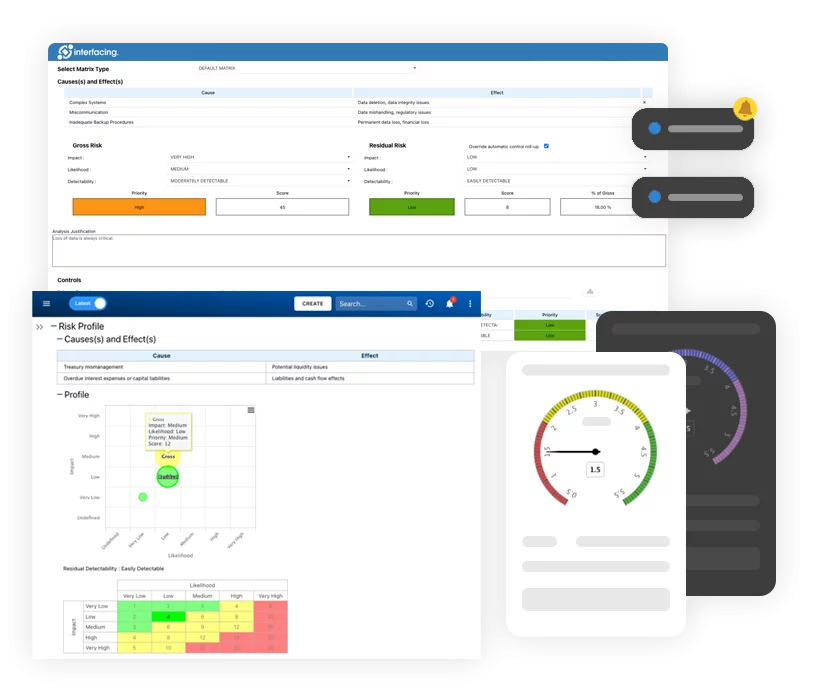
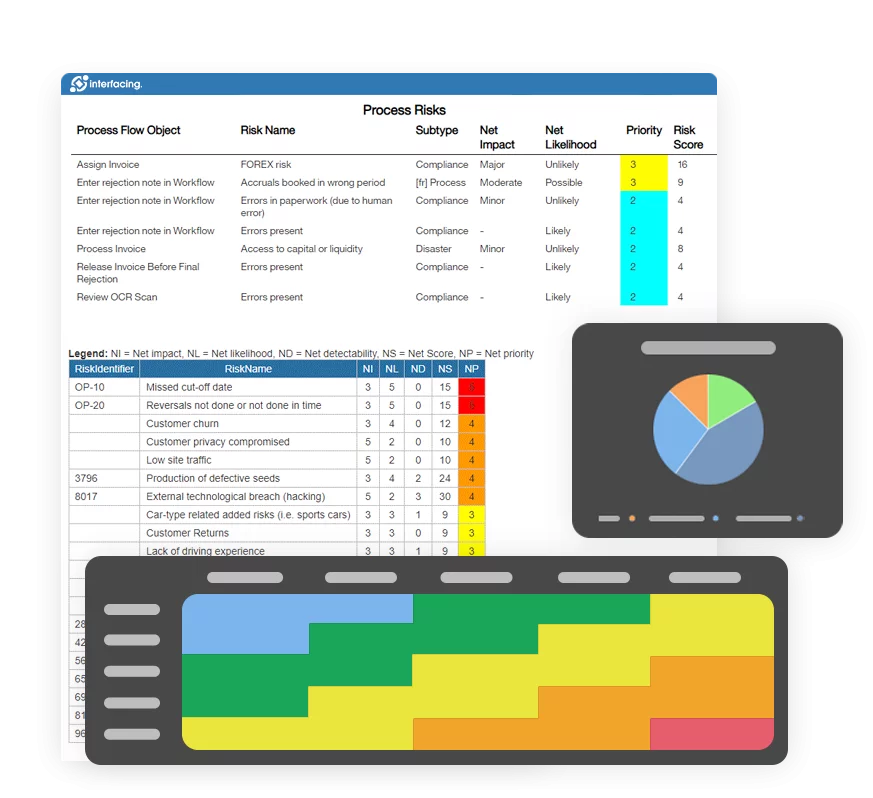
  • Understand risk exposure tied to process design
  • Support data-driven executive decisions

Unlike process mining, which analyzes past behavior, simulation is forward-looking. It answers “what will happen if” rather than “what already happened.”

That distinction matters.

The AI connection most vendors do not explain

Simulation becomes exponentially more powerful when combined with AI. AI-driven platforms can automatically adjust simulation variables, analyze thousands of scenarios, and surface insights humans would miss.

Within an AI-powered Integrated Management System, simulation is no longer a specialist exercise. It becomes part of everyday governance, quality management, and risk analysis.

This is where Interfacing Technologies Corporation differentiates itself. Simulation is not bolted onto BPM. It is embedded into a Digital Twin Organization that connects processes, roles, documents, risks, and controls in one model.

The result is predictive intelligence, not just automation.

Why simulation is critical for regulated industries


Highly regulated organizations face a unique challenge. They must improve efficiency while proving compliance at every step. Simulation allows them to test improvements without violating regulatory constraints.

For example:

  • Adding a validation step to meet regulatory requirements

  • Assessing the compliance impact of faster cycle times

  • Testing staffing changes without increasing audit risk

Without simulation, organizations make these changes live and hope audits confirm their assumptions later.

Hope is not a compliance strategy.

Business process simulation as a digital transformation accelerator


The uncomfortable truth is that many digital transformation initiatives fail because decisions are made too late. Simulation moves decision-making upstream, before systems are built, before workflows are automated, and before compliance gaps appear.

This is why simulation is increasingly seen as a foundational capability, not an advanced feature.

When combined with BPM, QMS, risk management, and AI-driven analytics, simulation transforms digital initiatives from reactive to resilient.

How Interfacing helps organizations simulate before they automate


Interfacing enables organizations to simulate processes directly from BPMN models inside its AI-driven Integrated Management System. Simulation is connected to real roles, documents, KPIs, and compliance controls, not isolated process diagrams.

Organizations can model scenarios, measure impact, and align decisions across quality, compliance, and operations, all within a single platform.

Pourquoi choisir Interfacing?


Avec plus de deux décennies de logiciels d'IA, de qualité, de processus et de conformité, Interfacing continue d'être un leader dans l'industrie. À ce jour, nous avons servi plus de 500+ entreprises de classe mondiale et des sociétés de conseil en gestion de toutes les industries et de tous les secteurs. Nous continuons à fournir des solutions numériques, cloud et IA qui permettent aux organisations d'améliorer, de contrôler et de moderniser leurs processus tout en allégeant le fardeau de la conformité réglementaire et des programmes de gestion de la qualité.

Pour en savoir plus ou discuter de la manière dont Interfacing peut aider votre organisation, veuillez remplir le formulaire ci-dessous.

Documentation : Piloter la transformation, la gouvernance et le contrôle

• Obtenez des informations complètes et en temps réel sur vos opérations.
• Améliorez la gouvernance, l'efficacité et la conformité.
• Assurez une conformité fluide avec les normes réglementaires.

eQMS : Automatiser les workflows de qualité et de conformité & rapports

• Simplifiez la gestion de la qualité avec des workflows automatisés et une traçabilité continue.
• Standardisez la gestion des CAPA, des audits fournisseurs, de la formation et des workflows associés.
• Transformez la documentation en informations exploitables pour la Qualité 4.0.

Développement rapide d'applications low-code : Accélérer la transformation numérique

• Créez rapidement des applications personnalisées et évolutives.
• Réduisez le temps et les coûts de développement.
• Adaptez-vous rapidement pour répondre aux besoins évolutifs des clients et de votre entreprise.


L’IA pour transformer votre entreprise !

Conçus pour optimiser les opérations, l'efficacité et renforcer la conformité. Découvrez nos solutions alimentés par l’IA :
• Répondre aux questions des employés.
• Transformer des vidéos en processus.
• Recommander des améliorations de processus et des impacts réglementaires.
• Générer des formulaire, processus, risques, réglementations, KPIs, et bien plus.
• Fragmenter les normes réglementaires

Apprenez-en plus sur l'IA avec EPC
CONTACT US

Request Free Demo

Document, analyze, improve, digitize and monitor your business processes, risks, regulatory requirements and performance indicators within Interfacing’s Digital Twin integrated management system the Enterprise Process Center®!

Approuvé par nos clients à travers le monde !

Plus de 400 entreprises de classe mondiale et cabinets de conseil en gestion.

INTEGRATION

Approuvé par les nos clients dans le monde entier !

Plus de 400 entreprises de classe mondiale et cabinets de conseil en gestion.