

CAPA fatigue appears when quality teams keep closing corrective actions while the same nonconformances return in audits, complaints, deviations, or production reviews. The issue is rarely effort. It is usually a disconnected quality system that treats CAPA as a record to complete instead of an operational learning cycle.
For Quality Managers and Compliance Leaders, repeat findings signal that root cause, process control, risk, and accountability are not fully connected.
CAPA Automation Must Prevent Recurrence, Not Just Close Records
CAPA automation becomes valuable when it changes the question from “Was this CAPA closed?” to “Did this CAPA prevent the issue from recurring?”
That distinction matters because quality teams can meet closure timelines, satisfy review meetings, and still face the same audit finding six months later.
CAPA fatigue is the operational exhaustion that follows. Quality Managers chase overdue tasks. Operations leaders feel blamed for investigations they see as paperwork. Compliance teams prepare explanations for repeat findings. Executives hear that corrective actions are complete, then discover that complaints, deviations, nonconformances, or supplier issues are still trending in the wrong direction.
The pattern often starts with a realistic scenario. A medical device manufacturer receives three internal audit findings over eighteen months related to incomplete line-clearance documentation. Each finding generates a CAPA. The first action retrains operators. The second updates the work instruction. The third adds a supervisor signoff. Every CAPA is closed on time. Yet the next audit finds the same gap on a different shift.
The failure is not that nobody cared. The failure is that the CAPA process never proved the real cause. The investigation focused on the missing form entry, not the process condition behind it: the line-clearance step was performed during a shift handoff, the digital work instruction did not match the physical sequence on the floor, and supervisors had no reliable signal that the task was being skipped until the audit found it.
Closure happened. Learning did not.
Why Repeat Findings Happen After Closed CAPAs
Repeat findings occur when CAPA is managed as a workflow endpoint instead of a quality-learning mechanism. The record can be complete while the system remains unchanged.
This is why CAPA fatigue is so frustrating for quality and operations leaders: the team may be working hard, but effort is trapped in disconnected administration.
Several execution gaps commonly sit beneath closed CAPAs:
- Root cause analysis stops at human error or procedural noncompliance.
- Corrective actions are assigned without changing the process that allowed the issue.
- Effectiveness checks confirm task completion rather than recurrence prevention.
- Training is recorded, but competency or behavioral adoption is not verified.
- Similar processes, sites, suppliers, or product lines are not evaluated for exposure.
Regulatory and quality-management references reinforce this distinction. FDA 21 CFR 820.100 requires procedures for corrective and preventive action, including investigating causes of nonconformities, identifying actions needed to correct and prevent recurrence, verifying or validating corrective actions, and disseminating quality problem information. ISO’s quality management guidance also frames ISO 9001 around customer satisfaction, quality assurance, and continual improvement.
In both contexts, the standard of performance is not administrative closure. It is controlled improvement.
That is where manual CAPA systems struggle. If nonconformances, audit findings, complaints, process maps, risk controls, SOPs, training, and verification evidence live in separate tools, investigators must reconstruct relationships by hand.
Quality leaders may know that a CAPA exists, but not whether it touched the process, risk, or control that caused the failure.
The Executive Cost of CAPA Fatigue
For Directors of Quality and Compliance Leaders, repeat CAPAs create more than backlog pressure. They weaken credibility.
When auditors see the same issue return, they ask whether the organization understands its own processes.
When customers see recurring complaints, they question whether improvement claims are reliable.
When executives review quality performance, they may see closure metrics that look healthy while operational risk remains unresolved.
The practical consequences are sharp.
Audit readiness becomes reactive because evidence has to be rebuilt after the fact.
Quality meetings become status reviews instead of decision forums.
Operations teams experience CAPA as interruption rather than improvement.
Supplier quality leaders lose time chasing corrective action responses that do not address systemic exposure.
In regulated industries, repeat issues may also increase inspection risk, product hold risk, remediation cost, and management review escalation.
Connected audit management matters because repeat findings should trigger controlled learning, not another scramble for proof.
The executive problem is visibility.
A CAPA dashboard that shows open, overdue, and closed records can be useful, but it does not prove that the organization is reducing recurrence.
Leaders need to see whether corrective actions are connected to:
- Root causes
- Process changes
- Risk controls
- Document updates
- Training impacts
- Effectiveness results
This is why a connected quality management system matters.
CAPA should not sit beside the operating model.
It should be tied to the way work is designed, governed, performed, monitored, and improved.
Executive Reality Check
CAPA fatigue rarely starts in the quality department.
It starts when organizations measure CAPA closure instead of CAPA effectiveness.
A CAPA completed in 30 days may still be a failure if the same finding appears six months later.
Many organizations celebrate administrative efficiency while recurrence rates remain unchanged.
The real KPI is not how many CAPAs were closed.
It is how many problems never returned.
When leaders focus on closure metrics alone, teams become experts at processing CAPAs rather than eliminating the conditions that created them.
Sustainable quality performance comes from preventing recurrence, not accelerating paperwork.
Where CAPA Automation Changes the Quality Conversation
CAPA automation is not simply faster routing.
Used well, it creates disciplined continuity from the moment an issue is identified through investigation, action, verification, and management review.
The benefit is not that people stop thinking.
The benefit is that quality decisions become harder to separate from evidence.
An effective automated CAPA workflow can prompt investigators to:
- Classify the event
- Connect it to the impacted process
- Document root cause logic
- Assign accountable owners
- Trigger related SOP or training updates
- Link risks and controls
- Define an effectiveness check before closure
It can also support read-across analysis, helping teams ask whether the same failure mode could exist in another site, supplier, line, or process variant.
For audit readiness, this changes the evidence trail.
Instead of explaining a CAPA through emails, spreadsheets, meeting notes, and file searches, the team can show how the issue moved through governed investigation and controlled execution.
The CAPA record becomes a structured narrative:
- What happened
- Why it happened
- What changed
- Who approved the change
- How it was verified
- What evidence shows recurrence risk was reduced
Corrective and preventive action is a process for examining problems, identifying causes, and taking action to prevent recurrence.
That recurrence point is the heart of the matter.
Automation should protect it from being diluted by closure pressure.
A Hard Truth About CAPA Automation
Automation can reduce administrative burden, improve traceability, and accelerate root cause investigations, but it cannot compensate for poor management priorities.
If executive dashboards emphasize CAPAs closed, overdue actions, and cycle times while ignoring recurrence rates, effectiveness checks, and repeat failure modes, the organization may be optimizing the wrong outcome.
The goal of a CAPA program is not efficient closure.
The goal is measurable risk reduction and the permanent elimination of recurring issues.
Automation can make CAPA execution faster and more consistent.
Leadership determines whether the organization is actually learning from failure or simply becoming more efficient at processing paperwork.
From CAPA Closure to Continuous Improvement
Continuous improvement depends on learning velocity.
A QMS that captures issues but cannot connect them to process intelligence leaves leaders reacting to symptoms.
A QMS that links CAPA to process, risk, compliance, controls, documents, workflows, and operational execution helps quality teams understand where the system is fragile.
This matters to Operations Leaders as much as Quality Leaders.
If repeat findings are tied to shift handoffs, supplier qualification, equipment changeover, document adoption, or unclear ownership, the solution must be operational.
CAPA automation should make those relationships visible so leaders can prioritize actions that change performance.
A business process management foundation helps corrective actions change how work is performed, while risk and control management helps leaders evaluate whether recurrence risk is actually reduced.
The stronger reframe is this:
CAPA is not a compliance form.
It is the governed memory of how the organization learns from failure.
When that memory is fragmented, fatigue grows.
When it is connected, CAPA becomes a practical engine for audit readiness, recurrence prevention, and measurable improvement.
CAPA Fatigue Is Often a Management Problem, Not a Workflow Problem
Many discussions about CAPA fatigue focus on process inefficiencies, disconnected systems, or manual administration.
While those issues certainly contribute, they are not always the root cause.
Some organizations have highly structured CAPA workflows, dedicated quality resources, and modern software platforms, yet they still experience repeat findings year after year.
The uncomfortable reality is that CAPA fatigue is often a management problem disguised as a workflow problem.
Organizations naturally measure what they value.
If leadership teams focus primarily on metrics such as CAPAs closed, overdue CAPAs, or average cycle time, quality teams will optimize for closure.
Corrective actions get completed, approvals get signed, and records move to closed status.
The process appears healthy on paper.
The problem is that closure does not necessarily equal improvement.
A CAPA completed within thirty days can still be ineffective if the same issue returns six months later.
An investigation can satisfy procedural requirements while failing to address the operational condition that created the problem.
When organizations reward administrative completion more than recurrence prevention, they unintentionally encourage activity over learning.
This is why repeat findings continue to appear even in mature quality environments.
The issue is not always the workflow itself.
The issue is often that the organization is measuring the wrong outcome.
How Interfacing Helps
Interfacing helps quality, compliance, and operations leaders move CAPA from isolated case management into a governance-first, AI-assisted Integrated Management System.
The value is not simply automating reminders or approvals.
It is connecting CAPA to the process context that determines whether corrective action will actually prevent recurrence.
Within one operating model, Interfacing connects BPM, QMS, GRC, document control, risk management, workflows, audit evidence, management review, and operational intelligence so teams can see how a quality issue relates to the way work is performed.
For CAPA fatigue, that connection matters.
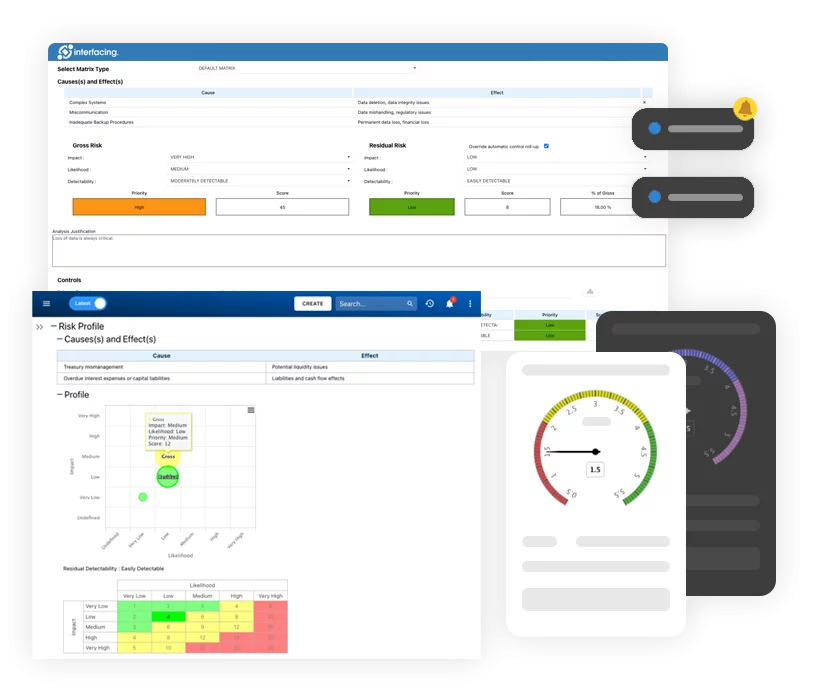
A recurring nonconformance can be linked to:
- The affected process
- Related SOPs
- Controls
- Risks
- Training obligations
- Owners
- Corrective actions
- Verification steps
- Effectiveness evidence
Leaders gain a clearer view of whether a CAPA changed the operating condition that caused the issue or merely documented a response.
AI-assisted insight can support pattern recognition, trend awareness, and decision support while keeping accountability with human owners.
The result is:
- Stronger audit readiness
- More reliable root cause analysis
- Better operational follow-through
- A QMS that supports continuous improvement instead of repeated administrative closure
Why Choose Interfacing?
With over two decades of AI, Quality, Process, and Compliance software expertise, Interfacing continues to be a leader in the industry. To-date, it has served over 500+ world-class enterprises and management consulting firms from all industries and sectors. We continue to provide digital, cloud & AI solutions that enable organizations to enhance, control and streamline their processes while easing the burden of regulatory compliance and quality management programs.
To explore further or discuss how Interfacing can assist your organization, please complete the form below.

Documentation: Driving Transformation, Governance and Control
• Gain real-time, comprehensive insights into your operations.
• Improve governance, efficiency, and compliance.
• Ensure seamless alignment with regulatory standards.

eQMS: Automating Quality & Compliance Workflows & Reporting
• Simplify quality management with automated workflows and monitoring.
• Streamline CAPA, supplier audits, training and related workflows.
• Turn documentation into actionable insights for Quality 4.0

Low-Code Rapid Application Development: Accelerating Digital Transformation
• Build custom, scalable applications swiftly
• Reducing development time and cost
• Adapt faster and stay agile in the face of
evolving customer and business needs.
AI to Transform your Business!
The AI-powered tools are designed to streamline operations, enhance compliance, and drive sustainable growth. Check out how AI can:
• Respond to employee inquiries
• Transform videos into processes
• Assess regulatory impact & process improvements
• Generate forms, processes, risks, regulations, KPIs & more
• Parse regulatory standards into requirements


Request Free Demo
Document, analyze, improve, digitize and monitor your business processes, risks, regulatory requirements and performance indicators within Interfacing’s Digital Twin integrated management system the Enterprise Process Center®!

Trusted by Customers Worldwide!
More than 400+ world-class enterprises and management consulting firms