Organizations have invested heavily in process mining to gain visibility into how work actually happens. Yet visibility alone rarely changes outcomes.
The challenge facing executives today is no longer understanding yesterday’s inefficiencies. It is evaluating tomorrow’s decisions before they create operational, quality, or compliance consequences.
That is where scenario testing changes the conversation.
Process Mining Solved One Problem, but Exposed Another
For years, organizations struggled with a basic challenge: they did not know how work was really being executed.
Official process maps rarely reflected operational reality. Teams developed local workarounds, approvals happened outside established workflows, and system data lived in disconnected environments.
Process mining helped close that visibility gap.
By analyzing event logs from enterprise systems, organizations gained a more objective view of execution patterns. Bottlenecks became visible. Rework loops surfaced. Variations between sites, regions, and business units could finally be measured.
For many organizations, this represented a major step forward.
However, visibility has limits.
Knowing where delays occur does not automatically reveal which corrective action will produce the best outcome. Understanding that a process deviates from the intended path does not explain how a proposed change will affect quality, risk, compliance, cost, or customer experience.
Process mining answers an important question:
“What happened?”
Executive teams are increasingly being asked a different question:
“What happens if we change something?”
Those are fundamentally different problems.
Decision-Making Has Become a Simulation Challenge
Modern organizations operate within environments defined by constant change.
Regulations evolve. Supply chains shift. New technologies emerge. Business units merge. Customer expectations rise. Resources fluctuate.
Every change creates downstream consequences.
A revised procedure affects training requirements. A new regulation impacts controls and documentation. A supplier disruption changes risk exposure. A process automation initiative alters roles, responsibilities, and approval structures.
Yet most organizations still evaluate these changes through workshops, spreadsheets, and expert opinion.
Experience remains valuable, but complexity has outgrown intuition.
Leaders increasingly need the ability to test assumptions before implementing change.
Scenario testing enables organizations to model potential outcomes before decisions are executed in production environments.
Instead of asking whether a process is underperforming, leaders can explore questions such as:
- What happens to audit readiness if approval steps are consolidated?
- How does a supplier disruption affect service levels and operational risk?
- Which controls become ineffective if a process is automated?
- What is the downstream impact of a regulatory update?
- How will a merger affect process ownership, documentation, and training obligations?
These questions cannot be answered through process mining alone.
They require a connected operating model.
Why Scenario Testing Requires More Than Event Data
Many organizations assume that more data naturally leads to better decisions.
In reality, data without context creates new blind spots.
Event logs reveal process behavior, but they rarely explain the relationships surrounding that behavior.
Processes do not operate independently. They intersect with people, systems, controls, risks, policies, procedures, KPIs, suppliers, assets, and regulatory requirements.
Without understanding those relationships, scenario testing becomes little more than educated guesswork.
This is where Digital Twins of an Organization differ from traditional analytics approaches.
A DTO creates a governed representation of how an organization operates by connecting operational data with the underlying business architecture. Processes, roles, systems, controls, risks, documents, and performance indicators exist within a single model rather than isolated repositories.
When these relationships are connected, leaders can evaluate change holistically rather than functionally.
The question shifts from:
“Can we make this process faster?”
to:
“What are the operational, quality, compliance, and financial consequences of making this process faster?”
That distinction matters.
Optimizing one area in isolation often creates unintended problems elsewhere.

The Hidden Cost of Reactive Decision-Making
Organizations rarely struggle because they lack dashboards.
They struggle because they discover consequences too late.
A process change triggers unexpected training requirements. A control modification creates audit findings. An automation initiative introduces new risks. A merger exposes conflicting procedures across business units.
The issue is not a lack of information.
It is a lack of foresight.
Reactive organizations learn through incidents, audit observations, customer complaints, and operational disruptions.
Resilient organizations learn through simulation.
Scenario testing allows leaders to evaluate alternatives before committing resources, changing procedures, or introducing new technologies.
It creates a safer environment for transformation because assumptions can be challenged before they become operational realities.
As regulatory expectations continue to evolve, the ability to demonstrate why decisions were made may become just as important as the decisions themselves.
Explainability is increasingly becoming a governance requirement.
From Visibility to Decision Intelligence
Process mining remains valuable.
Organizations still need objective visibility into how work actually occurs.
But visibility is only the starting point.
The next phase of operational maturity is decision intelligence: the ability to understand not only what happened, but what could happen next.
Organizations that connect process mining with scenario testing gain a more complete capability.
They can identify inefficiencies, evaluate alternatives, model consequences, and execute changes with greater confidence.
This is particularly important in regulated environments where every operational change can affect quality outcomes, compliance obligations, risk exposure, and customer trust.
The future belongs to organizations that can move beyond observation and toward informed experimentation.
How Interfacing Helps
Interfacing’s Integrated Management System (IMS) combines process mining, simulation, risk management, and low-code workflow automation within a single governed operating model. Instead of analyzing process data in one tool and managing improvements somewhere else, organizations can move directly from insight to execution.
Connect process mining to the full operating context
Most process mining platforms show event logs and bottlenecks, but they rarely explain why they occur.
Interfacing connects mined process data to:
- business processes and sub-processes
- roles and responsibilities
- systems and applications
- policies and SOPs
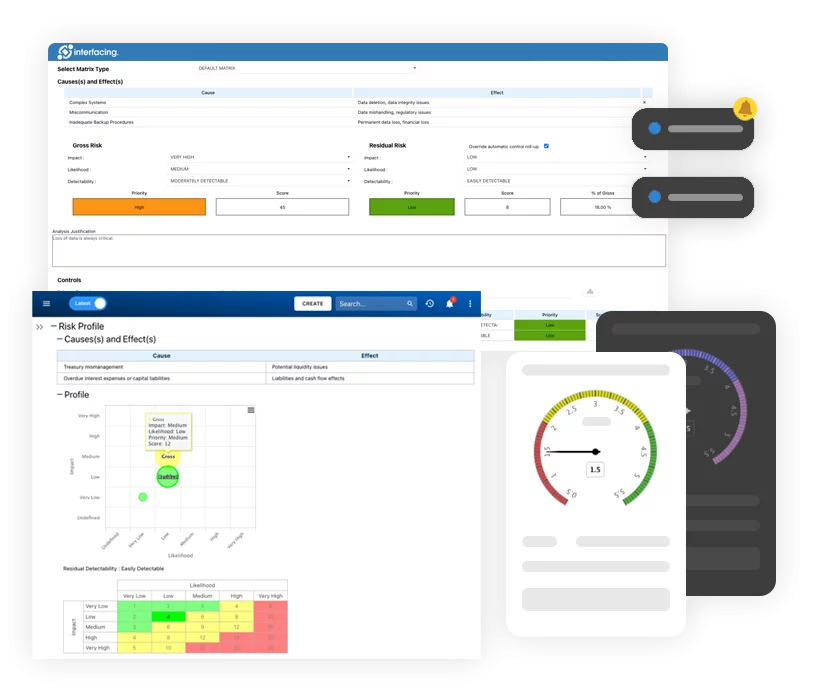
- risks and controls
- KPIs and SLAs
- training requirements
- audit findings and CAPAs
This creates end-to-end traceability between operational performance and compliance outcomes.
Discover how work actually happens
Using event logs from ERP, CRM, QMS, MRO, and other enterprise systems, organizations can automatically visualize real process execution, identify process variants, uncover bottlenecks, and detect deviations from standard operating procedures.
Teams can answer questions such as:
- Which process variants create the most delays?
- Where does rework occur most frequently?
- Which business rules are regularly bypassed?
- Which teams or locations generate the highest risk exposure?
Test changes before implementation
Interfacing enables both traditional discrete-event simulation and real-data-driven forecasting.
Organizations can model scenarios such as:
- introducing a new approval workflow
- reallocating resources across teams
- automating manual activities
- changing supplier processes
- implementing new regulatory requirements
- redesigning quality or audit workflows
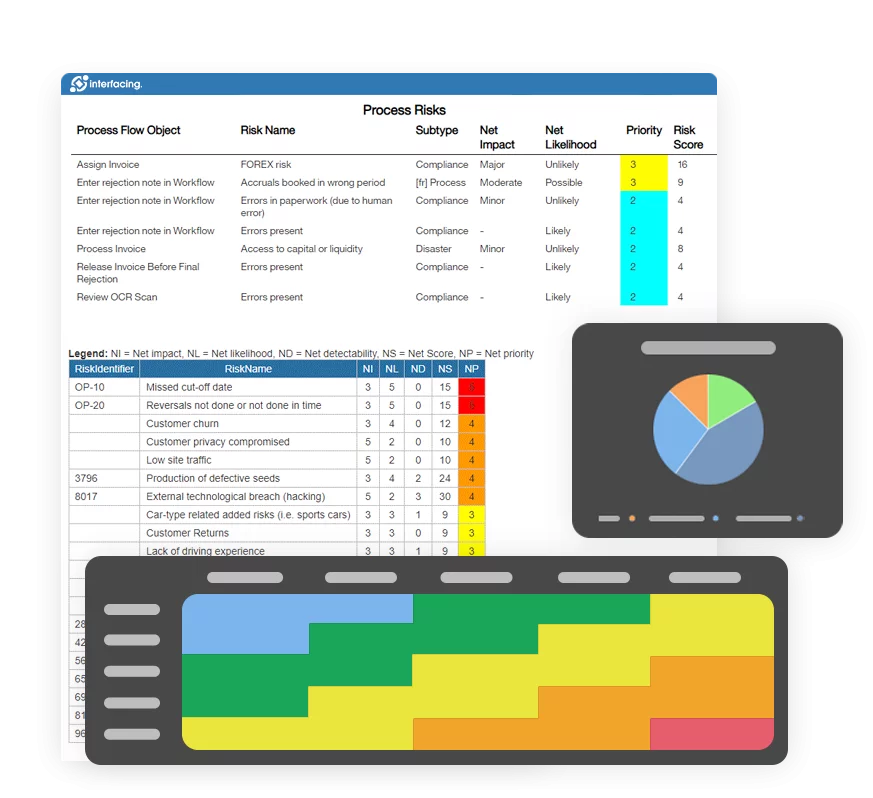
The platform predicts potential impacts on cycle time, resource utilization, cost, compliance exposure, and service levels before changes are deployed.
Understand downstream impacts automatically
Operational changes rarely affect a single process.
Interfacing automatically identifies downstream dependencies across processes, controls, systems, documents, roles, and training requirements. AI-assisted impact analysis helps teams understand what else must change before implementation begins.
This reduces the “whack-a-mole” effect where solving one problem unintentionally creates another.
Move directly from insight to action
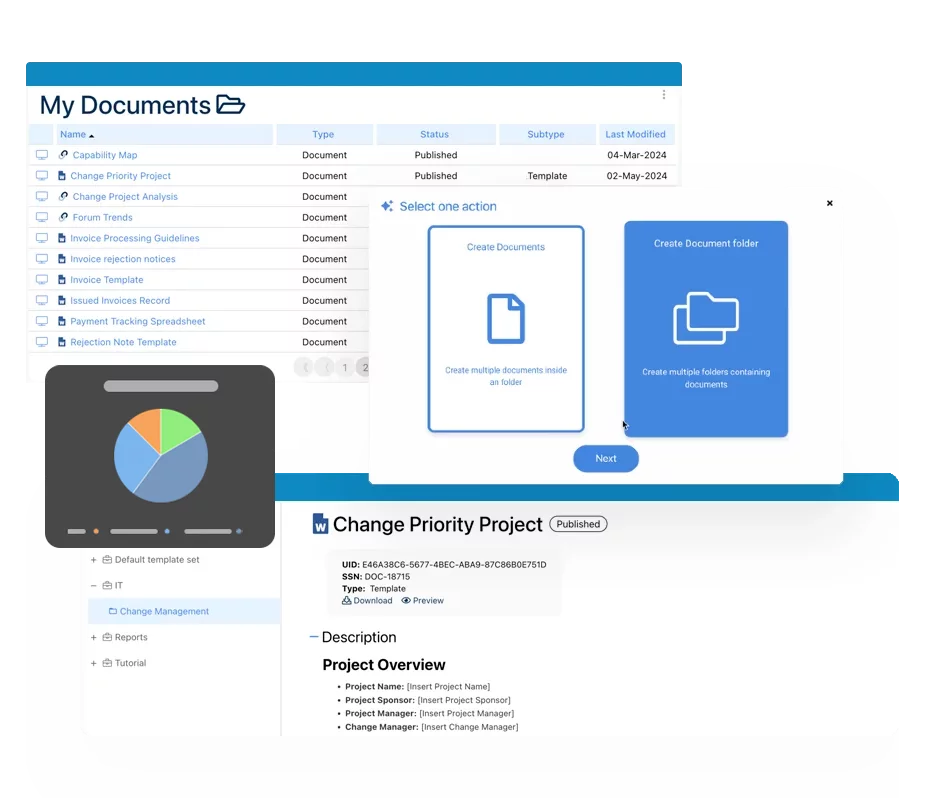
Once an improvement opportunity is identified, organizations can launch change requests, automate workflows, assign tasks, update SOPs, trigger training activities, and monitor KPIs without leaving the platform.
This closes the loop between:
Discovery → Analysis → Simulation → Execution → Monitoring
Rather than producing static reports, Interfacing helps organizations continuously optimize operations while maintaining governance, accountability, and audit readiness.
Why Choose Interfacing?
With over two decades of AI, Quality, Process, and Compliance software expertise, Interfacing continues to be a leader in the industry. To-date, it has served over 500+ world-class enterprises and management consulting firms from all industries and sectors. We continue to provide digital, cloud & AI solutions that enable organizations to enhance, control and streamline their processes while easing the burden of regulatory compliance and quality management programs.
To explore further or discuss how Interfacing can assist your organization, please complete the form below.

Documentation: Driving Transformation, Governance and Control
• Gain real-time, comprehensive insights into your operations.
• Improve governance, efficiency, and compliance.
• Ensure seamless alignment with regulatory standards.

eQMS: Automating Quality & Compliance Workflows & Reporting
• Simplify quality management with automated workflows and monitoring.
• Streamline CAPA, supplier audits, training and related workflows.
• Turn documentation into actionable insights for Quality 4.0

Low-Code Rapid Application Development: Accelerating Digital Transformation
• Build custom, scalable applications swiftly
• Reducing development time and cost
• Adapt faster and stay agile in the face of
evolving customer and business needs.
AI to Transform your Business!
The AI-powered tools are designed to streamline operations, enhance compliance, and drive sustainable growth. Check out how AI can:
• Respond to employee inquiries
• Transform videos into processes
• Assess regulatory impact & process improvements
• Generate forms, processes, risks, regulations, KPIs & more
• Parse regulatory standards into requirements

Request Free Demo
Document, analyze, improve, digitize and monitor your business processes, risks, regulatory requirements and performance indicators within Interfacing’s Digital Twin integrated management system the Enterprise Process Center®!
Trusted by Customers Worldwide!
More than 400+ world-class enterprises and management consulting firms