

Risk registers fail when they are treated as static lists instead of connected governance tools. To be effective, risk registers must link risks to business processes, controls, owners, SOPs, evidence, KPIs, audit findings, CAPA actions, suppliers, systems, and operational change.
Why Risk Registers Fail Without Process Context
Risk registers are supposed to help organizations understand, monitor, and manage uncertainty. Yet in many organizations, they become static spreadsheets, disconnected from the processes, systems, controls, people, and decisions where risk actually appears. The result is a false sense of visibility: leaders can see a list of risks, but they cannot always see whether those risks are being controlled in day-to-day operations.
That gap matters because risk management is no longer only a reporting exercise. In regulated and operationally complex environments, risk must be traceable, contextual, current, and connected to execution.
Risk Registers Were Never Meant to Be the Whole System
A risk register can be useful. It gives organizations a place to capture known risks, assign owners, define likelihood and impact, document mitigation plans, and track review dates.
The problem begins when the register becomes the risk management system itself.
A register can tell you that supplier failure, data integrity, process deviation, equipment downtime, regulatory change, or cybersecurity exposure is important. It can show who owns the risk and how it has been scored. But it rarely explains how that risk behaves across the organization.
The same risk may have very different implications depending on the process, site, product, supplier, system, control environment, or regulatory context involved. A global risk score may look acceptable at the enterprise level while masking serious exposure in a specific workflow or business unit.
That is where traditional risk registers break down.
ISO 31000 frames risk management as a principles-based approach supported by a framework and process that can apply across activities and sectors. It is not intended to be reduced to a standalone list. Risk management should help organizations identify threats and opportunities, improve decision-making, and allocate resources effectively.
The Real Problem Is Not Risk Identification, It Is Risk Traceability
Most organizations are not short on risk awareness. Leaders already know that operational, compliance, supplier, technology, quality, and business continuity risks exist.
The harder question is traceability.
Can the organization trace a risk to the processes where it appears? Can it show which controls reduce the risk? Can it prove those controls are working? Can it connect the risk to SOPs, policies, roles, systems, audit findings, training records, incidents, deviations, CAPAs, and management review?
If the answer is no, the register is only showing part of the truth.
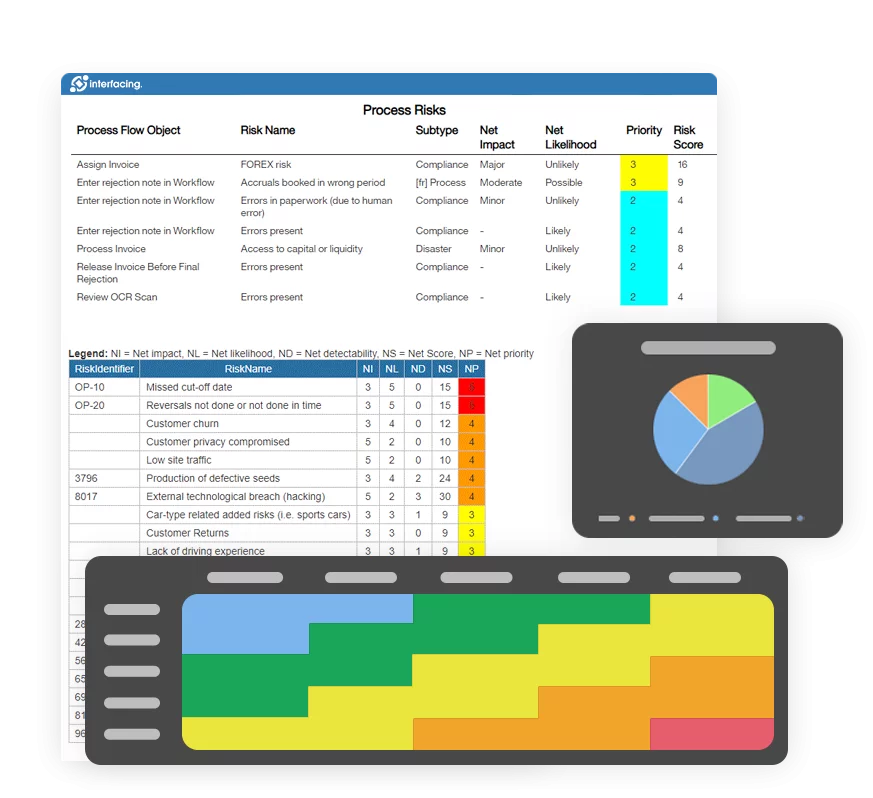
A disconnected register often creates a reporting view of risk, not an operational view of risk. It may support committee discussions, audit preparation, or executive summaries, but it does not necessarily help teams understand where risk is increasing, where controls are weakening, or where remediation should be prioritized.
This is especially important for quality and compliance leaders. Interfacing’s QMS campaign positioning already reflects this broader shift: quality systems should move beyond fragmented, document-heavy repositories and function as data-driven operational intelligence systems that connect processes, risk, compliance, workflows, and operational data.

Enterprise Risk Scores Can Hide Process-Level Weakness
Enterprise-level risk scoring is useful for prioritization, but it can also create dangerous averages.
A risk may be rated “medium” at the enterprise level because it is well controlled in most areas. But that same risk may be high in one location, one product line, one supplier process, or one manual workflow.
For example, a documentation risk may appear manageable overall because the organization has a document control policy. But in practice, risk may be concentrated where SOPs are not aligned to actual work, where training records are incomplete, or where process changes are not consistently reflected in controlled documents.
The same is true for supplier risk, cyber risk, quality risk, or operational resilience risk. A central risk register may record that controls exist, but it may not show whether those controls are embedded in the actual process where the risk occurs.
COSO’s Enterprise Risk Management framework emphasizes the importance of considering risk in strategy-setting and performance, not just treating risk as a separate compliance activity. That distinction is important. Risk that is not connected to performance, process, and execution becomes easier to report, but harder to manage.
Process Context Turns Risk Management Into Governance
When risks are connected to process context, risk management becomes more than a register. It becomes governance.
A process-connected risk model helps answer questions that a static register often cannot:
- Where does this risk appear in the operating model?
- Which controls prevent, detect, or reduce the risk?
- Who owns the process, the control, and the evidence?
- Which SOPs, policies, systems, suppliers, and training records are affected?
- What happens if the process changes?
- What audit findings, incidents, deviations, or CAPAs are related?
- Is residual risk changing because performance or control effectiveness is changing?
This is where the operating model matters. Risk does not live in isolation. It lives inside the way work is designed, assigned, performed, measured, changed, and governed.
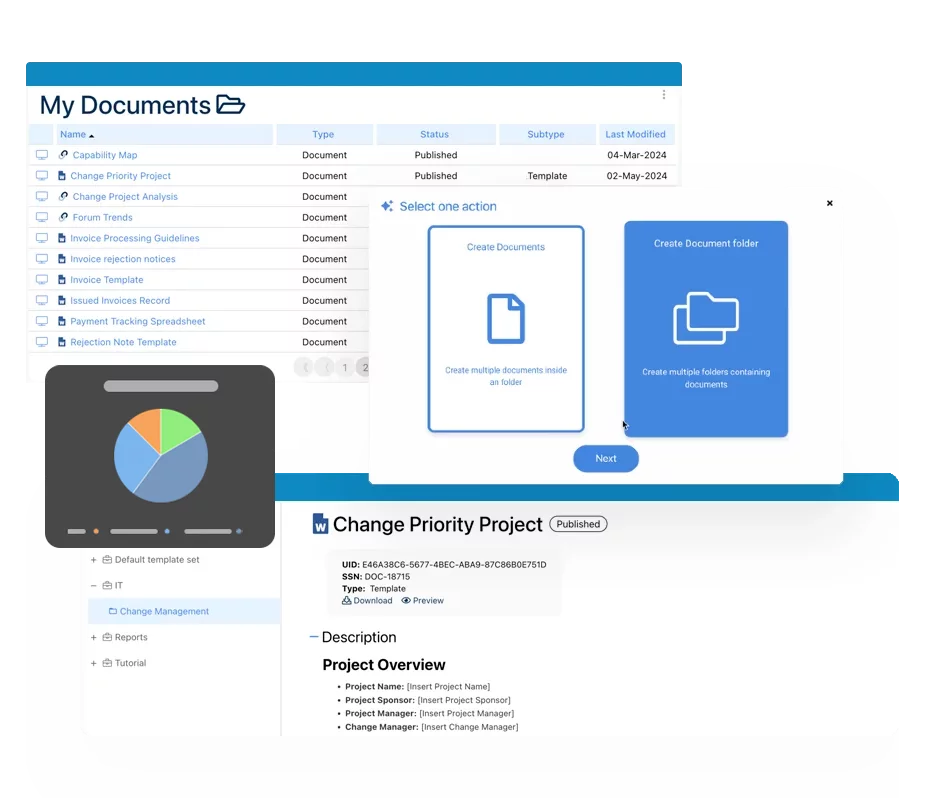
For Interfacing, this is a natural fit with the Integrated Management System approach. Interfacing’s knowledge pack describes the IMS as an environment that unifies QMS, BPM, GRC, and Low-Code while connecting processes, risks, controls, policies, SOPs, KPIs, and training for audit-ready traceability and data-driven improvement.
That connection is the real difference. A risk register records risk. A process-based management system shows how risk moves through the organization.
Why Spreadsheets and Isolated GRC Tools Often Fall Short
The issue is not that spreadsheets or point tools are useless. They can be effective for simple tracking, early maturity programs, or narrow reporting needs.
The issue is that they often create separation.
Risk teams may maintain the register. Quality teams may manage CAPA. Process teams may own maps and SOPs. Compliance teams may track obligations. IT may manage systems and access controls. Operations may manage the actual work.
Each team may be doing its job, but the organization still lacks a connected view.
That separation creates several practical problems:
- Risk scores are updated manually and infrequently.
- Controls are documented but not always tied to execution.
- Process changes do not automatically trigger impact reviews.
- CAPA actions may close without proving broader risk reduction.
- Audit evidence is collected late instead of maintained continuously.
- Executives see dashboards, but not always root operational context.
In regulated industries, those gaps become more than inefficiencies. They create audit exposure, compliance risk, and slower response to change.
AI-Assisted Risk Management Still Needs a Governed Model
AI-assisted capabilities can help organizations identify patterns, surface weak signals, suggest downstream impacts, and support risk analysis. But AI does not solve disconnected governance by itself.
This is a critical point.
If the underlying operating model is fragmented, AI may only accelerate fragmented insight. It may identify relationships, but those relationships still need to be governed, validated, and tied to accountable owners. Risk decisions still require human judgment, especially in quality, compliance, safety, cybersecurity, finance, and regulated operations.
NIST’s AI Risk Management Framework uses the functions Govern, Map, Measure, and Manage to help organizations address AI-related risks in practice. That same logic is useful here: organizations need governance, context, measurement, and management, not just faster analysis.
AI-assisted risk management becomes valuable when it operates within a structured environment where risks, processes, controls, evidence, roles, and actions are already connected.
What a Process-Connected Risk Model Should Include
A more mature approach to risk management should connect the risk register to the operating model itself.
At minimum, that means connecting risks to:
- Processes, subprocesses, activities, and work instructions
- Controls, policies, SOPs, and regulatory requirements
- Process owners, control owners, risk owners, and accountable roles
- Systems, suppliers, assets, forms, and records
- Audit findings, quality events, incidents, deviations, CAPAs, and actions
- KPIs, KRIs, KCIs, dashboards, and management review evidence
This does not mean every organization needs to rebuild its risk program from scratch. It means the register should stop functioning as a detached inventory and start functioning as part of a connected governance model.
How Interfacing Helps
Interfacing helps organizations move from static risk tracking to connected, process-based governance through its Integrated Management System.
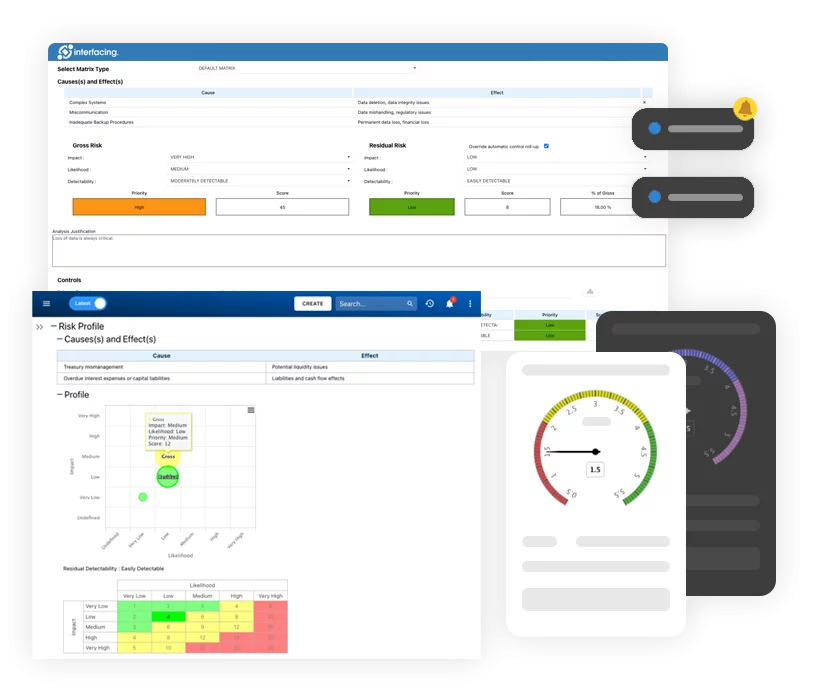
Instead of managing risks, processes, documents, quality events, CAPA, controls, audits, training, and operational evidence in separate environments, Interfacing enables organizations to connect them within a single governed model. This supports a clearer understanding of where risk exists, which controls are in place, who owns the response, what evidence proves effectiveness, and how changes may affect downstream obligations.
For organizations building or modernizing their Integrated Management System, this matters because risk management becomes part of operational execution rather than a parallel reporting activity.
The same connected logic supports QMS software modernization, CAPA management, quality event management, and broader governance across process, risk, compliance, and documentation.
Interfacing’s demo materials also position its IMS around a single source of truth, embedded governance, data reusability, process-based compliance, risk and control management, scheduled reviews, e-signatures, action monitoring, training assignment, and downstream impact visibility.
That is the core value: risk is no longer
Executive Reality Check
A risk register may satisfy a reporting requirement, but it does not prove operational control. Executives need to know whether critical risks are connected to the processes, controls, owners, systems, evidence, and actions that determine real exposure. If risk remains disconnected from operations, the organization may be documenting risk faster than it is reducing it.
Why Choose Interfacing?
With over two decades of AI, Quality, Process, and Compliance software expertise, Interfacing continues to be a leader in the industry. To-date, it has served over 500+ world-class enterprises and management consulting firms from all industries and sectors. We continue to provide digital, cloud & AI solutions that enable organizations to enhance, control and streamline their processes while easing the burden of regulatory compliance and quality management programs.
To explore further or discuss how Interfacing can assist your organization, please complete the form below.

Documentation: Driving Transformation, Governance and Control
• Gain real-time, comprehensive insights into your operations.
• Improve governance, efficiency, and compliance.
• Ensure seamless alignment with regulatory standards.

eQMS: Automating Quality & Compliance Workflows & Reporting
• Simplify quality management with automated workflows and monitoring.
• Streamline CAPA, supplier audits, training and related workflows.
• Turn documentation into actionable insights for Quality 4.0

Low-Code Rapid Application Development: Accelerating Digital Transformation
• Build custom, scalable applications swiftly
• Reducing development time and cost
• Adapt faster and stay agile in the face of
evolving customer and business needs.
AI to Transform your Business!
The AI-powered tools are designed to streamline operations, enhance compliance, and drive sustainable growth. Check out how AI can:
• Respond to employee inquiries
• Transform videos into processes
• Assess regulatory impact & process improvements
• Generate forms, processes, risks, regulations, KPIs & more
• Parse regulatory standards into requirements


Request Free Demo
Document, analyze, improve, digitize and monitor your business processes, risks, regulatory requirements and performance indicators within Interfacing’s Digital Twin integrated management system the Enterprise Process Center®!
Trusted by Customers Worldwide!
More than 400+ world-class enterprises and management consulting firms