Why is the FDA’s first AI warning letter important?
The FDA’s first AI-related warning letter establishes a clear regulatory expectation: organizations may use artificial intelligence to support regulated activities, but they remain responsible for ensuring all AI-generated content is accurate, verified, documented, and compliant. The warning highlights the importance of governance, human oversight, validation, traceability, and accountability when AI is used in quality systems, SOP creation, compliance documentation, and operational decision-making. As AI adoption accelerates across regulated industries, organizations will increasingly need governed processes that demonstrate how AI-assisted outputs were reviewed, approved, and controlled.
Overview
The FDA’s first warning letter explicitly referencing the use of artificial intelligence has generated considerable discussion across regulated industries. Headlines quickly focused on the technology itself, raising questions about whether regulators are becoming skeptical of AI and how organizations should approach adoption moving forward.
However, a closer examination of the warning letter reveals a different story. The FDA’s concern was not that AI had been used. The concern was that AI-generated content had entered regulated processes without sufficient oversight, verification, and quality governance.
For organizations pursuing AI-assisted quality, compliance, and operational transformation initiatives, this distinction may be one of the most important lessons emerging in 2026.
Why the Headlines Miss the Bigger Story
Whenever a regulator references a new technology, the immediate reaction is often to focus on the technology itself.
The same pattern occurred when cloud computing entered regulated environments. It happened again with electronic signatures, automated workflows, and digital records management systems. In each case, organizations initially asked whether the technology was acceptable.
Regulators asked a different question.
Can you demonstrate control?
The same principle applies to artificial intelligence.
The FDA has not indicated that organizations should avoid AI. In fact, AI is already being used across life sciences, pharmaceuticals, medical devices, and manufacturing to support document generation, complaint analysis, deviation investigations, CAPA management, regulatory intelligence, and process improvement.
The regulatory challenge is not whether AI participates in these activities. The challenge is whether organizations can demonstrate that appropriate governance remains in place when it does.
What Happened in the Purolea Case?
In its warning letter to Purolea Cosmetics Lab, the FDA noted that the organization had used AI-generated content within quality documentation, including specifications, procedures, and master production records.
Importantly, the agency did not criticize the use of AI itself.
Instead, the FDA emphasized that organizations remain responsible for ensuring that AI-generated documents are accurate, complete, and compliant with current Good Manufacturing Practices (CGMP). The warning letter specifically noted that quality oversight failed to adequately verify the generated content before it became part of regulated documentation.
This is a subtle but critical distinction.
The regulatory observation was not “you used AI.”
The observation was effectively “you failed to adequately govern the output.”
That difference changes the conversation entirely.
Quality Has Always Been Accountable for Decisions
For decades, quality organizations have served as the final checkpoint between documentation and execution.
Whether procedures were created by subject matter experts, consultants, external contractors, or internal teams, quality functions remained responsible for reviewing, approving, and maintaining compliance.
Artificial intelligence does not remove that obligation.
In many ways, it amplifies it.
AI can produce documentation faster than any human team. It can generate procedures, summarize regulations, recommend corrective actions, and draft quality records in seconds.
What it cannot do is assume regulatory accountability.
The moment an AI-generated output enters a regulated process, responsibility remains with the organization, its quality systems, and ultimately the individuals who approved its use.
The FDA warning letter reinforces a principle that has existed long before AI emerged: accountability cannot be delegated to software.
The New Compliance Risk Is Not AI. It Is Unverified AI
One of the most significant risks facing regulated organizations today is not the intentional deployment of enterprise AI platforms.
It is the growing use of AI across daily operations without corresponding governance controls.
Employees are increasingly using generative AI tools to:
- Draft SOPs
- Summarize investigations
- Create training materials
- Analyze complaints
- Prepare audit responses
- Generate regulatory documentation
In many cases, these activities occur outside validated systems and outside established quality workflows.
The result is an emerging governance challenge often referred to as “Shadow AI.”
The problem with Shadow AI is not visibility alone. It is traceability.
Months after a document is approved or a decision is made, organizations may struggle to answer basic questions:
Where did this information originate?
Was it generated by a human or AI?
Who reviewed it?
What source material was used?
How was accuracy validated?
These questions become especially important during inspections, audits, investigations, and compliance reviews.
AI Is Creating a New Category of Governance Requirements
Historically, document governance focused on version control, approvals, training, and retention.
AI introduces additional layers that many organizations are only beginning to address.
Quality leaders increasingly need visibility into:
- Data sources used by AI systems
- Validation approaches for generated outputs
- Human review requirements
- Change management impacts
- Downstream process dependencies
- Approval accountability
This is why many organizations are discovering that AI adoption is not simply a technology initiative.
It is an operational governance initiative.
The organizations experiencing the greatest success with AI are often not those deploying the most advanced models. They are the organizations that have established the strongest governance frameworks around their use.
Why Operating Model Governance Matters
Many AI governance discussions focus narrowly on policies.
Policies are necessary, but they are not sufficient.
A policy can tell employees how AI should be used. It cannot automatically enforce traceability, approvals, accountability, or impact analysis.
Those capabilities must exist within the operating model itself.
Organizations need the ability to connect processes, risks, controls, SOPs, training requirements, approvals, regulatory obligations, and quality events within a governed framework.
When AI-generated content enters that framework, organizations can demonstrate not only what was created, but how it was reviewed, approved, implemented, and monitored.
That level of traceability is increasingly becoming the foundation of defensible AI adoption.
The Future of AI Compliance Will Be Built on Explainability
The Purolea warning letter may ultimately be remembered as an early indicator of where regulatory expectations are heading.
The conversation is shifting away from whether AI should be used and toward how organizations govern its use.
Regulators are unlikely to evaluate organizations based on the sophistication of their AI tools.
They are far more likely to evaluate whether organizations can explain decisions, validate outputs, maintain oversight, and demonstrate accountability.
In other words, explainability may become the defining characteristic of compliant AI adoption.
Organizations that treat AI as an isolated productivity tool may struggle to meet those expectations.
Organizations that embed AI within governed operational processes will be far better positioned to demonstrate compliance, transparency, and control.
How Interfacing Helps
The lesson from the FDA’s warning letter is not simply that organizations need AI policies. It is that they need a governed operating model capable of demonstrating how AI-assisted work is created, reviewed, approved, implemented, and monitored.
Interfacing helps regulated organizations establish this level of governance by connecting processes, SOPs, quality events, risks, controls, regulatory requirements, training records, approvals, and operational workflows within a single Integrated Management System (IMS). Rather than treating AI as a standalone tool, organizations can embed AI-assisted activities directly into governed workflows that preserve accountability and traceability across the entire quality lifecycle. Interfacing’s governance-first platform is designed to unify processes, roles, systems, controls, risks, policies, SOPs, KPIs, and workflows within a single source of truth while maintaining explainability and auditability.
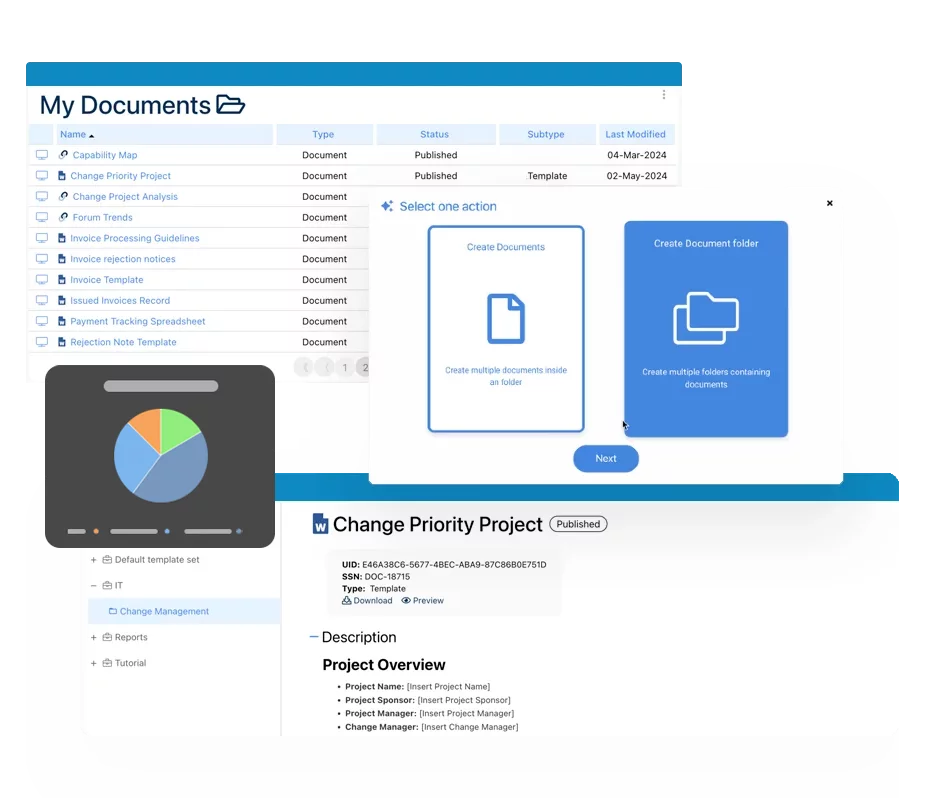
For example, if AI is used to assist in the creation or revision of an SOP, specification, CAPA record, deviation investigation, audit response, or training document, Interfacing can help organizations maintain documented review cycles, approval workflows, version control, electronic signatures, and complete audit trails. This creates a traceable record showing not only what was changed, but who reviewed it, who approved it, when it was approved, and how it relates to downstream processes, risks, controls, and compliance obligations. Interfacing’s platform includes controlled workflows, audit trails, digital signatures, document lifecycle management, and role-based governance designed for regulated environments.
Organizations can also use Interfacing’s Digital Twin of an Organization (DTO) capabilities to understand the operational impact of AI-assisted changes before they are implemented. If a procedure, requirement, control, or process is modified using AI-assisted recommendations, impact analysis can identify affected departments, roles, systems, training requirements, controls, risks, and related documentation. This helps quality and compliance teams evaluate changes within their broader operating context rather than reviewing documents in isolation. Interfacing positions its DTO approach around connecting processes, roles, systems, controls, risks, policies, SOPs, and workflows to improve operational transparency and change execution.
As regulatory scrutiny around AI continues to evolve, organizations will increasingly need to demonstrate not only that AI-generated outputs were reviewed, but that they were governed. Interfacing helps create the governance foundation required to support AI-assisted quality, compliance, and operational excellence initiatives while preserving the human accountability regulators ultimately expect.
Why Choose Interfacing?
With over two decades of AI, Quality, Process, and Compliance software expertise, Interfacing continues to be a leader in the industry. To-date, it has served over 500+ world-class enterprises and management consulting firms from all industries and sectors. We continue to provide digital, cloud & AI solutions that enable organizations to enhance, control and streamline their processes while easing the burden of regulatory compliance and quality management programs.
To explore further or discuss how Interfacing can assist your organization, please complete the form below.

Documentation: Driving Transformation, Governance and Control
• Gain real-time, comprehensive insights into your operations.
• Improve governance, efficiency, and compliance.
• Ensure seamless alignment with regulatory standards.

eQMS: Automating Quality & Compliance Workflows & Reporting
• Simplify quality management with automated workflows and monitoring.
• Streamline CAPA, supplier audits, training and related workflows.
• Turn documentation into actionable insights for Quality 4.0

Low-Code Rapid Application Development: Accelerating Digital Transformation
• Build custom, scalable applications swiftly
• Reducing development time and cost
• Adapt faster and stay agile in the face of
evolving customer and business needs.
AI to Transform your Business!
The AI-powered tools are designed to streamline operations, enhance compliance, and drive sustainable growth. Check out how AI can:
• Respond to employee inquiries
• Transform videos into processes
• Assess regulatory impact & process improvements
• Generate forms, processes, risks, regulations, KPIs & more
• Parse regulatory standards into requirements

Request Free Demo
Document, analyze, improve, digitize and monitor your business processes, risks, regulatory requirements and performance indicators within Interfacing’s Digital Twin integrated management system the Enterprise Process Center®!
Trusted by Customers Worldwide!
More than 400+ world-class enterprises and management consulting firms