

Interfacing

sales@interfacing.com

What is the relationship between Shadow AI and a Digital Twin of an Organization?

A Digital Twin of an Organization (DTO) depends on visibility into processes, decisions, controls, risks, systems, and operational activities. Shadow AI introduces AI-assisted decision-making and content generation that often occurs outside governed systems. As AI increasingly influences operational behavior, organizations may face a growing gap between their documented operating model and how work is actually performed. Maintaining visibility into AI-assisted activities is becoming a critical requirement for preserving DTO accuracy, explainability, governance, and trust.

Overview

The emergence of Digital Twin of an Organization (DTO) initiatives reflects a broader shift in how organizations think about operational visibility. For decades, leaders have pursued technologies and methodologies that promise a more complete understanding of how the enterprise functions. Business Process Management, Enterprise Architecture, Governance, Risk and Compliance programs, Enterprise Performance Management, and Operational Excellence initiatives have all pursued variations of the same objective: creating sufficient visibility to support better decision-making.

The DTO represents perhaps the most ambitious expression of that objective. Rather than examining individual processes, systems, risks, or organizational structures in isolation, DTO initiatives seek to create a connected representation of the enterprise itself. Processes, resources, controls, technologies, risks, policies, performance indicators, and operational relationships are linked together within a single model capable of supporting analysis, governance, and transformation.

The value of this approach extends well beyond documentation. Organizations invest in DTO capabilities because they want confidence that they understand how work is actually performed, how decisions affect downstream activities, and how operational change propagates across the enterprise. The DTO becomes a mechanism for reducing uncertainty. It provides leaders with a framework for understanding complexity and evaluating the consequences of change before those consequences appear in production environments.

Yet the effectiveness of any DTO depends upon a foundational assumption. The model must be able to observe and represent the factors that meaningfully influence organizational behavior. If important drivers of operational activity remain outside visibility, the DTO may continue to appear complete while becoming progressively less representative of reality.

This assumption has become increasingly relevant as organizations adopt generative AI technologies at scale.

The growing discussion surrounding Shadow AI is often framed in terms of cybersecurity, privacy, intellectual property protection, or regulatory compliance. While these concerns are legitimate, they may not represent the most significant long-term challenge for organizations pursuing DTO strategies. A more fundamental issue is emerging. Shadow AI is creating operational influences that frequently exist outside the visibility boundaries upon which DTO initiatives depend.

The result is not simply an AI governance problem. It is a DTO integrity problem.

The Visibility Assumption Behind Every DTO

Every DTO initiative is ultimately built on a theory of organizational visibility. Although vendors differ in terminology and technical implementation, the underlying premise remains remarkably consistent. If enough operational information can be connected together, leaders can develop a more accurate understanding of how the organization functions.

This theory has proven highly effective because modern enterprises generate enormous amounts of operational information. Processes can be modeled. Systems can be mapped. Risks can be documented. Controls can be linked to obligations. Performance indicators can be monitored. Relationships between organizational components can be analyzed and visualized. As these connections become more comprehensive, the DTO becomes increasingly valuable as a decision-support capability.

Importantly, DTO initiatives do not attempt to model everything. They focus on the relationships and influences that materially affect operational outcomes. The objective is not perfect representation but useful representation. A DTO succeeds when it captures enough of the operating environment to support governance, impact analysis, optimization, and strategic decision-making.

Historically, this objective has been achievable because most significant operational activities occurred within observable environments. Enterprise applications, workflow systems, quality management platforms, document repositories, risk systems, and transactional technologies all generated information that could be incorporated into the operating model. Even when execution varied from documented procedures, organizations generally retained visibility into the systems and structures through which work was performed.

Generative AI introduces a different dynamic.

Unlike traditional enterprise technologies, AI can influence operational outcomes without necessarily becoming embedded within the systems organizations use to understand operational behavior. Employees may use AI to analyze information, generate recommendations, summarize regulations, draft procedures, support investigations, develop training content, evaluate alternatives, or assist with decision-making. These activities can materially influence execution while leaving little evidence within the repositories, workflows, and governance mechanisms that form the foundation of many DTO initiatives.

The challenge is not that AI exists outside the DTO. The challenge is that AI increasingly influences the activities the DTO is attempting to represent.

Shadow AI and the Emergence of Invisible Influence

One of the most misunderstood aspects of Shadow AI is the assumption that it behaves like previous generations of unauthorized technology adoption. Comparisons to Shadow IT are common and, to some extent, appropriate. Both involve employees adopting technologies outside formal governance structures. Both create visibility challenges. Both introduce risks that organizations struggle to evaluate.

However, Shadow AI differs in one important respect.

Traditional Shadow IT primarily changed where work was performed. Shadow AI changes how decisions are made.

This distinction has significant implications for DTO initiatives.

When employees adopt an unauthorized collaboration platform, file-sharing application, or cloud service, governance teams lose visibility into a technology environment. When employees adopt generative AI, governance teams may lose visibility into the reasoning, interpretation, and analysis that influence operational outcomes.

Consider how generative AI is currently being used across many organizations. Quality professionals use AI to assist with investigations and corrective actions. Compliance teams use AI to interpret regulatory guidance. Process analysts use AI to evaluate workflow improvements. Operational managers use AI to analyze alternatives before making decisions. Documentation teams use AI to generate and refine procedures, work instructions, and communications.

None of these activities are inherently problematic. In many cases they may improve both productivity and quality.

The issue is that they introduce a new category of operational influence that often remains invisible within the organization’s formal operating model.

Historically, organizations have focused on documenting decisions, approvals, controls, procedures, and outcomes. AI introduces an additional layer. It increasingly influences how those decisions are formulated before they ever reach a formal governance process. As a result, organizations may retain visibility into outcomes while losing visibility into the factors that contributed to those outcomes.

This distinction becomes particularly important when organizations rely upon DTO capabilities to understand operational behavior.

A DTO can model processes, controls, resources, technologies, and organizational structures. It can identify dependencies and evaluate impacts. It can support transformation initiatives and improve governance. What it cannot do is represent influences that remain entirely outside its visibility boundary.

The more organizations depend upon AI-assisted activities that operate beyond that boundary, the greater the risk that the DTO gradually becomes disconnected from actual execution.

Why This Matters in Highly Regulated Environments

The implications of this challenge are particularly significant for organizations operating within regulated industries.

Governance frameworks have traditionally focused on demonstrating accountability, traceability, and explainability. Regulators, auditors, and stakeholders generally expect organizations to explain how decisions were made, which information was considered, what controls were applied, and who approved the resulting actions.

These expectations are not unique to regulatory compliance. Similar principles underpin quality management, operational risk management, business continuity planning, cybersecurity governance, and corporate accountability programs.

The growing influence of AI complicates this environment because AI-assisted activities frequently occur before formal governance processes begin. A recommendation generated by an AI system may influence a risk assessment. An AI-generated summary may shape a regulatory interpretation. AI-assisted analysis may contribute to a process redesign initiative. Months later, the resulting decision remains visible, but the influences that shaped that decision may be difficult to reconstruct.

This does not necessarily create immediate compliance failures. In fact, many organizations may continue operating successfully for years while relying extensively on AI-assisted activities.

The challenge is more subtle.

Organizations may gradually lose confidence in their ability to explain how operational outcomes are produced. The gap between documented execution and actual execution may expand. Governance systems continue functioning. Controls remain documented. Procedures remain current. Yet an increasing percentage of operational influence exists outside formal visibility.

For DTO initiatives, this represents a strategic concern rather than a technical one. The purpose of a DTO is not merely to document operations. Its purpose is to improve understanding. Any factor that reduces understanding ultimately reduces the value of the model itself.

The Future DTO Must Include AI Visibility

The long-term solution is unlikely to involve restricting AI adoption. History suggests that organizations rarely succeed by attempting to eliminate technologies that deliver meaningful productivity improvements. The economic incentives driving AI adoption are simply too strong.

A more realistic approach is expanding the scope of operational visibility.

Future DTO initiatives will likely need to evolve beyond traditional representations of processes, systems, controls, and resources. They will need mechanisms for understanding where AI influences operational outcomes and how those influences interact with governance structures, risk management activities, compliance obligations, and organizational decision-making.

This does not imply monitoring every interaction with an AI system. Such an objective would be impractical and undesirable. Rather, organizations will need visibility into the AI-assisted activities that materially affect execution, governance, and business outcomes.

The distinction is important. The objective is not surveillance. The objective is operational understanding.

Organizations that achieve this visibility will be better positioned to balance innovation with governance. They will be able to benefit from AI while maintaining confidence in the integrity of their operating models. More importantly, they will preserve the central promise that makes DTO initiatives valuable in the first place: the ability to understand how the organization actually operates.

As AI becomes increasingly embedded within day-to-day activities, the challenge facing DTO programs will not be determining whether AI is being used. That question has already been answered.

The challenge will be determining whether the DTO remains capable of seeing the influences that shape organizational behavior.

How Interfacing Helps

Interfacing’s vision of a Digital Twin of an Organization is built around the idea that governance, process management, quality management, risk management, compliance management, operational intelligence, and business execution should not exist as isolated disciplines. Instead, they should be connected within a governed operating model capable of supporting visibility, accountability, impact analysis, and informed decision-making.

As organizations introduce AI into operational environments, maintaining this connected view becomes increasingly important. AI-generated outputs can influence processes, investigations, controls, regulatory interpretations, operational decisions, and improvement initiatives. Understanding how those influences affect the broader enterprise requires more than isolated AI governance policies. It requires visibility into how decisions propagate across the operating model itself.

Interfacing’s AI-assisted Integrated Management System (IMS) and DTO approach help organizations connect processes, controls, risks, policies, systems, compliance obligations, quality activities, and operational workflows within a unified governance framework. This enables organizations to evaluate impacts, maintain traceability, strengthen explainability, and preserve confidence in the integrity of the operating model as AI adoption continues to expand.

The organizations that derive the greatest value from AI over the next decade are unlikely to be those that simply deploy the most AI. They will be the organizations that best understand how AI influences operational behavior and can incorporate those influences into a governed model of execution. Maintaining visibility into those influences is rapidly becoming one of the most important requirements for preserving trust in the Digital Twin of an Organization itself.

Why Choose Interfacing?


With over two decades of AI, Quality, Process, and Compliance software expertise, Interfacing continues to be a leader in the industry. To-date, it has served over 500+ world-class enterprises and management consulting firms from all industries and sectors. We continue to provide digital, cloud & AI solutions that enable organizations to enhance, control and streamline their processes while easing the burden of regulatory compliance and quality management programs.

To explore further or discuss how Interfacing can assist your organization, please complete the form below.

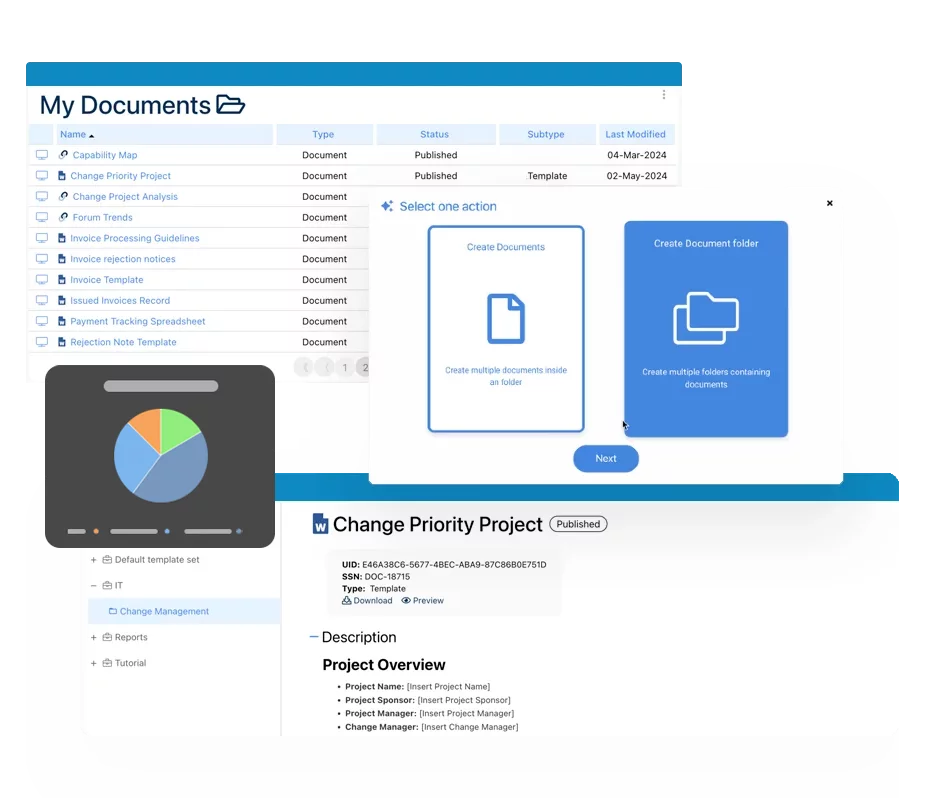
Documentation: Driving Transformation, Governance and Control

• Gain real-time, comprehensive insights into your operations.
• Improve governance, efficiency, and compliance.
• Ensure seamless alignment with regulatory standards.

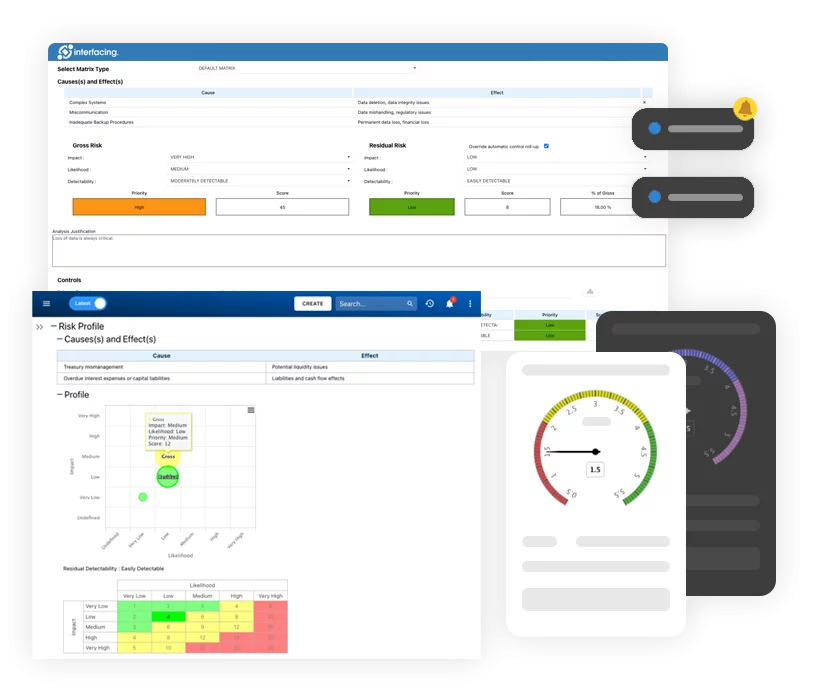
eQMS: Automating Quality & Compliance Workflows & Reporting

• Simplify quality management with automated workflows and monitoring.
• Streamline CAPA, supplier audits, training and related workflows.
• Turn documentation into actionable insights for Quality 4.0

Low-Code Rapid Application Development: Accelerating Digital Transformation

• Build custom, scalable applications swiftly
• Reducing development time and cost
• Adapt faster and stay agile in the face of evolving customer and business needs.


AI to Transform your Business!

The AI-powered tools are designed to streamline operations, enhance compliance, and drive sustainable growth. Check out how AI can:
• Respond to employee inquiries
• Transform videos into processes
• Assess regulatory impact & process improvements
• Generate forms, processes, risks, regulations, KPIs & more
• Parse regulatory standards into requirements


Learn more about EPC's AI Use Cases
CONTACT US

Request Free Demo

Document, analyze, improve, digitize and monitor your business processes, risks, regulatory requirements and performance indicators within Interfacing’s Digital Twin integrated management system the Enterprise Process Center®!
Trusted by Customers Worldwide!

More than 400+ world-class enterprises and management consulting firms