Interfacing ist hier, um Sie bei allen Transformationsinitiativen zu begleiten.


Organizations operating in regulated environments often evaluate quality management software as part of broader governance, risk, and compliance initiatives. While many platforms support quality activities, meaningful differences emerge when examining architectural scope, governance intent, and how quality is positioned within the overall operating model.
These differences are particularly clear when comparing Ideagen Q-Pulse and Interfacing.
Both solutions support compliance-driven objectives. However, they are designed to address different levels of organizational complexity and governance maturity.
Gartner® Recognized Digital Twin of an Organization (DTO)
ISO, FDA, and GxP Validated Platform
Global Deployments Across Life Sciences, Pharma & Healthcare

Ideagen Q-Pulse is a quality management platform designed to support organizations in managing core quality and compliance activities. Its functionality is centered on areas such as audit management, corrective and preventive actions, document control, training records, and incident handling.
Q-Pulse follows a QMS-centric model, where quality workflows and compliance records form the primary system focus. This approach aligns with organizations that manage governance primarily through the quality function and require a structured environment for maintaining compliance artifacts and quality processes.
Quality management systems are effective within the scope they are designed to address. However, as organizations grow in scale and regulatory exposure, quality outcomes are increasingly shaped by factors that exist outside traditional QMS boundaries.
In a QMS-centric architecture:
Processes may be referenced or documented, but are not governed as an enterprise process model
Risk is typically handled within quality contexts rather than embedded across operational workflows
Regulatory obligations are tracked, but not structurally linked to enterprise change
Quality data exists primarily within functional silos
These characteristics reflect architectural scope rather than functional limitations. They become relevant when organizations require broader governance visibility across operations.
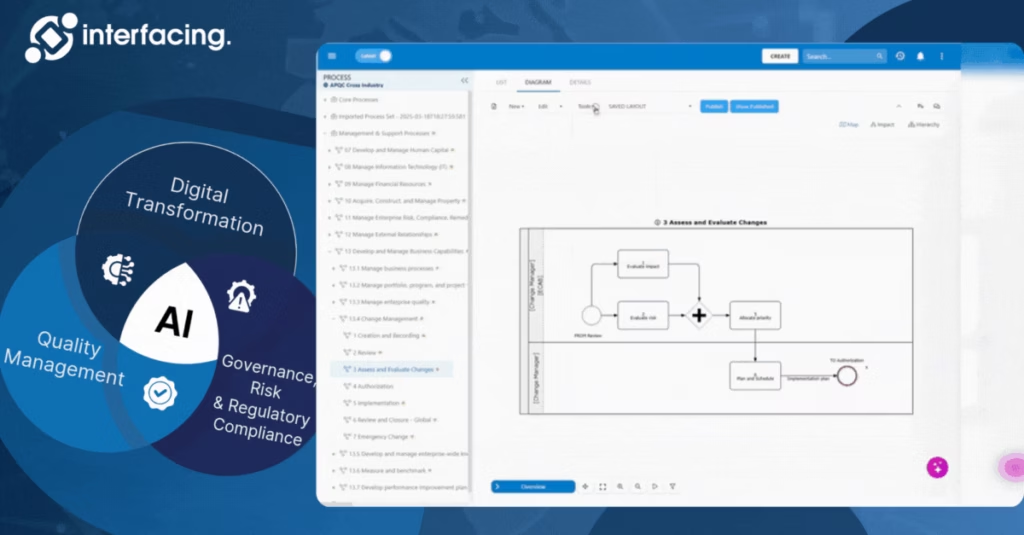
Interfacing is designed around an Integrated Management System (IMS), where quality management operates as one governed component of a broader enterprise operating model.
Instead of treating quality as a standalone discipline, Interfacing structurally connects processes, risks, controls, documents, roles, systems, and regulatory requirements within a single environment. This enables organizations to understand how quality outcomes are influenced by operational design, change, and governance decisions.
Interfacing supports a Digital Twin Organization approach, providing a structured representation of how work is performed across the enterprise. AI-assisted capabilities are used to support impact analysis and insight, augmenting governance and decision-making rather than replacing it.
| Feature | Interfacing IMS | Ideagen Q-Pulse |
|---|---|---|
| Platform Orientation | Integrated Management System spanning process, quality, risk, and compliance | Quality Management System centered on quality and compliance activities |
| AI Integration | AI-assisted impact analysis and governance insight across domains | Rule-based workflows and analytics within QMS scope |
| Unified IMS (QMS + BPM + GRC) | Single connected environment with shared governance model | QMS-focused modules; broader governance managed externally |
| Process Management | Enterprise BPMN-based process modeling and governance | Process references linked to quality records |
| Document Control & Validation | End-to-end governed lifecycle with traceability and audit evidence | Document control within quality management context |
| Audit & Inspection Management | Audit readiness linked directly to processes, risks, and controls | Audit and inspection management within QMS workflows |
| Risk & Control Management | Enterprise risk and controls embedded into operational processes | Risk handled primarily within quality-related activities |
A QMS-centric platform such as Q-Pulse may align with organizations where:
Quality management is the primary governance concern
Governance requirements are largely contained within the quality function
Enterprise process architecture is out of scope
The objective is to digitize and standardize quality workflows and records
These scenarios align with the design scope of a quality-focused system.
Interfacing is designed for organizations that require governance beyond individual functions and view quality as an outcome of how the business operates as a whole.
This typically applies when:
Quality outcomes depend on process design and execution
Organizations recognize that recurring quality issues are often rooted in upstream process structure, handoffs, and role accountability.
Governance spans multiple management disciplines
Quality, risk, compliance, performance, and business continuity must operate within a single, coherent governance framework rather than as parallel systems.
Regulatory change must be assessed across the enterprise
Regulatory updates need to be traced through processes, controls, documentation, and responsibilities to understand impact before implementation.
Leadership requires cross-domain visibility
Decision-makers need confidence that operational or digital changes do not introduce unintended risk or compliance exposure.
Digital transformation is tied to control and traceability
Automation initiatives must remain aligned with governed processes, validated documentation, and audit expectations.
The organization operates across regions or regulatory regimes
Managing local variation while maintaining global governance requires structural traceability that extends beyond traditional QMS boundaries.
In these environments, an Integrated Management System provides a foundation for sustained operational governance rather than incremental quality optimization.
The distinction between Ideagen Q-Pulse and Interfacing is not a question of product quality, but of governance scope and architectural intent.
Q-Pulse is designed to manage quality activities within a QMS-centric framework.
Interfacing is designed to govern how the enterprise operates, with quality integrated as one component of a broader, connected management system.
The appropriate choice depends on how broadly governance, risk, and compliance are expected to operate within the organization.
Interfacing’s AI-powered IMS combines QMS, BPM, GRC, and Low-Code into one environment.
Teams document, automate, and continuously improve operations while maintaining audit-ready traceability and regulatory alignment.
Unify systems: Processes, risks, training, and evidence in one connected model.
Automate compliance: AI links CAPA, audits, and training to SOPs automatically.
Accelerate improvement: Mining and dashboards surface inefficiencies and predict risks.
Request a Demo
Mit mehr als zwei Jahrzehnten Erfahrung in den Bereichen KI, Qualität, Prozesse und Compliance ist Interfacing nach wie vor ein führendes Unternehmen in der Branche. Bis heute hat das Unternehmen mehr als 500 erstklassige Unternehmen und Unternehmensberatungen aus allen Branchen und Sektoren bedient. Wir bieten weiterhin digitale, Cloud- und KI-Lösungen an, die es Organisationen ermöglichen, ihre Prozesse zu verbessern, zu kontrollieren und zu rationalisieren und gleichzeitig die Last der Einhaltung von Vorschriften und Qualitätsmanagementprogrammen zu verringern.
Wenn Sie weitere Informationen wünschen oder besprechen möchten, wie Interfacing Ihr Unternehmen unterstützen kann, füllen Sie bitte das folgende Formular aus.

· Gewinnen Sie in Echtzeitd umfassende Einblicke in Ihre Abläufe.
· Verbessern Sie Governance, Effizienz und Compliance.
· Sorgen Sie für nahtlose Einhaltung von regulatorischen Standards.

· Vereinfachen Sie das Qualitätsmanagement mit automatisierten Workflows und Überwachung.
· Optimieren Sie CAPA, Lieferantenaudits, Schulungen und verwandte Workflows.
· Verwandeln Sie Dokumentation in
umsetzbare Erkenntnisse für Quality 4.0.

· Erstellen Sie benutzerdefinierte, skalierbare Anwendungen schnell.
· Reduzieren Sie Entwicklungszeit und -kosten.
· Passen Sie sich schneller an und bleiben Sie agil angesichts sich wandelnder Kunden- und Geschäftsanforderungen.

KI-gestützte Tools sind darauf ausgelegt, Abläufe zu optimieren, Compliance zu verbessern und nachhaltiges Wachstum voranzutreiben. Erfahren Sie, wie KI:
· Mitarbeiterfragen beantworten kann.
· Videos in Prozesse umwandelt.
· Empfehlungen zur Prozessverbesserung und zu regulatorischen Auswirkungen gibt.
· eForms, Prozesse, Risiken, Vorschriften, KPIs und vieles mehr generiert.
· Regulatorische Standards in fragmentierte Anforderungen zerlegt.

Document, analyze, improve, digitize and monitor your business processes, risks, regulatory requirements and performance indicators within Interfacing’s Digital Twin integrated management system the Enterprise Process Center®!
Mehr als 400 Unternehmen und Unternehmensberatungen von Weltrang


Mehr als 400 Unternehmen und Unternehmensberatungen von Weltrang