





A critical process change has been reviewed by the appropriate stakeholders. Leadership has approved it. The change request is marked complete, and the organization is ready to move forward.
Three weeks later, one department is working from the revised procedure. Another is following the previous version. The system configuration has changed, but the related control assessment has not. Training records indicate that some affected employees have yet to acknowledge the new requirements.
The decision itself was sound. The problem was what happened after that decision.
This is one of the least visible challenges in organizational change management: the distance between an authorized change and a change that has been consistently implemented across the business. Approval establishes permission to proceed. Operational adoption requires a different level of coordination.
The organization must coordinate updates to affected processes, responsibilities, systems, documents, controls, and training. Accountable owners then need to verify implementation, retain supporting evidence, and monitor whether the intended business outcome is being achieved.
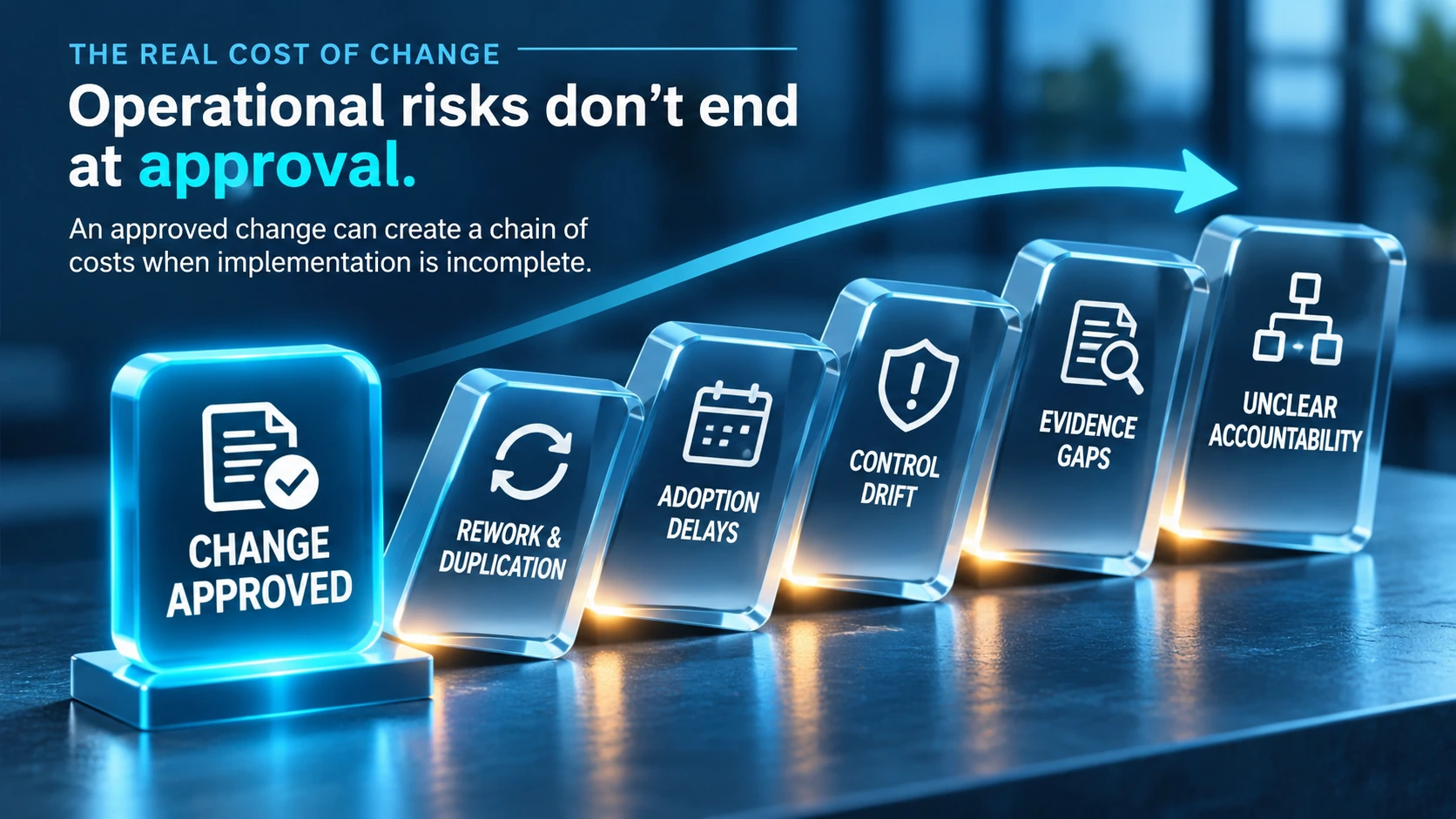
The distinction matters because a change can be administratively closed while its operational consequences remain unresolved. For regulated enterprises, that disconnect can create additional exposure when implementation evidence is required for internal review, audit, or regulatory scrutiny.
Why Organizational Change Management Cannot End at Approval
Formal approval is an essential control. It confirms that someone with the appropriate authority has evaluated a proposed change and authorized its implementation. Without this gate, important operational decisions could be introduced without sufficient review.
But approval answers only one question: May we proceed? It does not answer whether everyone affected understands the change, whether all dependent activities have been updated, or whether the new way of working produces the expected result.
Approval
Confirms the proposed change has been evaluated and authorized by the appropriate decision-makers.
Verified implementation
Confirms affected activities were updated, responsibilities were fulfilled, and the change is functioning as intended.
A mature approach to change management treats these as related but separate responsibilities. The first governs a decision. The second governs execution.
This distinction is consistent with business process governance, where ownership, change control, collaboration, version history, and accountability support controlled operational improvement.
That does not mean every minor adjustment needs an elaborate implementation program. The level of oversight should be proportionate to the impact, complexity, and risk of the change. A wording correction in an internal reference document warrants a different response from a change that affects validated systems, regulated procedures, or enterprise-wide responsibilities.
The Six Areas an Approved Change Can Affect
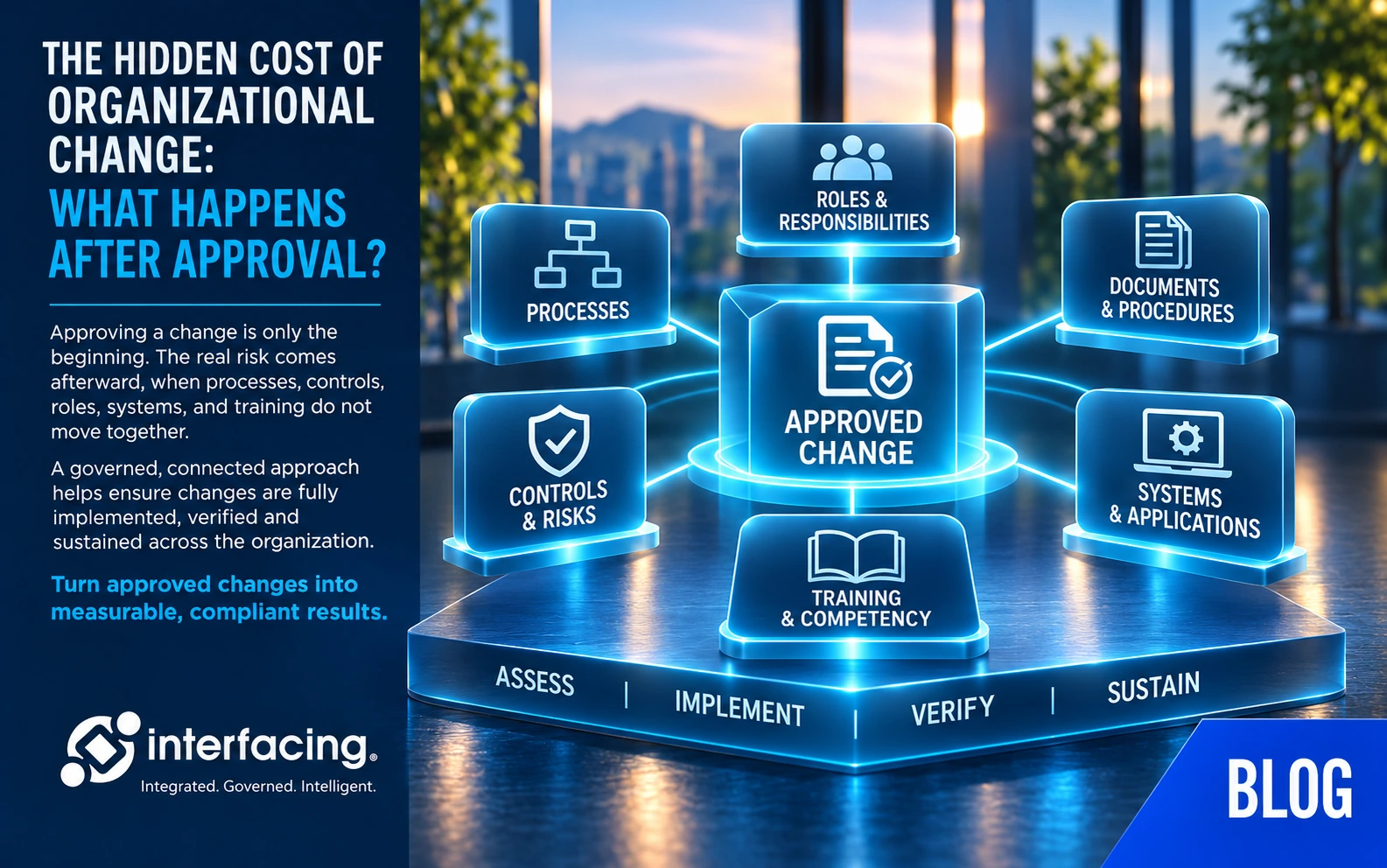
A business change rarely respects departmental or software boundaries. A revised approval threshold may alter a workflow, transfer responsibility to another role, require a system rule to be updated, and change which records must be retained. The individual updates may be straightforward. The challenge is recognizing that they belong to the same decision.
Consider a financial services organization that approves a new exception-handling procedure. The procedure itself may be documented in one location, but its implementation can require coordinated work across several domains.
Review the steps, handoffs, conditions, escalation paths, and decision points affected by the approved change.
Confirm responsibility, approval authority, segregation of duties, and ownership of implementation tasks.
Identify policies, SOPs, work instructions, templates, and records that need controlled revision or retirement.
Review configurations, access rules, integrations, forms, automated tasks, and reporting logic.
Determine whether existing controls remain effective and whether new preventive or detective measures are necessary.
Identify affected personnel, required competency updates, communication needs, and evidence of appropriate training.
These relationships are the foundation of dependency-aware change impact analysis. A simple list of affected applications or departments may be useful, but it does not necessarily reveal how a change moves through operational responsibilities, controls, procedures, and supporting evidence.
An effective dependency review should also allow for uncertainty. Not every relationship is known, not every system is integrated, and not every operational dependency has been documented. Responsible reviewers need a way to flag these gaps and resolve them before treating the impact assessment as complete.
From Approval to Verified Implementation
Organizations do not necessarily need another complex governance layer to manage this gap. They need a repeatable approach that connects authorization to coordinated action and evidence-based closure.
A practical six-stage lifecycle can help establish that continuity: Approve, Assess Dependencies, Assign Ownership, Implement, Verify, and Monitor.
- Every material impact identified during review has an accountable owner.
- Required process, document, system, and control changes have been completed.
- Affected personnel have received appropriate communication or training.
- Evidence supports that the change is operating as intended.
- Residual issues have been accepted, escalated, or assigned for resolution.
- Performance measures or review dates are defined for ongoing monitoring.
The distinction between disconnected and coordinated implementation is illustrated below, together with the six-stage lifecycle.
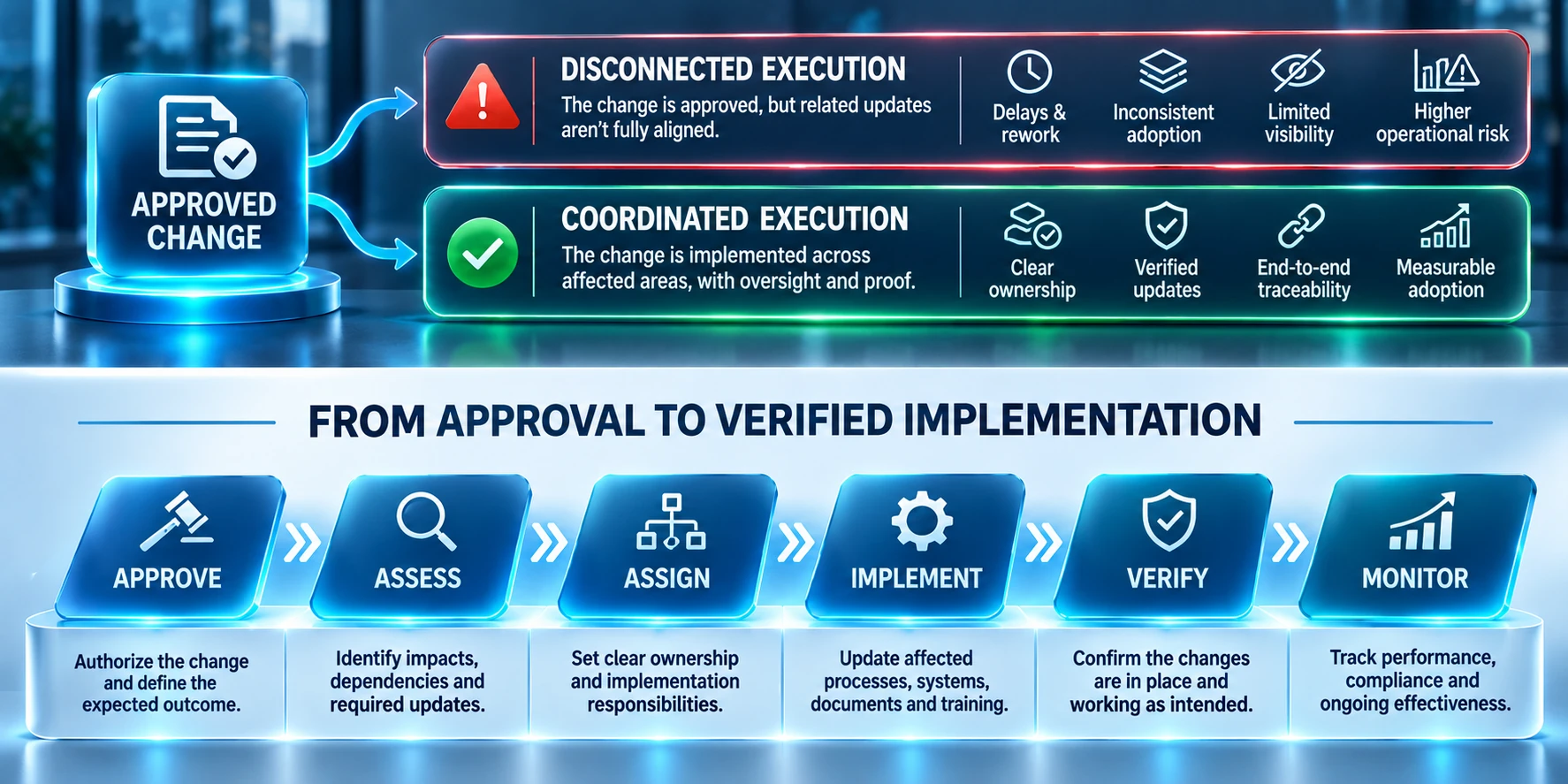
The final two stages deserve particular attention. Verification is a point-in-time assessment that implementation requirements have been met. Monitoring evaluates whether the change continues to perform as expected after it enters normal operations. Passing the first test does not guarantee the second.
For example, a revised approval workflow may pass configuration testing and be released successfully. Monitoring may later reveal unexpected approval bottlenecks or an increase in exception volumes. That information should inform further improvement, rather than remain isolated in a performance dashboard.
How a Connected Operating Model Improves Change Execution
A conventional change request can record the decision, approval date, priority, assigned tasks, and closure status. These records are valuable, but the ticket itself may not explain the operational relationships that determine whether implementation is complete.
A connected operating model provides additional context. Rather than treating a process, system, document, risk, and training requirement as unrelated records, it establishes how they contribute to the organization's activities and depend on one another.
This is the strategic role of a Digital Twin of an Organization (DTO). A DTO is a governed representation of the organization's operating model. It connects processes, roles, systems, documents, controls, requirements, and performance information, providing context for how a change in one area may affect others.
Record the activity
A conventional change workflow tells leaders which tasks were assigned, approved, and completed.
Understand the operating impact
A connected model helps leaders understand what those tasks affect, which dependencies require attention, and how the completed work relates to the approved decision.
A DTO does not eliminate the need for accurate information or responsible ownership. If a critical dependency has never been documented, a connected model cannot automatically guarantee that it will be discovered. The value comes from improving the visibility, governance, and maintenance of these relationships over time.
AI-assisted analysis can support this work by helping teams review dependencies, identify potential impacts, and evaluate possible consequences. However, a recommendation is not an approval, and an identified impact is not proof of implementation. Human reviewers must remain accountable for evaluating material changes and determining whether the evidence is sufficient.
This relationship between AI assistance and human authority is explored further in human-in-the-loop AI for a Digital Twin of an Organization.
Making Organizational Change Traceable from Decision to Outcome
Interfacing's Integrated Management System (IMS) provides a connected foundation for managing processes, organizational responsibilities, controlled documents, risks, controls, training, and governance activities.
By bringing these operational elements into a related environment, organizations can move beyond tracking individual change requests toward understanding how each approved decision affects the wider operating model.
Use connected process and organizational information to examine affected activities, responsibilities, documents, and controls.
Support defined ownership, collaboration, review and approval processes, version control, and traceable change histories.
Help teams manage related tasks, communications, updated operational content, and training requirements.
Use governance records, controlled content, action histories, and related information to support internal review and audit preparation.
The objective is not simply to digitize the approval process. It is to create greater continuity between the decision, the implementation activities that follow, and the evidence that supports operational accountability.
This approach also creates a stronger foundation for continuous improvement. When actual execution differs from the approved process, leaders have more context for determining whether the issue reflects inadequate training, a system constraint, a missing control, or a process design that needs further refinement.
The Real Finish Line Is Operational Adoption
Approval is an important milestone, but it should never be mistaken for the result of organizational change. The expected business value only begins to emerge when revised decisions are consistently reflected in day-to-day activities.
The organizations best positioned to manage complex change are not necessarily those with the greatest number of approval checkpoints. They are those that understand how decisions affect their operating model, assign clear responsibility for implementation, and verify that intended outcomes have been achieved.
By connecting governance with execution, organizational change management becomes more than an administrative procedure. It becomes an ongoing discipline for protecting operational consistency, improving accountability, and enabling change that lasts.
Organizational Change Management FAQs
What happens after an organizational change is approved?
After approval, affected processes, roles, systems, documents, controls, and training must be updated through coordinated implementation. Responsible owners should verify completion, retain supporting evidence, and monitor whether the change achieves its intended outcome.
Why is approval alone insufficient for organizational change management?
Approval authorizes a decision but does not prove that affected teams, systems, or procedures have adopted it. Without implementation tracking and verification, an approved change may leave outdated instructions, inconsistent controls, or unclear responsibilities.
How can organizations identify the downstream impact of a change?
Organizations can assess the relationships between the item being changed and its dependent processes, roles, systems, documents, risks, controls, and training requirements. A connected operating model helps make these dependencies visible so owners can review the implications before implementation.
What evidence shows that an organizational change was implemented?
Useful evidence may include approved revisions, completed implementation tasks, updated system configurations, training acknowledgements, control assessments, and verification records. The appropriate evidence depends on the type of change and the organization's regulatory and operational obligations.
How does a Digital Twin of an Organization support change management?
A Digital Twin of an Organization connects operational elements and their dependencies in a governed model. It can help teams assess change impacts, identify affected stakeholders, coordinate updates, and maintain traceability between decisions and implementation activities.
How does Interfacing help manage organizational change after approval?
Interfacing's Integrated Management System connects processes, documents, roles, systems, risks, controls, training, and governance workflows. These relationships support change impact analysis, assigned responsibilities, controlled revisions, and implementation traceability, while people remain accountable for review and approval.

Documentation: Driving Transformation, Governance and Control
• Gain real-time, comprehensive insights into your operations.
• Improve governance, efficiency, and compliance.
• Ensure seamless alignment with regulatory standards.

eQMS: Automating Quality & Compliance Workflows & Reporting
• Simplify quality management with automated workflows and monitoring.
• Streamline CAPA, supplier audits, training and related workflows.
• Turn documentation into actionable insights for Quality 4.0

Low-Code Rapid Application Development: Accelerating Digital Transformation
• Build custom, scalable applications swiftly
• Reducing development time and cost
• Adapt faster and stay agile in the face of
evolving customer and business needs.
AI to Transform your Business!
The AI-powered tools are designed to streamline operations, enhance compliance, and drive sustainable growth. Check out how AI can:
• Respond to employee inquiries
• Transform videos into processes
• Assess regulatory impact & process improvements
• Generate forms, processes, risks, regulations, KPIs & more
• Parse regulatory standards into requirements