

Interfacing

sales@interfacing.com

A DTO for Risk and Controls connects risks, controls, processes, systems and evidence in one operating model, helping organizations understand exposure, control effectiveness and change impact.

AI-assisted analysis helps identify dependencies, emerging patterns and potential risk impacts across the organization. This gives leaders stronger context for decision-making while keeping human oversight, accountability and approval in place.

A Risk Register Can Tell You What Exists. It Cannot Always Tell You What Is Happening.

Risk registers remain important. They give organizations a structured way to document threats, assess likelihood and impact, assign responsibility and record mitigation actions.

The problem begins when the risk register becomes the primary view of risk rather than one part of a broader operating model.

A risk might be rated medium. A control might be marked effective. An owner might be assigned. Yet none of those fields necessarily explains where that risk enters the operation, which activities create the exposure, which systems or suppliers influence it, or what evidence demonstrates that the control is still working.

This is where a Digital Twin of an Organization changes the picture. Interfacing describes a DTO as a connected representation of how the organization actually operates, linking processes with roles, systems, risks, controls, policies, performance measures and other operational dependencies. What is a Digital Twin of an Organization?

Risk therefore becomes more valuable when it is modeled inside the operating environment rather than maintained beside it.

Risk Only Makes Sense in Operational Context

Consider a common enterprise risk such as unauthorized system access.

That same risk may appear in finance, human resources, manufacturing, quality, customer service and IT. But the exposure is not identical in every area.

The affected systems differ. The data differs. The responsible roles differ. The applicable regulations may differ. The consequences of failure may differ.

A single enterprise-level score can therefore hide meaningful differences in how the risk behaves across the organization.

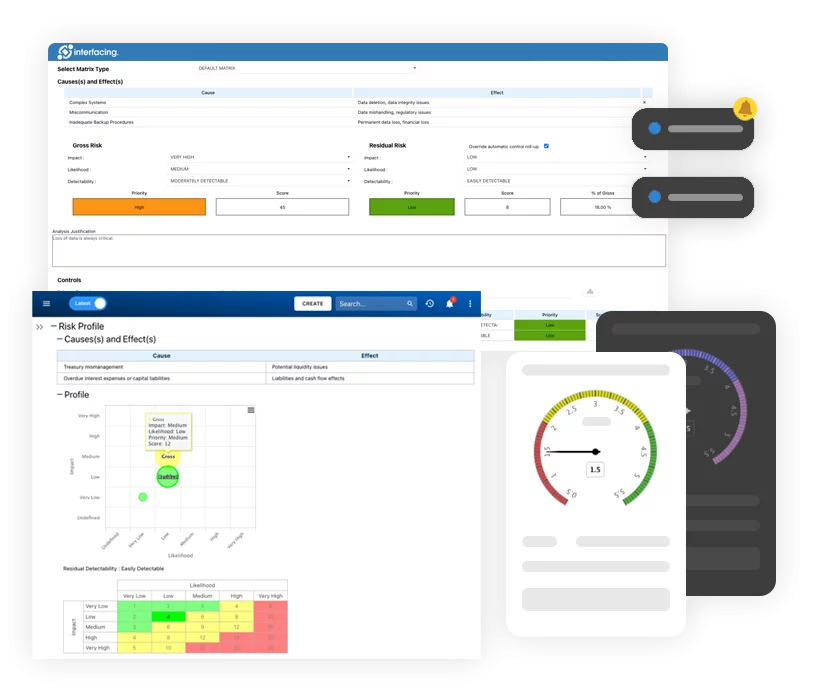
A DTO allows the same risk to be evaluated within multiple operational contexts. Interfacing’s Risk & Control Management approach supports risk assessment at the process and task level, allowing organizations to assess likelihood, impact and residual risk where the exposure actually occurs. Risk Control and Process Risk Management

That shifts the discussion from:

  • What is the enterprise risk score?
  • Who owns this risk?
  • When was it last reviewed?

to more operational questions:

  • Where does this risk actually occur?
  • Which processes and activities are exposed?
  • Which controls mitigate it?
  • Which systems, documents and people support those controls?
  • What evidence shows that the control remains effective?
  • What happens elsewhere if the exposure changes?


That is a much stronger foundation for governance.

Controls Need Operational Context Too

Controls can become just as disconnected as risks.

A control library may clearly describe the objective, owner, testing frequency and implementation requirements. What may remain unclear is where that control is relied upon across the organization.

A segregation-of-duties control may support several processes. A supplier approval control may protect quality, business continuity and regulatory obligations simultaneously. A document approval control may affect compliance, employee training and audit readiness.

If those relationships are not modeled, organizations can underestimate the consequences of changing or weakening a control.

A DTO connects controls to the processes, systems, documents, regulations, roles and risks that depend on them. Interfacing’s own risk-management approach integrates controls directly into business processes so users can understand when a control applies, why it matters and who is responsible for executing it. Explore Interfacing Risk & Control Management

This connection becomes especially important when something changes.

Change Impact Is Where the DTO Becomes More Powerful

Most organizational changes do not affect a single object in isolation.

Replacing a system can affect controls. Changing a supplier can alter operational risk. Redesigning a process can change role responsibilities. Updating a policy can affect training, evidence requirements and compliance obligations.

Interfacing’s DTO dependency-modeling approach is built around these interconnected relationships. It connects processes with regulations, systems, training, risks, controls, quality events and other organizational elements so downstream impact can be evaluated more systematically. DTO Dependency Modeling for Change Impact

For Risk & Controls teams, this creates a much more useful change-assessment model.

Instead of asking only whether a proposed change creates a new risk, leaders can examine:

  • which existing controls may become weaker or obsolete
  • whether new controls are required
  • which regulatory obligations may be affected
  • whether training or procedures need revision
  • which systems or roles now carry additional exposure
  • whether residual-risk assumptions remain valid
  • what evidence should be updated after implementation


That moves risk management earlier into the decision process rather than leaving it as a review step after a change has already been designed.

Periodic Risk Reviews Are Necessary, but They Are Not Enough

Traditional risk programs often rely on scheduled reviews.

Quarterly assessments, annual control testing and periodic governance meetings all remain important. The limitation is that operational conditions can change between those reviews.

A control may begin failing. A supplier may deteriorate. Transaction volumes may increase. A system may change. An audit finding may expose a weakness.

The organization may still be looking at a technically accurate assessment that no longer reflects current conditions.

A DTO can strengthen this model by connecting risk and control information with operational indicators.

Interfacing supports KPIs, KRIs and KCIs as part of its broader operating model, allowing organizations to monitor performance, risk exposure and control effectiveness within a connected environment. Interfacing Integrated Management System

This does not eliminate periodic reviews. It makes those reviews more informed.

KRIs and KCIs Add Meaning When They Are Connected to the Process

A Key Risk Indicator is only useful if the organization understands what it is signalling.

A Key Control Indicator is only useful if its relationship to a specific control and process is clear.

When indicators exist separately from the operating model, a threshold breach can create another investigation exercise. Teams must determine which processes are affected, which controls are involved, who owns the issue and what action should follow.

Within a DTO, those relationships can already exist.

A useful risk and control model can connect:

  • KRIs to the risks they monitor
  • KCIs to the controls they measure
  • KPIs to process and operational performance
  • controls to risks and regulatory obligations
  • owners to accountability and remediation
  • evidence to control execution
  • actions to findings and improvement work


Interfacing’s Human-in-the-Loop GRC approach specifically supports connecting risks and controls to processes, systems and business units, monitoring KRIs and KCIs, assessing inherent and residual risk, and linking remediation to broader governance workflows. Human-in-the-Loop AI for GRC

Residual Risk Should Reflect Operational Reality

Residual risk is usually calculated after controls are considered.

The weakness is that the calculation can become static even while the organization changes.

If a control weakens, residual risk may need to change. If transaction volume increases significantly, the exposure may change. If a system or supplier becomes unreliable, previous assumptions may no longer hold.

The same is true in the opposite direction. If a control becomes stronger or automation improves consistency, the assessment may also change.

Interfacing’s Risk & Control Management capabilities support process-specific gross and residual risk assessment, including evaluating the same risk differently depending on the process or task where it occurs.

That is an important DTO principle.

Risk is not simply a property stored in a register. It reflects the current condition of the operating environment.

AI-Assisted Risk Analysis Should Reveal Relationships, Not Replace Judgment

Risk and control management is a strong use case for AI-assisted analysis because of the number of relationships involved.

A change to one process may affect systems, documents, risks, regulations, training and controls. Manually tracing every dependency can be difficult in a large organization.

AI-assisted capabilities can help identify those relationships and highlight areas that warrant attention.

Useful applications include:

  • identifying potentially affected risks and controls
  • surfacing downstream dependencies
  • detecting patterns across incidents or findings
  • highlighting potential control gaps
  • identifying where supporting evidence may need review
  • assisting with risk and impact analysis


But AI should not determine risk appetite or make consequential governance decisions independently.

Interfacing’s Human-in-the-Loop approach is based on exactly this distinction. AI can help analyze interconnected information, but accountable people remain responsible for reviewing recommendations, evaluating tradeoffs and approving actions. Human-in-the-Loop AI for Digital Twin of an Organization

The objective is better context for human decision-making, not the removal of human accountability.

How Interfacing Can Help

Interfacing provides more than a standalone risk register or control library.

Its Integrated Management System brings BPM, GRC, QMS, document control, regulatory management, audit, business continuity, performance management and workflow automation into a shared operating environment. This allows risks and controls to remain connected to the processes and governance structures that give them meaning.

Within that environment, organizations can connect risks and controls to:

  • business processes and individual tasks
  • regulations and compliance requirements
  • policies, procedures and controlled documents
  • roles, responsibilities and ownership
  • systems, applications and assets
  • KPIs, KRIs and KCIs
  • audits, findings and evidence
  • incidents, quality events and CAPAs
  • remediation and improvement actions


The result is not simply better documentation.

It is a governed, traceable risk operating model.

Interfacing’s Risk & Control Management capabilities support the full risk lifecycle, including identification, likelihood and impact assessment, residual risk evaluation, process-oriented risk assessment, integrated controls and monitoring. Risk & Control Management

Combined with the DTO, those capabilities provide something more valuable than isolated risk records: context.

Teams can see where a risk occurs, what controls it, what depends on that control, how changing operational conditions may alter exposure and what evidence supports the current assessment.

AI-assisted analysis can then help identify dependencies and potential downstream impacts, while governance workflows preserve review, approval and accountability.

For regulated and operationally complex organizations, that creates a stronger path from risk identification to operational action.


What is a DTO for Risk and Controls?

A DTO for Risk and Controls is a connected digital model that places risks and controls inside the broader operating environment. It links them with processes, systems, people, requirements, indicators and evidence so organizations can understand where exposure exists and how it is being managed.

How is a DTO different from a traditional risk register?

A traditional risk register records risks, ownership and assessments. A DTO adds operational context by connecting those risks to the processes, controls, systems, people and requirements affected by them.

Can a DTO monitor control effectiveness?

Yes. A DTO can connect controls with evidence, KPIs, KRIs, KCIs, audit findings and operational information, giving organizations a stronger basis for assessing whether controls continue to operate as intended.

What are KRIs and KCIs in a DTO?

KRIs provide signals about changing risk exposure, while KCIs provide signals about control performance or effectiveness. Connecting both to the operating model helps organizations understand what those indicators mean operationally.

Can a DTO support residual-risk monitoring?

Yes. When risk assessments, controls and operational indicators are connected, organizations can reassess residual risk as operational conditions or control effectiveness change.

How does a DTO help during organizational change?

A DTO maps dependencies between processes, systems, risks, controls, roles, documents and requirements. This can help teams identify what may need reassessment before a proposed change is implemented.

Does AI replace risk managers in a DTO?

No. AI-assisted capabilities can help identify dependencies, patterns and potential impacts. Risk appetite, control acceptance, remediation priorities and consequential decisions still require human judgment and accountability.

Is DTO risk management only useful for regulated organizations?

No. Any complex organization can benefit from connected risk information. The value is especially strong in regulated environments where traceability between risks, controls, requirements, ownership and evidence must be demonstrated.

Why Choose Interfacing?


With over two decades of AI, Quality, Process, and Compliance software expertise, Interfacing continues to be a leader in the industry. To-date, it has served over 500+ world-class enterprises and management consulting firms from all industries and sectors. We continue to provide digital, cloud & AI solutions that enable organizations to enhance, control and streamline their processes while easing the burden of regulatory compliance and quality management programs.

To explore further or discuss how Interfacing can assist your organization, please complete the form below.

Documentation: Driving Transformation, Governance and Control

• Gain real-time, comprehensive insights into your operations.
• Improve governance, efficiency, and compliance.
• Ensure seamless alignment with regulatory standards.

eQMS: Automating Quality & Compliance Workflows & Reporting

• Simplify quality management with automated workflows and monitoring.
• Streamline CAPA, supplier audits, training and related workflows.
• Turn documentation into actionable insights for Quality 4.0

Low-Code Rapid Application Development: Accelerating Digital Transformation

• Build custom, scalable applications swiftly
• Reducing development time and cost
• Adapt faster and stay agile in the face of evolving customer and business needs.


AI to Transform your Business!

The AI-powered tools are designed to streamline operations, enhance compliance, and drive sustainable growth. Check out how AI can:
• Respond to employee inquiries
• Transform videos into processes
• Assess regulatory impact & process improvements
• Generate forms, processes, risks, regulations, KPIs & more
• Parse regulatory standards into requirements


Learn more about EPC's AI Use Cases
CONTACT US

Request Free Demo

Document, analyze, improve, digitize and monitor your business processes, risks, regulatory requirements and performance indicators within Interfacing’s Digital Twin integrated management system the Enterprise Process Center®!
Trusted by Customers Worldwide!

More than 400+ world-class enterprises and management consulting firms