Interfacing

sales@interfacing.com

A Digital Twin of an Organization connects documents and records to the processes, roles, systems, risks, controls, regulations and training they support. Instead of treating information as isolated files, a DTO places it within the operating model so organizations can understand where it applies, what may be affected when it changes, and how records provide evidence of execution. This strengthens traceability, change impact analysis, audit readiness and AI-assisted review while turning document control into a more connected governance capability.

Digital Documents Can Still Exist in Operational Silos

Digitization solved many practical problems associated with paper-based information. Employees gained faster access to procedures, quality teams gained better revision control, and organizations gained clearer approval histories. Modern document management systems can also automate reviews, maintain retention periods and restrict access according to roles or permissions.

However, digitization can preserve the same organizational silos in a more efficient form. The document may now be electronic, but the process it supports can still live in a separate BPM platform. Risks may be maintained in a GRC application, employee training may sit in an LMS, regulatory requirements may be tracked in spreadsheets, and operational evidence may be scattered across quality applications, shared folders and business systems.

This becomes especially visible when something changes. Consider a supplier qualification procedure. A document management system can show the current version, owner, approval date and review cycle. What it may not show is that the procedure supports several business processes, mitigates specific supplier risks, satisfies regulatory requirements, defines responsibilities for several roles and generates records later used as audit evidence.

The document is controlled, but the relationships that explain its significance remain fragmented. A DTO addresses that limitation by connecting documents with the operating structures they describe and govern. Interfacing’s current IMS positioning reflects this broader model by connecting processes and tasks with resources, roles, systems, risks, controls, regulations, policies, quality events and performance indicators.

Documents Describe the Intended State, Records Provide Evidence of Execution

Documents and records are often managed within the same governance environment, but they serve different purposes. Policies, procedures, SOPs, specifications and work instructions generally establish what should happen. Records capture evidence that an activity, transaction, decision or control actually occurred.

An inspection procedure, for example, describes how an inspection should be performed. The resulting inspection record identifies what was inspected, who completed the work, what was observed and what happened afterward. A training procedure establishes how competence is managed, while training records demonstrate that designated employees completed the required activity. A CAPA procedure establishes governance for corrective and preventive action, while CAPA records document investigation, implementation and effectiveness review.

Regulated organizations need both sides of this relationship. It is not enough to demonstrate that an approved procedure existed. Organizations often need to show that the procedure was communicated, followed, monitored and supported by reliable records.

When documents and records are separated from the wider operating model, that chain of evidence has to be reconstructed. Quality teams may need to move between repositories, workflow systems, training applications and spreadsheets to establish the complete story. In a connected DTO, the relationships can exist as part of normal governance. The procedure can be linked to the process it governs, the control it implements, the regulation it supports and the employees who require training. The resulting records can then provide evidence of execution within that same operational context.

This distinction is central to why documents and records matter within a DTO. The value is not simply that information is stored together. The value is that the organization can connect its intended operating model with evidence of what actually occurred.

Document Change Is Often Organizational Change

Traditional document lifecycle management is usually effective at controlling the document itself. A change request is initiated, the content is revised, reviewers provide input, approvers authorize the revision and the new version is published. The previous version can be retained for historical purposes, while affected employees may receive notifications or read confirmations.

The weakness appears when the organization treats publication as the end of the change. A revised procedure can alter much more than the wording inside the file. It can change who is responsible for an activity, which control must be performed, what evidence needs to be collected, how a system must be configured or which employees require new training.

This is why dependency modeling is so important to a mature DTO. Interfacing’s work on DTO dependency modeling argues that organizations often understand what has changed but struggle to identify everything the change will affect. Its model connects processes, systems, people, policies, risks, controls, suppliers, data and performance measures so that downstream effects can be examined before implementation.

Applied to document governance, this changes the meaning of revision control. A change to a controlled procedure should not only create a new version number. It should create an opportunity to examine the relationships surrounding that procedure and determine whether connected processes, training, controls, forms, roles or other documents also require attention.

The decision does not need to be automated. In fact, consequential changes should remain subject to accountable human review. The DTO provides the context needed to make that review more complete.

Document Control Becomes More Useful When It Is Process-Aware

Many organizations manage process architecture and document management as separate disciplines. Process teams model how work flows, while quality or documentation teams govern the procedures describing selected activities. Both functions can be mature independently and still create gaps at the points where they intersect.

A process may be redesigned while associated procedures remain unchanged. A procedure may be revised without identifying every process that depends on it. A role may change within the organization while old responsibilities remain embedded in controlled documents. Regulatory requirements can also change without a reliable method for identifying every document, control and process that depends on them.

A DTO provides a structural way to connect these layers. Interfacing’s explanation of incomplete DTOs makes the same point from the process perspective: process models alone cannot provide a complete operational picture because documents, systems, roles, controls, risks and records provide additional context about how work is governed and executed.

The reverse is equally important. Documents alone cannot provide a complete representation of operations. A procedure may describe an approved method, but it does not automatically reveal actual execution, operational dependencies or whether the associated controls remain effective.

Connecting documents and processes therefore creates reciprocal governance. Process owners can see the documentation supporting execution, while document owners can understand where their controlled information applies.

Records Become More Valuable When Their Context Is Preserved

Records management is frequently associated with retention, disposition and audit requirements. Those responsibilities remain essential, particularly in highly regulated industries, but a DTO can make records valuable for more than historical preservation.

Consider a recurring inspection finding. A traditional records environment may allow the organization to locate each inspection report and retain the required evidence. A connected operating model can go further by relating those records to the process being inspected, the procedure in force, the responsible role, the control that failed, associated risks, equipment or systems, and any corrective actions subsequently opened.

Once these relationships exist, patterns become easier to investigate. Several apparently unrelated findings may originate in the same process. Multiple CAPAs may point to one ineffective control. Training issues may consistently follow a particular type of procedural change. Supplier records may reveal recurring quality problems that are otherwise dispersed across several business functions.

The record has not changed, but its analytical value has. Instead of remaining a historical file, it becomes evidence positioned within a network of operational relationships.

This is where DTO-based records governance begins to contribute to operational intelligence. The organization can investigate not only individual records but also the relationships across them.

Audit Readiness Depends on Relationships, Not Just Retrieval

Audit preparation provides a practical test of whether an organization’s information is truly connected. An auditor may begin by requesting a procedure and then ask for its approval history, employee training records, applicable regulatory requirements, evidence that a related control was performed, and records showing how exceptions were handled.

Every requested item may exist somewhere, yet assembling the full evidence chain can still become a manual exercise. Teams search multiple systems, export reports, consult subject matter experts and reconstruct relationships that were never explicitly maintained.

A DTO offers a different model. If regulatory requirements, processes, procedures, controls, roles, training and records are connected during normal operations, audit preparation becomes less about reconstructing the governance story and more about following relationships that already exist.

Interfacing’s current IMS includes document control capabilities such as versioning, change tracking, records, electronic signatures and archiving, while the wider platform also brings together process management, risk and control management, regulatory information, quality workflows and training. The significant advantage is therefore not any one document-management feature in isolation. It is the ability to position document and record governance within a broader operational model.

Historical Context Matters as Much as the Current Version

Most operational users need the latest approved information, so document systems naturally emphasize the current version. Investigations, audits and regulatory reviews often require something different. They need to know what was true at a particular moment in the past.

An incident that occurred eighteen months ago may need to be evaluated against the procedure effective at that time, the process configuration then in use, the person responsible for the activity and the control requirements that applied before later changes were introduced. Retaining the historical PDF is important, but it may not be sufficient if the relationships surrounding that file have disappeared.

This is where contextual records governance becomes important. The evidentiary value of historical information is stronger when the organization can reconstruct not only the document itself but also its relationship to the operating model at the time.

A DTO can support that objective because documents and records are modeled as connected operational objects rather than isolated files. Historical information therefore has the potential to retain more of its organizational meaning.

AI Increases the Need for Governed Document Context

The rapid adoption of generative AI has made enterprise document retrieval far easier. Employees increasingly expect to ask questions conversationally and receive answers from internal policies, procedures and technical documentation. This can significantly improve access to organizational knowledge, but retrieval and operational understanding are not the same thing.

An AI system may locate the correct procedure without understanding which control the document implements, which process it governs, which regulatory requirement sits upstream or which employees will require retraining if the procedure changes. Giving AI access to more documents therefore does not automatically give it a reliable model of the organization.

A DTO can provide some of that missing context by connecting documents to the other operational objects around them. This can make AI-assisted dependency analysis, impact assessment and information discovery more useful because the system has relationships to examine rather than relying entirely on document text.

Interfacing’s human-in-the-loop DTO model explicitly positions AI as an analytical aid rather than an autonomous decision-maker. AI can help analyze dependencies, detect patterns, evaluate impacts and generate recommendations, while human decision-makers remain responsible for tradeoffs, risk acceptance, approvals and consequential organizational changes.

That distinction is particularly important in documents and records governance. AI can help reviewers identify what may need attention, but accountable owners should determine what actually changes.

Executive Reality Check

The maturity of document management should not be measured only by how quickly employees can locate the latest approved file. A more revealing test is whether the organization can explain how that document participates in the operating model.

If a critical SOP changes, can the organization identify the affected processes, roles, controls, training requirements and related records without launching a manual investigation? If an auditor challenges an historical event, can the organization reconstruct which procedure, responsibility and control applied at that point in time? If repeated records indicate the same operational weakness, can those patterns be traced back to the processes and governance structures producing them?

When these questions still require multiple systems, spreadsheets and interviews, the information may be digital, but the operating context remains fragmented.

How Interfacing Helps Turn Documents and Records Into a Connected Governance System

Interfacing’s value proposition goes beyond providing another place to store controlled documents. Its Integrated Management System provides a governed environment in which process management, document control, regulatory information, risk and control management, quality workflows, training and operational evidence can be connected within the same broader operating model. Interfacing’s current DTO positioning describes the IMS as the governed operational foundation of the Digital Twin, connecting processes, resources, roles, systems, risks, controls, regulations, policies, quality events and performance indicators.

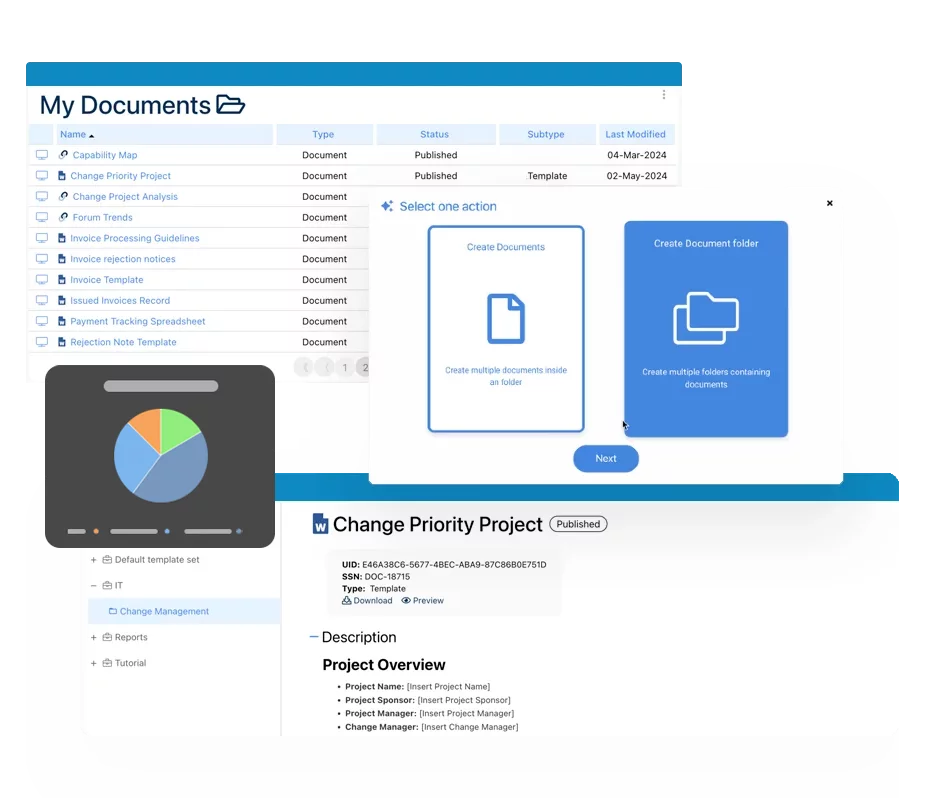
For documents and records, this creates an important shift in emphasis. Organizations can manage the lifecycle of a controlled document while also maintaining the relationships that explain where it applies and why it matters. A procedure can be connected to its process, regulatory requirement, risk, control and responsible roles. Training and read-confirmation requirements can follow changes, while records generated through governed workflows can provide evidence of execution.

Interfacing can therefore help organizations:

  • manage controlled document lifecycles, including versioning, change tracking, electronic signatures, records and archiving
  • connect policies, procedures and records with the processes and roles they support
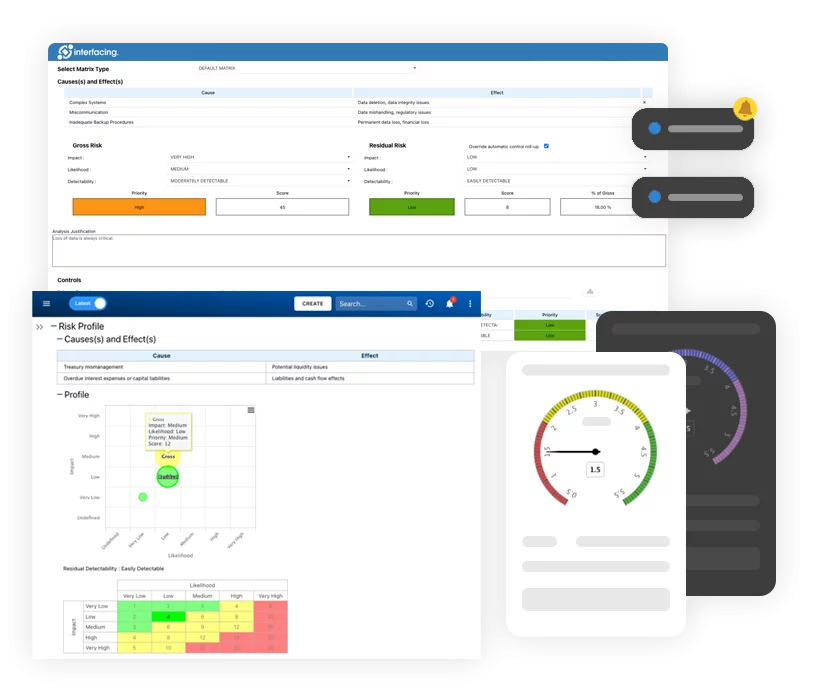
  • link documentation to risks, controls and regulatory obligations
  • identify upstream and downstream dependencies when controlled information changes
  • use AI-assisted impact recommendations to help reviewers identify potentially affected operational objects
  • govern approvals, confirmations, training and implementation through workflows and audit trails
  • maintain operational evidence alongside quality events, CAPAs, audits and other governed activities
  • create a more traceable relationship between approved requirements and records of execution


The solution proposition is therefore larger than replacing a document management system. The objective is to create a connected governance layer in which controlled information becomes part of the organization’s operational model.

Documents establish what the organization expects to happen. Processes describe how work is structured. Roles establish responsibility. Risks and controls explain what must be protected. Training helps establish readiness. Records provide evidence of execution, while audits and quality events show where reality diverged from the intended state.

Bringing those relationships together allows Interfacing to position documents and records not as the end point of organizational knowledge, but as active components of a governed Digital Twin of the Organization. That is the difference between controlling files and managing operational evidence.

What is a DTO for documents and records?

A DTO for documents and records is a Digital Twin of an Organization that connects policies, procedures, SOPs, forms and records with the processes, roles, systems, risks, controls, regulations and training they support. This adds operational context to traditional document and records management.

Is a DTO the same as a document management system?

No. A document management system usually concentrates on storage, access, versioning, approvals and document lifecycle control. A DTO connects that information to the wider operating model so organizations can understand how documents and records relate to processes, responsibilities, controls, risks and regulatory requirements.

Why should documents be connected to business processes?

Connecting documents to processes shows where policies, SOPs and procedures apply operationally. It also makes it easier to identify potentially affected documentation when a process changes and to understand which processes may be affected when a controlled document is revised.

How can a DTO improve document change control?

A DTO can make the dependencies surrounding a document visible. Reviewers can evaluate related processes, roles, controls, risks, regulations, training requirements and documentation before determining whether a revision requires additional organizational changes.

What is the difference between a document and a record?

Documents generally describe requirements, approved methods or expectations. Records provide evidence that an activity, decision or transaction occurred. Connecting both within a DTO helps organizations trace the relationship between the intended operating model and actual execution.

How can a DTO improve audit readiness?

A DTO can maintain relationships among requirements, processes, documents, controls, roles, training and operational records as part of normal governance. This can reduce the amount of manual reconstruction required when preparing evidence for an audit.

Can AI help with document impact analysis?

Yes. AI-assisted analysis can help identify dependencies, compare information and surface potentially affected processes, documents, controls or requirements. Human owners should continue to evaluate recommendations and remain responsible for approval and governance decisions.

Does a DTO have to replace an existing document management system?

Not necessarily. Organizations can use document lifecycle capabilities within an integrated platform or connect existing repositories to the broader operating model. The essential capability is preserving governed relationships between documents, records and their operational context.

Why is historical document context important?

Historical investigations often require more than an earlier document version. Organizations may need to establish which process, responsibility, control or regulatory requirement applied at the time an event occurred. Preserving these relationships strengthens traceability and evidentiary value.

How does Interfacing support documents and records within a DTO?

Interfacing combines document control with process management, risks and controls, regulations, roles, training, quality workflows and operational evidence within its Integrated Management System. This enables organizations to manage documents and records as connected components of a governed operating model.

Why Choose Interfacing?


With over two decades of AI, Quality, Process, and Compliance software expertise, Interfacing continues to be a leader in the industry. To-date, it has served over 500+ world-class enterprises and management consulting firms from all industries and sectors. We continue to provide digital, cloud & AI solutions that enable organizations to enhance, control and streamline their processes while easing the burden of regulatory compliance and quality management programs.

To explore further or discuss how Interfacing can assist your organization, please complete the form below.

Documentation: Driving Transformation, Governance and Control

• Gain real-time, comprehensive insights into your operations.
• Improve governance, efficiency, and compliance.
• Ensure seamless alignment with regulatory standards.

eQMS: Automating Quality & Compliance Workflows & Reporting

• Simplify quality management with automated workflows and monitoring.
• Streamline CAPA, supplier audits, training and related workflows.
• Turn documentation into actionable insights for Quality 4.0

Low-Code Rapid Application Development: Accelerating Digital Transformation

• Build custom, scalable applications swiftly
• Reducing development time and cost
• Adapt faster and stay agile in the face of evolving customer and business needs.


AI to Transform your Business!

The AI-powered tools are designed to streamline operations, enhance compliance, and drive sustainable growth. Check out how AI can:
• Respond to employee inquiries
• Transform videos into processes
• Assess regulatory impact & process improvements
• Generate forms, processes, risks, regulations, KPIs & more
• Parse regulatory standards into requirements

Learn more about EPC's AI Use Cases
CONTACT US

Request Free Demo

Document, analyze, improve, digitize and monitor your business processes, risks, regulatory requirements and performance indicators within Interfacing’s Digital Twin integrated management system the Enterprise Process Center®!

Trusted by Customers Worldwide!

More than 400+ world-class enterprises and management consulting firms