Regulatory change rarely affects only the regulation itself. A revised requirement can alter processes, controls, SOPs, responsibilities, systems, training, evidence, and risk exposure across the organization.
The real compliance challenge is therefore not identifying that a regulation changed. It is determining everything inside the organization that the change affects, deciding what must be updated, and proving that the response was completed.
Regulatory Change Is an Impact Problem, Not a Document Problem
Organizations have become reasonably good at tracking regulations.
Regulatory teams subscribe to alerts. Legal teams review new requirements. Quality groups maintain standards libraries. Compliance teams compare new language against existing policies.
Yet the difficult question begins after the change is identified.
What does this change actually mean for the organization?
A regulatory requirement does not operate independently. It may govern a process performed by several departments, implemented through multiple procedures, supported by specific systems, mitigated through controls, assigned to particular roles, and demonstrated through records or other evidence.
Changing one requirement can therefore create a chain of consequences.
This is where a Digital Twin of an Organization overview becomes particularly relevant.
A DTO should represent not simply how the organization works, but how its operational elements relate to one another. Processes, roles, systems, controls, risks, policies, documents, training, performance measures, and regulatory requirements form part of the same operating model.
Once those relationships are visible, regulatory change can be evaluated as an organizational impact rather than a document revision.
The Compliance Gap Usually Appears Downstream
Consider a regulatory requirement that changes how a controlled activity must be performed.
The compliance team identifies the change and updates the regulatory register.
That may be correct, but it does not establish compliance.
The affected SOP may still describe the previous procedure. A control may need to be redesigned. An employee role may carry a new responsibility. A digital form may collect the wrong information. A training program may teach the previous process. An audit checklist may still test the old requirement.
Even the evidence proving compliance may need to change.
The regulatory record can therefore be completely current while operational compliance remains outdated.
This gap exists because many organizations manage regulations and operations in different systems.
The regulation resides in one repository. Procedures live somewhere else. Risk and controls may sit in a GRC platform or spreadsheet. Training sits in an LMS. Process documentation is maintained independently. Change requests are managed through another workflow.
The organization knows that something changed.
What it cannot easily determine is where the consequences travel next.
A DTO Makes Regulatory Dependencies Visible
This is where Digital Twin Dependency Modeling for Change Impact becomes central to regulatory intelligence.
Instead of treating a requirement as an isolated record, the DTO connects it with the elements responsible for operationalizing it.
A regulatory requirement might be connected to:
- the processes it governs
- the policies and procedures implementing it
- the controls demonstrating compliance
- the risks associated with non-compliance
- the systems supporting execution
- the roles responsible for the activity
- the training required by affected employees
- the records and evidence produced
- the audits or inspections verifying performance
Â
The value is not the number of relationships being modeled.
The value is what happens when one of those objects changes.
A connected operating model allows the organization to follow those relationships upstream and downstream and ask a far more useful question:
If this regulation changes, what else should we evaluate?
That turns regulatory change management from search into impact analysis.

AI-Assisted Impact Analysis Can Accelerate the First Assessment
Large organizations may have thousands of procedures, controls, risks, records, roles, and regulatory requirements.
Expecting compliance teams to manually identify every potential dependency creates an obvious scaling problem.
AI-assisted analysis can help identify potentially affected relationships, compare content, surface dependencies, and recommend areas requiring review.
But recommendation should not be confused with approval.
Regulatory interpretation frequently requires context. Similar language may apply differently across jurisdictions, products, processes, facilities, or regulated activities. An apparent dependency may prove irrelevant. A subtle operational relationship may be more important than an algorithm initially indicates.
This is why Human-in-the-Loop AI for Digital Twin of an Organization matters.
AI can help teams discover and analyze potential consequences.
Human owners still determine what the regulation means, which impacts are valid, what level of change is required, and whether the resulting response is acceptable.
The objective is not autonomous compliance.
It is faster, better-informed compliance analysis with accountability intact.
Regulatory Impact Should Trigger Governance, Not Another Spreadsheet
Identifying an impact is useful only if something happens next.
Suppose an updated requirement affects a procedure, two controls, three employee roles, a training package, a digital form, and an audit checklist.
The organization now needs to coordinate change.
Content owners must review the affected materials. Changes may require endorsement and approval. Updated procedures must be published. Employees may need read confirmations or retraining. Control owners may need to reassess effectiveness. Risk owners may need to reconsider residual exposure.
Evidence of those activities must also remain traceable.
This is where the distinction between a descriptive DTO and an operational DTO becomes important.
A DTO Without Governance Is Just a Diagram may reveal that objects are connected.
A governed DTO can help move the organization from recognizing the impact to managing the response.
The lifecycle becomes:
Regulatory Change → Impact Analysis → Owner Review → Change Actions → Approval → Implementation → Training and Communication → Verification
Compliance becomes a managed operational response rather than a collection of disconnected updates.
Regulatory Change Can Also Be Tested Before It Is Implemented
Some regulatory changes have effects that are difficult to predict.
A new control may improve compliance but increase cycle time.
A revised approval requirement may strengthen accountability while creating capacity constraints.
A system change required by regulation may affect segregation of duties, resource allocation, or business continuity.
This creates another role for the DTO.
Rather than simply identifying what is connected to the change, organizations can use DTO Scenario Testing for Better Business Decisions to examine possible responses before implementation.
The question changes from:
What must we change?
to:
What is the safest and most operationally effective way to make that change?
That distinction matters.
Regulatory compliance establishes constraints, but organizations often retain choices about how those requirements are implemented operationally.
A connected DTO gives leaders a structure for evaluating those choices against processes, resources, risks, controls, responsibilities, and performance before committing to a particular response.
From Regulatory Monitoring to Regulatory Intelligence
Monitoring tells an organization that something changed.
Regulatory intelligence should explain what that change means.
Operational regulatory intelligence goes further again.
It connects the changed requirement to the operating model, identifies potentially affected dependencies, assigns accountability, governs the resulting change, and maintains evidence that implementation occurred.
That is a materially different capability from maintaining a regulatory library.
It creates a continuous relationship between external requirements and internal operations.
How Interfacing Can Help
Interfacing goes beyond regulatory monitoring by connecting regulatory intelligence directly to the operating model. Instead of treating regulations, risks, controls, processes, SOPs, systems, roles, training, and evidence as separate records, Interfacing brings them together in a governed Integrated Management System.
That connected structure is the key advantage.
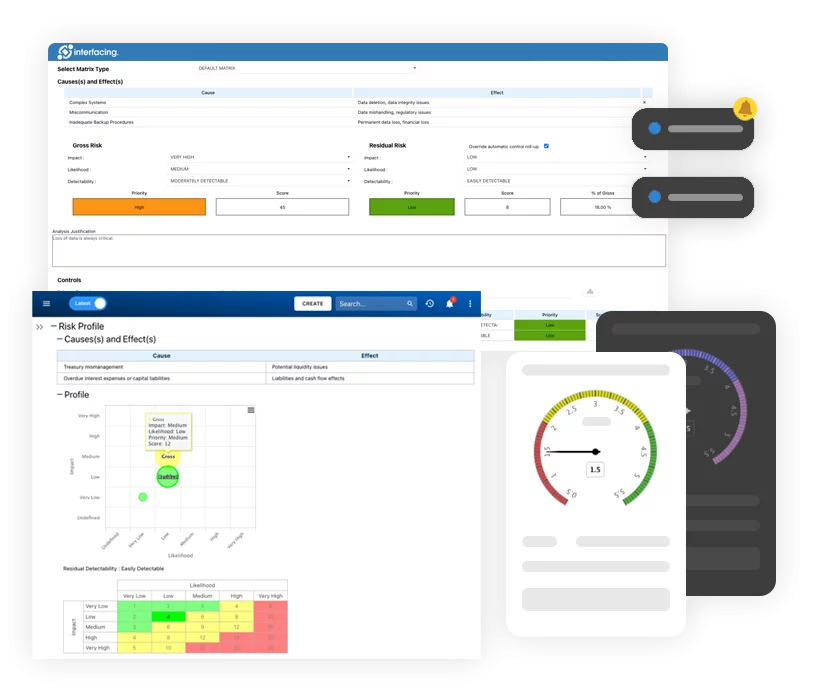
When a regulatory requirement changes, Interfacing can help organizations understand not only that a change occurred, but where that change may create operational impact. The platform connects requirements to the processes they govern, the controls that support compliance, the documents that define execution, the people responsible for action, the systems involved, the risks that may need reassessment, and the training or evidence required to complete the response.
This gives organizations a stronger foundation for regulatory change management because impact analysis is tied to real operational dependencies rather than isolated documents or spreadsheets.
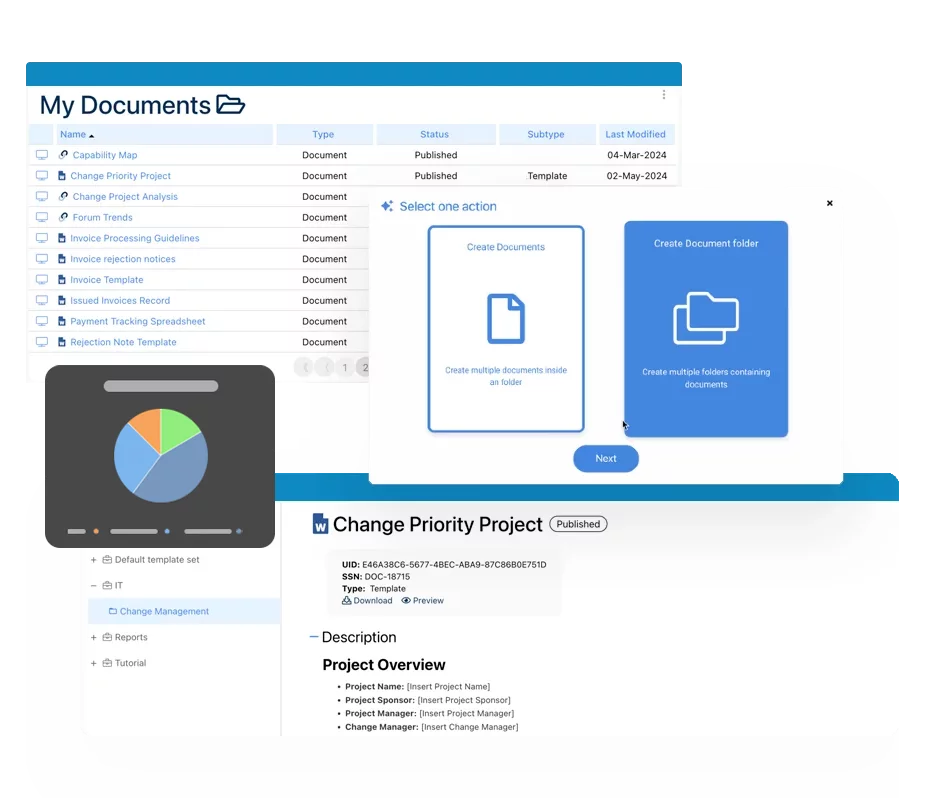
Interfacing also helps move organizations from analysis into governed execution. Change requests, reviews, approvals, digital signatures, version control, notifications, training, read confirmations, audit trails, and implementation activities can all be managed within the same connected environment. This creates traceability from the original regulatory change through to the actions taken in response.
The broader value is that Interfacing combines DTO, BPM, QMS, GRC, document control, risk management, regulatory management, and low-code workflow automation within one integrated platform. That reduces the fragmentation created by point solutions and gives compliance, quality, operations, and transformation teams a shared operating model for managing change.
For highly regulated organizations, this means regulatory change can become a controlled, visible, and accountable process rather than a reactive exercise.
Interfacing helps organizations:
- identify where regulatory changes may create downstream operational impact
- connect requirements to processes, controls, risks, systems, roles, documents, and training
- use AI-assisted impact recommendations to accelerate analysis while keeping human oversight in place
- initiate governed change workflows directly from identified impacts
- maintain end-to-end traceability from requirement to implementation
- preserve audit-ready evidence of decisions, approvals, communication, and completion
- evaluate broader operational consequences before changes are implemented
Â
The result is more than regulatory tracking.
It is a connected regulatory intelligence capability built into the organization’s operating model, helping teams respond faster, govern change more consistently, and reduce the risk that an updated requirement is missed somewhere downstream.
This positioning is well supported by your existing IMS and DTO material, which emphasizes a single governed environment connecting processes, risks, controls, policies, SOPs, KPIs, workflows, regulatory management, and downstream impact visibility.
Frequently Asked Questions
What is regulatory change impact analysis?
Regulatory change impact analysis determines which parts of an organization may be affected when a law, standard, regulation, or regulatory requirement changes. This can include processes, procedures, controls, risks, systems, employee roles, training requirements, records, and compliance evidence.
How does a DTO help manage regulatory change?
A Digital Twin of an Organization connects regulatory requirements with the operational elements that implement them. This allows teams to trace dependencies and assess downstream impacts when requirements change.
Is regulatory monitoring the same as regulatory impact analysis?
No. Regulatory monitoring identifies new or revised requirements. Impact analysis evaluates what those changes mean for the organization’s processes, controls, documents, risks, systems, people, and other operational dependencies.
Can AI determine the impact of a regulatory change automatically?
AI-assisted analysis can help identify possible dependencies, compare information, and recommend potentially affected areas. Human regulatory, quality, process, and operational owners should validate those recommendations and remain responsible for interpretation and approval.
Why are process relationships important for regulatory compliance?
Regulations are implemented through operational processes. Connecting regulatory requirements to processes makes it easier to understand which procedures, controls, responsibilities, systems, risks, training, and evidence support compliance.
Can a DTO help evaluate different responses to a regulatory change?
Yes. When the operating model includes processes, resources, controls, risks, systems, and performance relationships, scenario testing can help organizations examine how different implementation choices may affect operations before changes are approved.
What happens after an impact is identified?
A governed regulatory change process can assign affected items to owners, initiate change requests, coordinate reviews and approvals, update controlled information, trigger training or read confirmations, and maintain evidence that implementation occurred.
What is the difference between a regulatory repository and regulatory intelligence?
A regulatory repository stores requirements. Regulatory intelligence connects those requirements with organizational context so teams can understand their meaning, dependencies, impacts, responsibilities, and required actions.
Why Choose Interfacing?
With over two decades of AI, Quality, Process, and Compliance software expertise, Interfacing continues to be a leader in the industry. To-date, it has served over 500+ world-class enterprises and management consulting firms from all industries and sectors. We continue to provide digital, cloud & AI solutions that enable organizations to enhance, control and streamline their processes while easing the burden of regulatory compliance and quality management programs.
To explore further or discuss how Interfacing can assist your organization, please complete the form below.

Documentation: Driving Transformation, Governance and Control
• Gain real-time, comprehensive insights into your operations.
• Improve governance, efficiency, and compliance.
• Ensure seamless alignment with regulatory standards.

eQMS: Automating Quality & Compliance Workflows & Reporting
• Simplify quality management with automated workflows and monitoring.
• Streamline CAPA, supplier audits, training and related workflows.
• Turn documentation into actionable insights for Quality 4.0

Low-Code Rapid Application Development: Accelerating Digital Transformation
• Build custom, scalable applications swiftly
• Reducing development time and cost
• Adapt faster and stay agile in the face of
evolving customer and business needs.
AI to Transform your Business!
The AI-powered tools are designed to streamline operations, enhance compliance, and drive sustainable growth. Check out how AI can:
• Respond to employee inquiries
• Transform videos into processes
• Assess regulatory impact & process improvements
• Generate forms, processes, risks, regulations, KPIs & more
• Parse regulatory standards into requirements

Request Free Demo
Document, analyze, improve, digitize and monitor your business processes, risks, regulatory requirements and performance indicators within Interfacing’s Digital Twin integrated management system the Enterprise Process Center®!
Trusted by Customers Worldwide!
More than 400+ world-class enterprises and management consulting firms