Governance, risk and compliance programs are designed to help organizations understand obligations, manage uncertainty and maintain control. Yet the information supporting those programs is often spread across risk registers, control libraries, policy repositories, audit systems, spreadsheets, process documentation and separate compliance applications.
A Digital Twin of an Organization changes the structure behind GRC. Instead of managing governance information as a series of disconnected records, a DTO connects risks, controls, regulations, processes, systems, roles, documents, suppliers, performance measures and workflows within the operating model itself.
That connection matters because governance ultimately succeeds or fails inside operations.
GRC Has a Context Problem
The conventional GRC model is built around important objects: risks, controls, regulations, policies, assessments, findings, issues and corrective actions.
The difficulty is rarely that these objects do not exist.
The difficulty is understanding how they relate to the way the organization actually operates.
Consider a critical supplier risk. The risk register may identify supplier interruption as a major exposure. Procurement may maintain supplier qualification procedures. Business continuity may define alternate-source plans. Quality teams may track supplier performance. Compliance teams may maintain regulatory obligations affecting that supplier. Operations may depend on the supplier across several processes and locations.
Every record can be correct individually while management still lacks a reliable view of the overall dependency.
This is where traditional GRC can become administratively complete but operationally incomplete.
The organization knows the risk exists. It may know which control addresses it. It may even know who owns that control.
What it may not know is how broadly the exposure reaches through processes, systems, products, documents, responsibilities, customer commitments and regulatory requirements.
A Digital Twin of an Organization is designed to close that gap by putting GRC into the context of a connected operating model.
A DTO Changes the Question GRC Can Answer
Traditional risk management often begins with a question such as:
What are our highest risks?
That remains important, but it is incomplete.
A DTO allows the organization to ask a richer set of questions.
Where does this risk actually occur? Which processes expose the organization to it? What systems support those processes? Which controls reduce the exposure? Which roles are accountable? What regulations make the control necessary? What evidence proves the control is functioning? Which suppliers, products or customers could be affected if the risk materializes?
Those relationships are what transform GRC from a recordkeeping function into a more operational governance capability.
Interfacing describes a DTO as a connected model of how an organization operates, including relationships between processes, capabilities, people, systems, risks, controls, policies, resources and performance measures. That same connected model can support governance, risk and compliance because GRC objects no longer exist outside the operational environment they are meant to govern.
Controls Need the Same Operational Context
Controls are often treated as catalog entries.
The organization documents the control objective, owner, frequency, evidence and testing requirements. That is necessary, but the existence of the control record does not necessarily show where the control matters or what depends on it.
A connected operating model allows the control to be related directly to the process activity, system, policy, regulation, risk, role or asset it governs.
This becomes particularly important when something changes.
Suppose a control is redesigned because a business process is automated. A conventional GRC workflow may record the control update and approval. But the operational consequences may extend further. The new automation could affect segregation of duties, system permissions, audit evidence, training, recovery procedures, process ownership or regulatory documentation.
If those relationships are not visible, the control change can appear complete while downstream governance remains incomplete.
This is one of the core ideas behind Interfacing’s dependency-based DTO approach. Organizational change rarely remains isolated to the object being changed. Processes, controls, systems, responsibilities, documents and obligations are interdependent, so governance needs to evaluate the network rather than the individual record.

Regulatory Compliance Is Ultimately an Operating Model Problem
Regulations are often managed as documents or requirements libraries.
But compliance does not occur inside the regulation repository.
It occurs through the processes, controls, procedures, systems and people that translate the requirement into operational behavior.
A regulatory obligation may require a policy. The policy may require a procedure. The procedure may require a specific control. That control may depend on a system configuration, a trained role, an approval workflow and retained evidence.
When any one of those elements changes, the compliance position can change with it.
This is why regulatory impact analysis becomes much stronger when requirements are connected to the operating model.
A change in a regulation can then be traced downstream to affected policies, processes, procedures, controls, training, records and workflows. Conversely, a process change can be traced upstream to the regulatory obligations and controls that may be affected.
That two-way visibility turns compliance from a static mapping exercise into an ongoing governance capability.
Interfacing already applies this principle to regulatory intelligence and change impact analysis, where regulatory changes can be connected with internal procedures, controls and workflows rather than treated as isolated external updates.
The Difference Between GRC Data and GRC Intelligence
Organizations frequently respond to GRC complexity by adding more reporting.
That can improve visibility, but visibility is not the same as understanding.
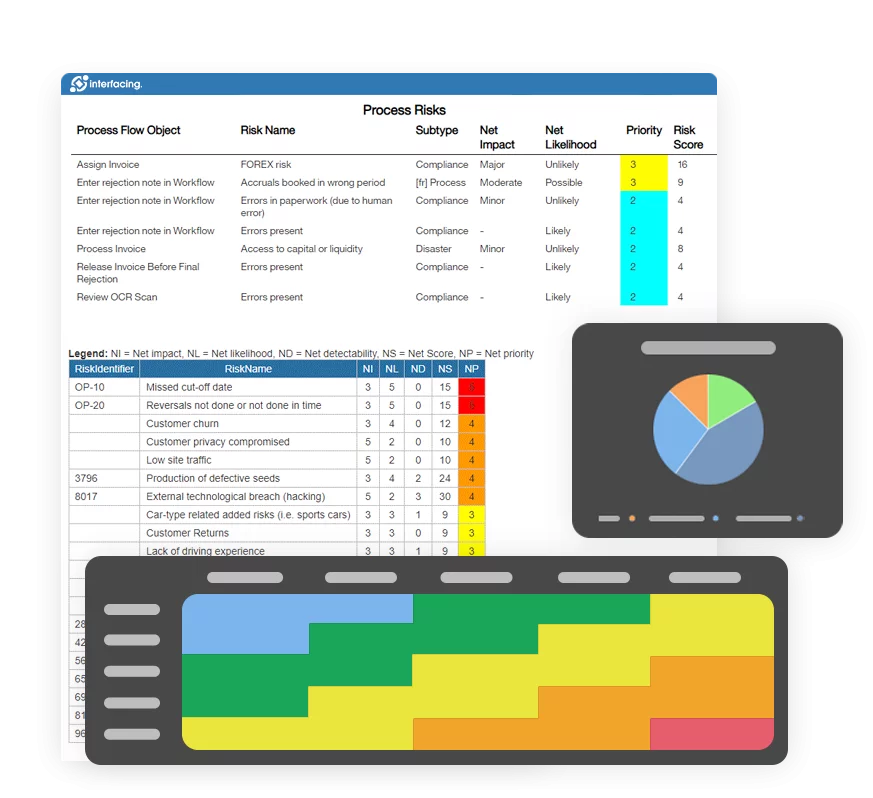
A dashboard might show that risk exposure has increased. A heat map may identify several red risks. A control report may show overdue assessments.
Those outputs answer what is happening.
A connected DTO helps address the more difficult question:
Why is it happening, and what else does it affect?
That distinction matters.
If a control effectiveness score deteriorates, leaders may need to know whether the issue originates with the control itself, the process in which it operates, a system change, a resource constraint, an overdue training requirement, a supplier issue or a change in regulatory expectations.
Without relationships between those elements, teams investigate them separately.
With a connected operating model, they can analyze the underlying dependencies.
This is where DTO technology begins to complement GRC rather than simply duplicate it.
Continuous GRC Requires More Than Periodic Assessments
Many governance programs still operate primarily through cycles.
Risk reviews are performed quarterly or annually. Controls are tested according to scheduled frequencies. Policies receive periodic reviews. Audits provide snapshots of compliance at a particular point in time.
Those activities remain necessary, but they can leave gaps between formal assessments.
Operational conditions change continuously.
Processes are modified. Employees move roles. Suppliers change. Applications are upgraded. Regulations evolve. Controls are redesigned. New products are introduced. Business continuity assumptions become outdated.
A risk score captured six months ago may no longer reflect the current environment.
Connecting risk and control indicators to the operating model creates an opportunity to move toward more continuous awareness.
KRIs and KCIs can provide signals that the underlying exposure or control environment is changing. Workflow events, audit findings, quality events, performance indicators and external data can add further context.
The goal is not to eliminate formal risk assessment.
The goal is to make formal assessment part of a wider governance system that is capable of detecting when the assumptions behind the assessment have changed.
Scenario Testing Extends GRC Beyond Monitoring
There is another limitation to conventional GRC.
It generally evaluates current exposure.
Executives also need to understand the possible consequences of decisions that have not happened yet.
Suppose management is considering replacing a critical application, consolidating two facilities, changing a supplier, outsourcing a process or automating a regulated activity.
The decision may appear attractive from a cost or efficiency perspective.
But it could also alter risk exposure, control effectiveness, segregation of duties, business continuity, resource requirements, regulatory obligations and service performance.
A DTO provides the structure for evaluating those potential impacts before implementation.
Because processes, systems, resources, risks, controls and performance measures are connected within the operating model, organizations can use scenario testing and simulation to examine possible consequences before committing to the change.
Interfacing’s DTO strategy includes scenario analysis and simulation specifically for this reason. The purpose is not simply to represent the enterprise digitally, but to use that representation as a decision system.
For GRC leaders, that represents an important shift.
Risk management becomes part of decision design rather than an assessment applied after the decision has largely been made.
AI Can Strengthen GRC, but It Still Needs Governance Context
AI can help organizations interpret increasingly complex governance information.
It can assist with dependency analysis, impact identification, pattern recognition, document analysis and recommendations. It can help teams surface relationships that would be difficult to review manually across thousands of processes, controls, policies and requirements.
But AI does not eliminate the need for governance.
An AI system may suggest that a new regulation affects a particular SOP. It can identify semantic similarities or probable dependencies. That recommendation still needs to be evaluated against approved relationships, ownership, organizational context and regulatory interpretation.
The same principle applies to risk and controls.
AI can assist the analysis.
Human decision-makers remain responsible for reviewing the implications, challenging assumptions, deciding whether the recommendation is valid and approving the resulting action.
Interfacing’s human-in-the-loop DTO approach deliberately keeps review, approval and accountability inside this process. AI-assisted analysis is used to increase visibility and analytical depth, while consequential governance decisions remain controlled by responsible people.
That distinction becomes increasingly important as organizations apply AI to GRC.
The objective should not be autonomous compliance.
It should be better-informed governance.
Executive Reality Check
A mature GRC program should be able to do more than produce a risk register, control inventory and audit report.
Executives should be able to understand how a major risk enters the operating model, which processes create the exposure, which controls mitigate it, who owns those controls, which regulations apply, what evidence demonstrates effectiveness and what other parts of the organization could be affected if conditions change.
If answering those questions requires manually reconciling several applications, spreadsheets and document repositories, the organization has GRC information but not necessarily a connected governance model.
A DTO addresses that structural problem.
Its value is not simply that it contains more information. Its value comes from connecting the information already used to govern the organization.
How Interfacing Can Help
Interfacing provides the operational foundation required to turn connected GRC from a concept into a working management system.
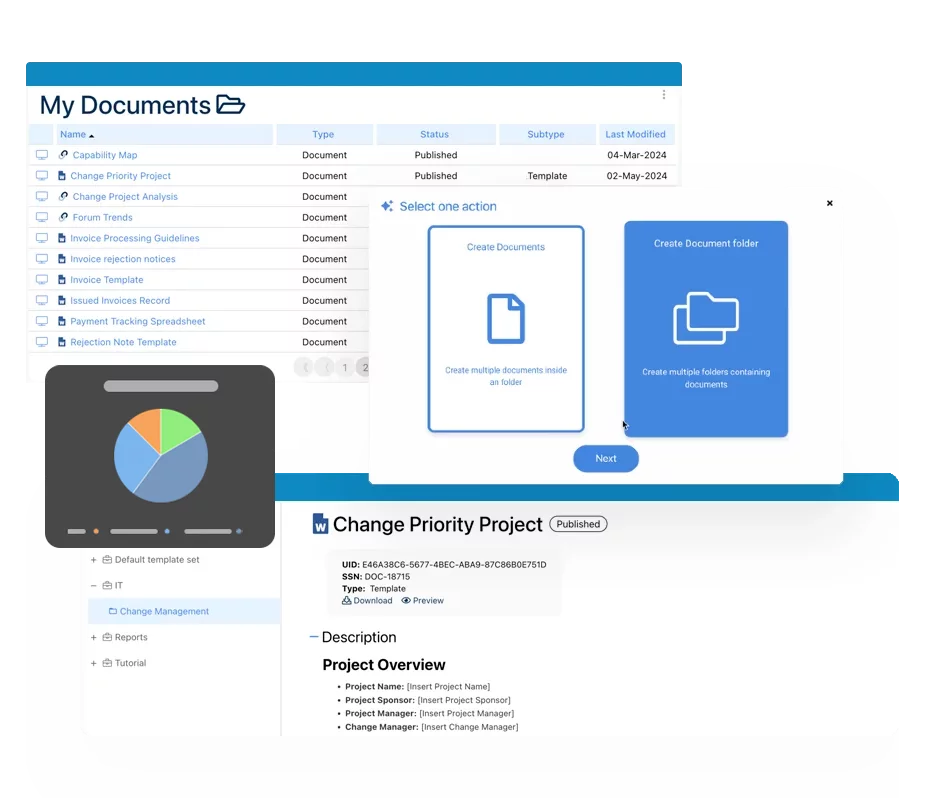
The Interfacing Integrated Management System brings together GRC, BPM, risk and control management, regulatory management, quality, document and records governance, audit management, training, business continuity, analytics and low-code workflow automation within a shared platform. These capabilities are not treated as isolated applications sitting beside one another. They can be connected through the same governed operating model.
That matters because the GRC challenge described throughout this article is fundamentally a relationship problem.
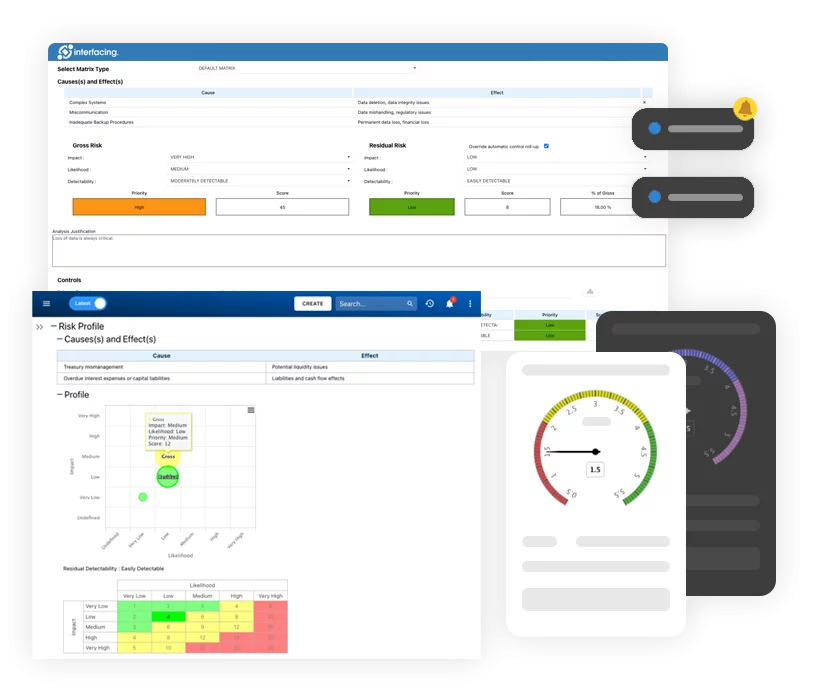
Interfacing allows organizations to connect risks and controls directly to processes, roles, systems, assets, suppliers, policies, procedures and regulatory requirements. Risk assessments can therefore reflect the operational context in which the exposure actually exists rather than relying only on enterprise averages or disconnected registers.
The platform also provides the governance mechanisms required to act on that information. Ownership, endorsement and approval workflows, electronic signatures, change requests, periodic reviews, audit trails, version control, training assignments and read confirmations can all become part of the same lifecycle.
When a requirement changes, teams can assess the downstream impact on related procedures, controls, processes and training. When a process changes, they can identify affected risks, requirements and documents. When a KRI or KCI moves outside an acceptable threshold, the issue can be connected to the underlying operating context and routed into a governed remediation workflow.
This is where Interfacing’s DTO capability extends the value of conventional GRC.
The connected operating model provides visibility into dependencies across processes, systems, people, risks, controls, policies and performance. AI-assisted impact analysis can help identify potentially affected objects. Process mining can compare documented processes against actual execution. Simulation can help teams test alternative scenarios before changes are implemented. Dashboards and analytics provide ongoing visibility into risk, control, compliance and performance conditions.
Together, these capabilities allow organizations to move away from fragmented GRC administration toward a more integrated governance environment where risk, compliance and operational execution are managed as parts of the same system.
For highly regulated and operationally complex organizations, that is the practical value of combining GRC with a Digital Twin of an Organization.
It creates a governed digital representation not only of what the organization is required to do, but of how those requirements are implemented, where risks arise, how controls operate and what may be affected when the organization changes.
Frequently Asked Questions
What is a DTO for GRC?
A DTO for GRC is a Digital Twin of an Organization that connects governance, risk and compliance information with the operating model. Risks, controls, regulations, policies and assessments can be related directly to processes, systems, roles, assets, documents and performance measures.
How is a DTO different from traditional GRC software?
Traditional GRC software primarily manages governance records such as risks, controls, requirements, audits and issues. A DTO adds operational context by modeling how those objects relate to the processes, resources, systems and organizational structures where governance is actually implemented.
How does a Digital Twin improve risk management?
A Digital Twin can connect risks to the specific processes, systems, assets, controls and organizational units where the exposure exists. This helps organizations understand how the same risk may have different likelihood, impact or residual exposure across different operational contexts.
Can a DTO help with control management?
Yes. Controls can be connected to the risks they mitigate, the process activities where they operate, the systems supporting them, the owners responsible for them and the requirements that make them necessary. This improves traceability and change impact analysis.
How does a DTO support regulatory compliance?
Regulatory requirements can be connected to policies, procedures, processes, controls, systems, training and evidence. When a requirement changes, those relationships can help identify potentially affected areas and support governed remediation workflows.
Can a DTO support continuous risk monitoring?
A connected operating model can incorporate KRIs, KCIs, workflow events, audit findings, quality events and performance indicators. These signals can help organizations identify changing risk or control conditions between formal assessment cycles.
What role does AI play in DTO-based GRC?
AI can assist with dependency analysis, impact identification, pattern detection and recommendations across connected governance information. Human reviewers should remain responsible for interpreting recommendations, evaluating business context and approving consequential decisions.
Can a DTO help organizations test GRC impacts before a change?
Yes. Scenario testing and simulation can help organizations assess how proposed changes to processes, systems, suppliers, resources or controls may affect risk exposure, compliance obligations and operational performance before implementation.
Why Choose Interfacing?
With over two decades of AI, Quality, Process, and Compliance software expertise, Interfacing continues to be a leader in the industry. To-date, it has served over 500+ world-class enterprises and management consulting firms from all industries and sectors. We continue to provide digital, cloud & AI solutions that enable organizations to enhance, control and streamline their processes while easing the burden of regulatory compliance and quality management programs.
To explore further or discuss how Interfacing can assist your organization, please complete the form below.

Documentation: Driving Transformation, Governance and Control
• Gain real-time, comprehensive insights into your operations.
• Improve governance, efficiency, and compliance.
• Ensure seamless alignment with regulatory standards.

eQMS: Automating Quality & Compliance Workflows & Reporting
• Simplify quality management with automated workflows and monitoring.
• Streamline CAPA, supplier audits, training and related workflows.
• Turn documentation into actionable insights for Quality 4.0

Low-Code Rapid Application Development: Accelerating Digital Transformation
• Build custom, scalable applications swiftly
• Reducing development time and cost
• Adapt faster and stay agile in the face of
evolving customer and business needs.
AI to Transform your Business!
The AI-powered tools are designed to streamline operations, enhance compliance, and drive sustainable growth. Check out how AI can:
• Respond to employee inquiries
• Transform videos into processes
• Assess regulatory impact & process improvements
• Generate forms, processes, risks, regulations, KPIs & more
• Parse regulatory standards into requirements

Request Free Demo
Document, analyze, improve, digitize and monitor your business processes, risks, regulatory requirements and performance indicators within Interfacing’s Digital Twin integrated management system the Enterprise Process Center®!
Trusted by Customers Worldwide!
More than 400+ world-class enterprises and management consulting firms