Risk management becomes difficult when risk is documented separately from the operations that create it.
A Digital Twin of an Organization changes that relationship. Instead of viewing risks as isolated entries in a register, organizations can connect risk to processes, controls, systems, roles, suppliers, performance measures and operational dependencies. The result is not simply better risk reporting. It is a more realistic picture of where exp
Risk Management Has a Context Problem
Most organizations do not have a shortage of identified risks.
They have operational risks, compliance risks, supplier risks, cybersecurity risks, quality risks, financial risks, business continuity risks and strategic risks. Risk teams assess them, score them, assign owners and review them according to established schedules.
The harder problem is understanding what those risks actually mean inside the operating environment.
Consider something as common as supplier failure.
An enterprise-level risk register may assign supplier failure a likelihood, impact, owner and mitigation strategy. But the real exposure can differ dramatically depending on which supplier, product, process, facility, customer obligation or regulatory requirement is involved.
The same risk can therefore be relatively minor in one process and critical in another.
A Digital Twin of an Organization provides the structure needed to understand that difference because it represents the relationships between the elements that make the organization operate. Interfacing describes a DTO as a connected representation of processes, roles, controls, documents, risks, systems and governance relationships rather than simply a visualization or reporting layer.
That distinction becomes particularly important for risk management.
A Risk Register Tells You What the Risk Is. A DTO Shows Where It Matters.
A traditional risk register remains useful. The problem arises when it becomes the primary model through which the organization understands risk.
We explored that limitation separately in Why Risk Registers Fail Without Process Context. A risk register may identify a threat, assign ownership and record inherent or residual risk. What it often cannot show is the full operational environment surrounding that risk.
A DTO adds that context.
A risk can be connected to the process where it appears, the control intended to mitigate it, the system supporting the process, the person accountable for the control, the SOP governing execution, the regulatory requirement driving the control and the performance indicators showing whether conditions are deteriorating.
The question therefore changes from:
What is our risk score?
to:
Where is this risk occurring, what is influencing it, which controls are protecting us and what happens if something changes?
That is a much more useful governance question.
Risk Is Part of the Operating Model, Not a Separate Layer
A major weakness in enterprise risk management is that risk is often governed separately from the operational environment that creates it. Risk teams maintain risk registers and assessment frameworks, process teams document workflows, quality teams manage deviations and CAPAs, compliance teams track obligations, and IT manages applications and technical controls. Each function may be well managed on its own, yet the relationships between them can remain difficult to see.
That separation matters because risk is rarely confined to a single function. A control may depend on a particular system, a regulated process may rely on a specific supplier, or a quality issue may expose weaknesses in training, documentation, ownership, or process design. When those relationships are managed in separate systems or repositories, understanding the full impact of a change often requires manual investigation across multiple teams.
A Digital Twin of an Organization addresses this by placing risk within the same operating model as the processes, systems, roles, controls, regulations, policies, quality events, and performance measures that influence it. Interfacing’s DTO approach uses its Integrated Management System to connect these elements so operational and performance information can be evaluated in context rather than treated as a collection of unrelated records.
This becomes especially important during change. Redesigning a process, replacing a system, changing a supplier, modifying a control, revising a regulatory requirement, or losing a key resource can all alter the organization’s risk exposure. A connected operating model makes those dependencies visible, helping decision-makers understand not only what changed, but where the consequences may appear elsewhere in the organization.

A DTO Makes Risk Dependencies Visible
This is where the digital twin becomes particularly valuable.
The purpose is not merely to create more relationships between data. It is to make dependencies understandable enough that leaders can evaluate consequences before acting.
Suppose a critical application is scheduled for replacement.
From an IT perspective, the project may appear straightforward. But that application could support regulated processes, generate audit evidence, enforce controls, retain required records or provide data used by risk indicators.
Replacing it could therefore affect:
- operational processes and responsibilities
- preventive or detective controls
- compliance obligations
- procedures and training
- business continuity requirements
- audit evidence
- KRIs, KCIs and KPIs
- residual risk calculations
A connected DTO makes those relationships easier to identify before the change is approved.
Interfacing’s dependency-modeling approach is designed around this principle. Processes, documents, regulations, risks, controls, roles, systems, training, quality events and performance indicators can be related within the operating model so upstream and downstream impacts can be assessed rather than reconstructed after an incident.
That turns risk management into part of change governance.
From Periodic Risk Assessment to Continuous Risk Awareness
Traditional risk programs are often built around scheduled reviews. Risks may be reassessed quarterly, annually, or after a significant event, with updated scores and mitigation plans recorded at each stage. That approach provides structure, but it can also create a lag between what is happening in operations and when the risk profile is formally reviewed.
For organizations operating in dynamic or highly regulated environments, that lag matters. Control effectiveness can weaken between review cycles, supplier performance can deteriorate, and process exceptions can begin to accumulate long before the next formal assessment. By the time a scheduled review takes place, the underlying conditions may already have changed materially.
A Digital Twin of an Organization can help reduce that gap by connecting risk to the operational indicators that influence it. Key Risk Indicators can provide early signs that exposure is increasing, while Key Control Indicators can show whether controls continue to perform as intended. Process, quality, supplier, and performance data can add further context, creating a more current view of the conditions surrounding a risk.
Interfacing’s risk and control model supports this approach by linking risks and controls to the broader operating model, including qualitative and quantitative indicators and relationships between risk, process, and control information.
The value is not simply more frequent measurement. It is the ability to interpret changes in operational data within the context of the risks they may affect. That allows risk management to become more responsive, with reassessment driven by meaningful changes in operating conditions rather than by the calendar alone.
The Digital Twin Also Changes Residual Risk
Residual risk is often treated as a score updated during an assessment.
But if control effectiveness or operational conditions change, why should residual risk remain static until someone manually reassesses it?
A more connected model can use risk indicators, control indicators and other performance information to provide a more current picture of exposure.
This does not mean allowing an algorithm to decide organizational risk tolerance.
Human judgment remains essential.
What technology can do is surface the evidence that decision-makers need: changing indicators, weakening controls, connected incidents, affected processes and emerging dependencies.
That aligns with Interfacing’s broader human-in-the-loop DTO approach. AI-assisted analysis can identify dependencies, patterns and potential impacts, while people remain responsible for evaluating tradeoffs, accepting risk and approving consequential actions.
Scenario Testing Makes Risk Management More Forward-Looking
Understanding current exposure is only part of effective risk management. Leaders also need a way to evaluate how proposed changes could alter that exposure before those changes are implemented.
This is where simulation and scenario testing add another layer of value to a Digital Twin of an Organization. Rather than assessing risk only after a decision has been made, a DTO can provide the operational context needed to examine potential consequences in advance.
For example, an organization may be considering consolidating facilities, replacing a critical supplier, or automating part of a regulated process. Each option may appear attractive when viewed through a cost, efficiency, or transformation lens. But the decision can also affect process capacity, control coverage, segregation of duties, recovery capability, supplier concentration, regulatory obligations, employee responsibilities, and downstream service levels.
Evaluating those impacts separately can make it difficult to see how one change creates consequences elsewhere. A connected DTO provides a common operating model in which those dependencies can be examined together.
That makes scenario testing useful not only for operational planning, but for risk governance. Decision-makers can compare alternatives, identify where exposure may increase, and understand which controls or dependencies may require attention before moving forward.
In that sense, risk management becomes part of the design of the decision itself, rather than a review performed after the organization has already committed to a course of action.
Executive Reality Check
A risk heat map can tell leadership which risks have been classified as high, medium or low.
It cannot automatically tell them why the exposure changed.
That distinction matters.
If leaders cannot trace a material risk back to the processes, systems, suppliers, controls, responsibilities and performance conditions driving it, then the organization has risk reporting without complete risk intelligence.
A Digital Twin of an Organization should close that gap.
The goal is not to create a more sophisticated risk register. It is to create an operating model where risk can be understood in context, monitored through evidence and evaluated whenever the organization changes.
How Interfacing Helps
Interfacing’s Integrated Management System provides the governed operating foundation for a Digital Twin of an Organization, connecting risk management with the processes and enterprise objects that determine real operational exposure.
Rather than maintaining risks independently from operations, organizations can connect risks and controls to processes, roles, systems, regulations, policies, documents, suppliers, quality events and performance measures.
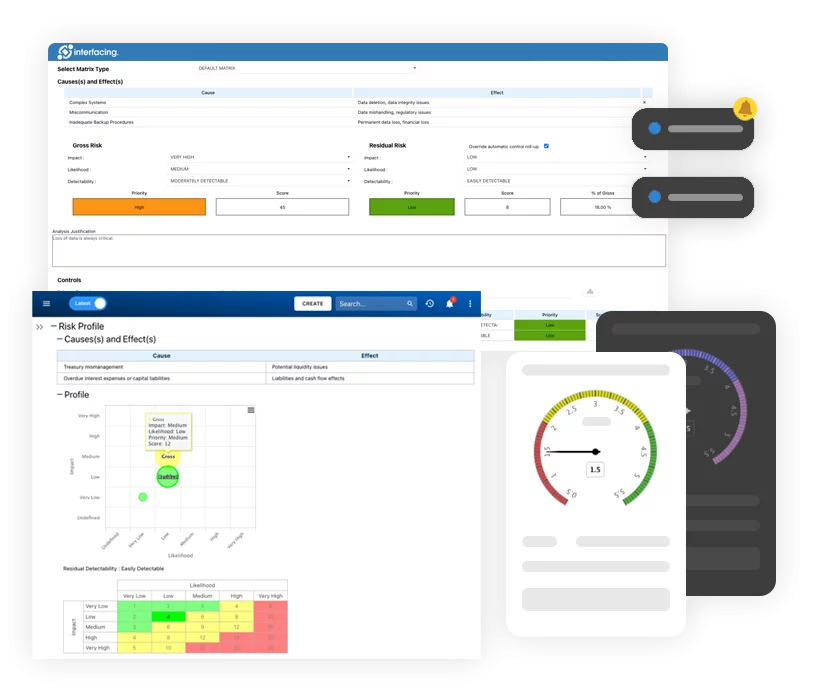
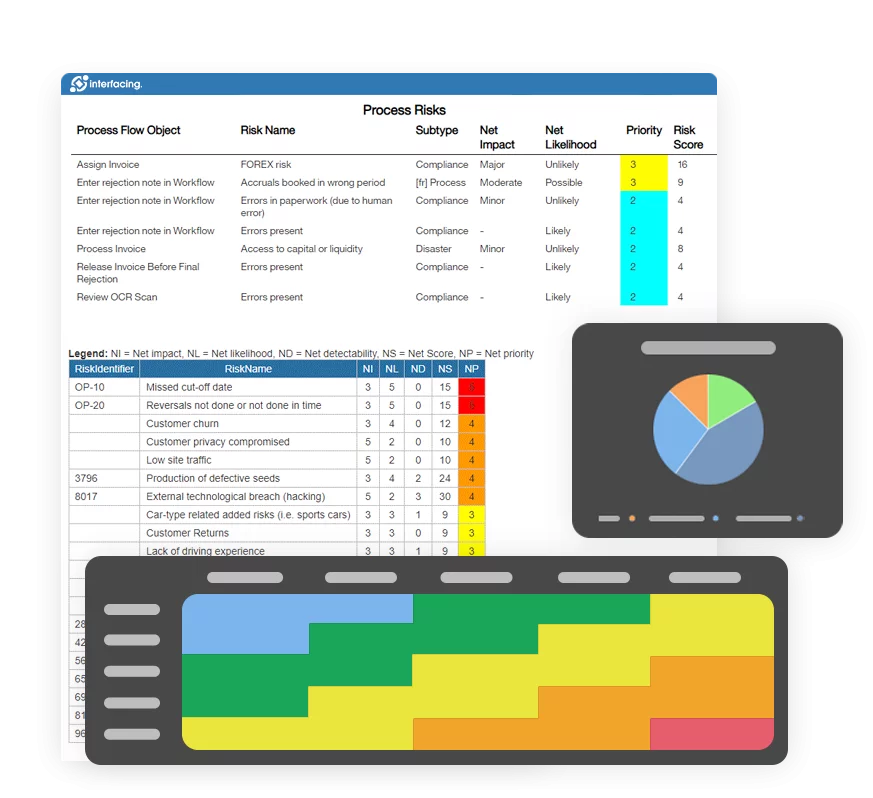
The platform supports risk and control management, process-oriented assessment, configurable governance workflows, dashboards and analytics within the broader IMS environment.
This connected approach can help organizations:
- assess the same risk differently depending on its operational context
- connect preventive and detective controls directly to processes
- establish ownership and accountability
- monitor KRIs and KCIs against defined thresholds
- investigate incidents and quality events within their broader risk context
- identify upstream and downstream dependencies when change occurs
- evaluate scenarios before implementing operational changes
- use AI-assisted analysis to surface relationships and potential impacts while retaining human approval
The result is not risk management operating beside the organization.
It is risk management operating inside the organization’s digital model.
From Risk Documentation to Risk Intelligence
The next stage of risk management is not another dashboard.
It is better context.
Organizations need to understand not only which risks have been identified, but where those risks exist, which controls influence them, what evidence demonstrates control effectiveness and how exposure may change when the organization changes.
A Digital Twin of an Organization provides the connective structure required to make that possible.
When processes, risks, controls, systems, people, suppliers, requirements and performance measures are represented as parts of the same operating model, risk stops being a periodic reporting exercise.
It becomes part of how the organization sees, governs and changes itself.
Frequently Asked Questions
What is a Digital Twin for risk management?
A Digital Twin for risk management connects risks and controls to the operating environment where they exist, including processes, systems, roles, suppliers, regulations and performance indicators. This provides more operational context than managing risks as isolated entries in a register.
How is a DTO different from a risk register?
A risk register records identified risks, ownership, assessments and mitigation information. A Digital Twin of an Organization adds relationships between those risks and the processes, controls, systems, people and dependencies that influence actual exposure.
Can a Digital Twin replace a risk management system?
A DTO should not be viewed simply as a replacement for a risk register or GRC application. Its greater value is providing an interconnected operating model in which risk management can be integrated with process, compliance, quality, performance and change governance.
How does a DTO help monitor risk continuously?
Risks can be connected with KRIs, control indicators, process measures and other operational information. Changes in those indicators can help organizations identify deteriorating conditions or control weaknesses instead of relying exclusively on scheduled reassessments.
Can a DTO calculate residual risk?
A connected DTO can support residual-risk assessment by incorporating changing risk and control information into the operating context. Risk acceptance and consequential decisions should remain governed by accountable human decision-makers.
How does a Digital Twin help with risk mitigation?
A DTO can show where a risk occurs, which controls address it, who owns those controls and what related processes, systems or policies may need to change. This allows mitigation plans to target the operational causes and dependencies associated with the risk.
How does scenario testing improve risk management?
Scenario testing allows organizations to evaluate how a proposed operational change could affect processes, resources, controls, performance and exposure before implementation. This brings risk analysis earlier into the decision-making process.
How can AI support DTO risk management?
AI-assisted analysis can help identify relationships, detect patterns, analyze dependencies and surface potential impacts across the operating model. Human decision-makers should remain responsible for interpreting those findings, determining risk tolerance and approving consequential actions.
Why Choose Interfacing?
With over two decades of AI, Quality, Process, and Compliance software expertise, Interfacing continues to be a leader in the industry. To-date, it has served over 500+ world-class enterprises and management consulting firms from all industries and sectors. We continue to provide digital, cloud & AI solutions that enable organizations to enhance, control and streamline their processes while easing the burden of regulatory compliance and quality management programs.
To explore further or discuss how Interfacing can assist your organization, please complete the form below.

Documentation: Driving Transformation, Governance and Control
• Gain real-time, comprehensive insights into your operations.
• Improve governance, efficiency, and compliance.
• Ensure seamless alignment with regulatory standards.

eQMS: Automating Quality & Compliance Workflows & Reporting
• Simplify quality management with automated workflows and monitoring.
• Streamline CAPA, supplier audits, training and related workflows.
• Turn documentation into actionable insights for Quality 4.0

Low-Code Rapid Application Development: Accelerating Digital Transformation
• Build custom, scalable applications swiftly
• Reducing development time and cost
• Adapt faster and stay agile in the face of
evolving customer and business needs.
AI to Transform your Business!
The AI-powered tools are designed to streamline operations, enhance compliance, and drive sustainable growth. Check out how AI can:
• Respond to employee inquiries
• Transform videos into processes
• Assess regulatory impact & process improvements
• Generate forms, processes, risks, regulations, KPIs & more
• Parse regulatory standards into requirements

Request Free Demo
Document, analyze, improve, digitize and monitor your business processes, risks, regulatory requirements and performance indicators within Interfacing’s Digital Twin integrated management system the Enterprise Process Center®!
Trusted by Customers Worldwide!
More than 400+ world-class enterprises and management consulting firms