

Enterprise AI is quickly moving beyond answering questions and summarizing documents. AI-enabled agents are increasingly being considered for work that touches processes, systems, decisions and operational workflows. That makes access to information only the beginning of the problem. The harder question is whether an AI agent has enough organizational context to recognize not only how work happens, but also the governance boundaries that determine what should happen next.
More Enterprise Data Does Not Automatically Create Better AI Decisions
A common assumption behind enterprise AI adoption is that better access to organizational information will produce better results. Connect an AI system to procedures, policies, databases, process repositories and applications, and it should become increasingly capable of supporting the business.
There is truth in that idea, but it overlooks an important distinction between information and operational context.
An AI agent might retrieve the correct procedure governing a quality event. It might identify the workflow associated with that procedure and even recognize the systems used during execution. Yet that information alone may not explain why a particular approval exists, who has authority to make the decision, what regulatory requirement drives the control, whether segregation of duties applies or what other parts of the organization would be affected by a change.
This becomes increasingly important as AI moves from information retrieval toward participation in enterprise work.
An agent that summarizes an SOP creates a very different governance problem from an agent that recommends modifying the SOP, initiates a corrective action, assigns responsibilities or triggers another workflow.
The difference is not primarily intelligence. It is authority and accountability.
Interfacing has explored this broader issue through its work on the relationship between AI agents and the organizational operating model. The premise is straightforward: an agent participating in enterprise operations requires more than isolated documents and records. It needs connections between the elements that define how the organization operates.
Process Context Is Necessary, but It Does Not Define Authority
Process context is one of the most valuable forms of context an enterprise can provide to AI.
A process model can show how work moves from one activity to another, who participates, where handoffs occur and where decisions are made. Process hierarchies can provide additional depth, connecting high-level value streams to subprocesses, activities, procedures and individual tasks.
But a process model does not necessarily explain the complete governance environment surrounding those activities.
Consider a corrective and preventive action process. The workflow may show investigation, root cause analysis, corrective action, effectiveness review and closure. An AI-assisted system examining the workflow could potentially identify delays or suggest changes intended to improve cycle time.
Yet an apparently inefficient approval might exist because it provides an important control. A required review may protect segregation of duties. A document retention step may exist because of regulatory obligations. A training activity might be necessary before a revised procedure becomes effective.
If the AI sees only workflow efficiency, removing one of those steps might appear sensible.
If it sees the surrounding governance context, the same recommendation can look very different.
This illustrates the limitation of treating process context as the complete answer to enterprise AI readiness.
A process explains how work is structured. Governance explains the conditions under which that work is controlled.
The Missing Layer Is the Relationship Between Information
Organizations have invested heavily in knowledge management, enterprise search and document repositories. More recently, retrieval-augmented generation has made it possible for AI systems to search internal information and use that material when responding to users.
These technologies can solve an important problem: finding the right information.
They do not automatically solve another one: understanding how that information relates to everything around it.
An SOP, for example, is not just a file. In a regulated operating environment it may be connected to a process, process owner, employee role, regulatory requirement, control, risk, training obligation, supporting application, quality event and approval lifecycle.
Those relationships provide meaning that cannot always be inferred reliably from the document itself.
This is why a Digital Twin of an Organization becomes strategically important. Interfacing’s DTO approach connects processes with roles, systems, documents, risks, controls, regulatory requirements, capabilities, resources and performance information instead of treating each as an isolated record. Its DTO model also incorporates the relationships and interdependencies that exist across the wider operating environment.
Digital Twin Dependency Modeling for Change Impact
The distinction matters because real organizational changes rarely remain confined to the object that was originally changed.
A regulatory revision can affect processes, procedures, controls, training and evidence requirements. A system replacement can affect process execution, business continuity and compliance controls. A process redesign can alter responsibilities, risk exposure and downstream quality requirements.
Providing AI with a document may explain the immediate issue.
Providing AI with the connected operating model can help reveal the consequences surrounding that issue.

Agentic AI Makes Governance Context More Important
The governance problem becomes more significant as AI systems gain the ability to interact with enterprise workflows and applications.
Traditional AI assistance is primarily informational. A user asks a question and receives a response.
Agentic approaches introduce a different possibility. An AI-enabled agent may participate in a sequence of activities, interact with tools, prepare recommendations or initiate permitted actions as part of a wider workflow.
At that point, organizations need to define more than what information an agent can access.
They also need to determine what it can recommend, what it can initiate, what it can modify, which actions require approval, what evidence must be retained and who remains accountable for the outcome.
That is not simply an AI configuration issue. It is an organizational governance issue.
Interfacing’s current thinking around AI agent decision authority makes this boundary explicit. An agent may have access to information without having reliable visibility into the ownership, controls and decision rights surrounding that information. Connecting AI-assisted activity to an operating model helps expose those relationships rather than assuming that access equals authority.
AI Agent Governance: Who Has Decision Authority?
This is particularly relevant in regulated environments, where organizations must often demonstrate not simply what decision was made, but why it was made, who approved it and which policies or requirements governed the decision.
A DTO Can Become Context Infrastructure, Not Just a Visualization
Digital Twin of an Organization has often been understood as a way to create a richer representation of the enterprise.
That remains useful, but the emergence of AI changes the potential role of the model.
When the DTO connects processes, responsibilities, capabilities, resources, systems, regulations, risks, controls and performance information, it can provide a structured environment through which both humans and AI-assisted systems can interpret organizational relationships.
Interfacing’s documented DTO capabilities reflect this broader model. Its orchestration repository is designed to consolidate processes, capabilities, resources and stakeholders into an integrated operating-model context, supporting cross-model analysis, traceability and governance. The same DTO framework can connect risk and control information, operational measurements, simulation and process intelligence with that operating context.
This moves the discussion beyond simply asking whether AI has access to the right data.
The more meaningful question becomes whether AI is operating against a representation of the organization that includes the dependencies, controls and responsibilities that make the data operationally meaningful.
Governance Context Does Not Mean Autonomous Decision-Making
There is an important boundary here.
Better organizational context does not make an AI agent infallible, nor should it imply that human responsibility disappears.
An AI-assisted system may identify relationships faster than a person could manually. It may surface potential impacts, detect patterns, summarize evidence or recommend areas requiring attention. None of those capabilities eliminate the need for verification, approval and accountable ownership.
For regulated organizations in particular, the goal should not be to create the maximum possible autonomy.
The goal should be to determine where AI can improve analysis and execution while keeping decision authority, governance and accountability visible.
This is also why human-in-the-loop governance remains important. AI can contribute insight while designated people retain responsibility for review and action.
The strongest enterprise AI architecture may therefore not be the one that removes the most human involvement. It may be the one that makes the boundary between AI assistance and human authority easiest to define, monitor and audit.
Executive Reality Check
Organizations should be cautious about confusing AI connectivity with AI readiness.
Connecting an agent to SharePoint, an ERP, a QMS and a process repository may create impressive access to information, but access alone does not reveal why controls exist, who owns decisions or what dependencies surround a proposed action.
The more consequential an AI-supported task becomes, the more important those relationships become.
Executives considering agentic AI should therefore ask a more difficult question:
Can the organization provide AI with governed operational context, or is that context still distributed across systems, documents, spreadsheets and institutional knowledge?
If the answer is the latter, the AI may have access to enormous amounts of enterprise information while still operating with an incomplete representation of the business.
The Next Enterprise AI Question Is Not “What Can the Agent Do?”
Early enterprise AI initiatives focused heavily on capability. Can the system answer questions? Can it summarize documents? Can it automate a task? Can an agent interact with another application?
Those remain useful questions, but they become less important as the technology matures.
The harder question is whether the organization can explain the operating boundaries around those capabilities.
An agent may know how a workflow functions.
A mature organization also needs it to operate within the context of why the workflow is structured that way, what controls apply, who holds authority and what could be affected if something changes.
That is the transition from enterprise information access to governed enterprise context.
And as AI agents become more deeply involved in operational work, that context may become one of the most important foundations organizations can build.
How Interfacing Helps Build Governed Enterprise Context
Interfacing’s AI-Integrated Management System brings process management, quality management, risk and compliance, document control, operational information and workflow automation into a connected environment. Rather than treating these disciplines as independent repositories, the platform is designed to establish relationships across the operating model.
Interfacing AI-Integrated Management System
Processes can be connected with roles and responsibilities, applications, risks, controls, documents, policies, regulatory requirements, training, KPIs, quality events and workflow governance.
That connected structure is significant for AI-assisted operations because context is not limited to what an individual document says. It can include where that document sits within the organization, what depends on it and which governance structures surround it.
The same approach also supports broader compliance architectures. Interfacing’s Integrated Management System connects process architecture, document lifecycle management, audit and CAPA workflows, risk and control management, training and regulatory intelligence within a shared and traceable system model.
Hyper-Connected Compliance and IMS
The objective is not to create AI that operates independently of organizational governance.
It is to create an environment where AI-assisted analysis and action can take place within an operating model that already defines ownership, dependencies, controls and accountability.
Frequently Asked Questions
What is governance context for an AI agent?
Governance context is the organizational information that defines the boundaries around an AI-assisted activity. This can include ownership, decision authority, risks, controls, policies, regulatory obligations, approval requirements, segregation of duties and accountability.
Why is process context alone not enough for AI agents?
Process context can explain how work is performed, but it may not fully explain why controls exist, which regulations apply, who can authorize an action or what downstream consequences a change may create. Governance and relationship context provide those additional layers.
How does a Digital Twin of an Organization help enterprise AI?
A DTO can connect processes with people, capabilities, systems, risks, controls, regulations, documents and performance information. This creates a more complete representation of how organizational components depend on one another, which can support AI-assisted analysis and impact assessment.
Does connecting AI to a DTO make the AI autonomous?
No. Better operational context does not remove the need for human review, validation or accountability. AI-assisted capabilities should operate within clearly defined permissions, controls and decision boundaries.
Is a DTO the same thing as a knowledge base or RAG system?
No. A knowledge base or retrieval system primarily helps identify and retrieve relevant information. A DTO focuses on the relationships among operational elements such as processes, roles, systems, risks, controls and regulations. The two approaches can complement each other.
Why is governance particularly important for agentic AI?
Agentic AI may participate in workflows rather than simply answer questions. As AI-supported systems gain the ability to recommend, initiate or interact with enterprise actions, organizations need stronger control over permissions, approvals, traceability and accountability.
Why Choose Interfacing?
With over two decades of AI, Quality, Process, and Compliance software expertise, Interfacing continues to be a leader in the industry. To-date, it has served over 500+ world-class enterprises and management consulting firms from all industries and sectors. We continue to provide digital, cloud & AI solutions that enable organizations to enhance, control and streamline their processes while easing the burden of regulatory compliance and quality management programs.
To explore further or discuss how Interfacing can assist your organization, please complete the form below.

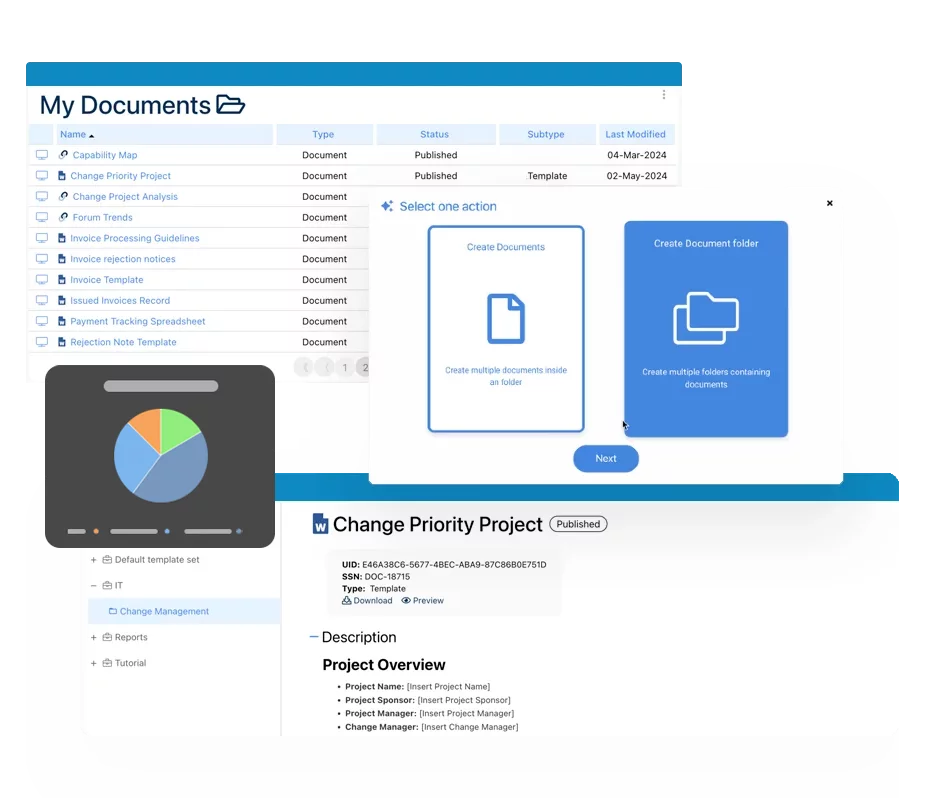
Documentation: Driving Transformation, Governance and Control
• Gain real-time, comprehensive insights into your operations.
• Improve governance, efficiency, and compliance.
• Ensure seamless alignment with regulatory standards.

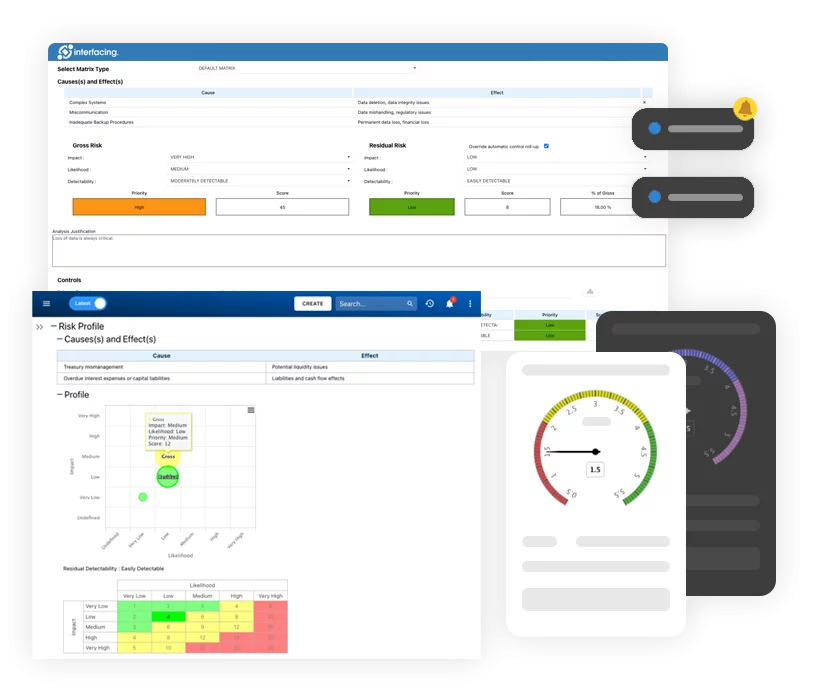
eQMS: Automating Quality & Compliance Workflows & Reporting
• Simplify quality management with automated workflows and monitoring.
• Streamline CAPA, supplier audits, training and related workflows.
• Turn documentation into actionable insights for Quality 4.0

Low-Code Rapid Application Development: Accelerating Digital Transformation
• Build custom, scalable applications swiftly
• Reducing development time and cost
• Adapt faster and stay agile in the face of
evolving customer and business needs.
AI to Transform your Business!
The AI-powered tools are designed to streamline operations, enhance compliance, and drive sustainable growth. Check out how AI can:
• Respond to employee inquiries
• Transform videos into processes
• Assess regulatory impact & process improvements
• Generate forms, processes, risks, regulations, KPIs & more
• Parse regulatory standards into requirements


Request Free Demo
Document, analyze, improve, digitize and monitor your business processes, risks, regulatory requirements and performance indicators within Interfacing’s Digital Twin integrated management system the Enterprise Process Center®!
Trusted by Customers Worldwide!
More than 400+ world-class enterprises and management consulting firms