AI agents are moving beyond answering questions. They can interpret information, use enterprise tools, initiate workflows and increasingly participate in operational decisions. That changes the governance challenge considerably.
The issue is no longer simply whether an AI agent can perform an activity. The more important question is whether the organization has explicitly determined which activities that agent is authorized to perform, where its authority ends, who remains accountable and what evidence must exist afterward.
An AI agent may know what to do. That does not mean it should be allowed to do it.
AI Agent Governance Is Becoming a Question of Authority
For most of the enterprise software era, governance was built around a relatively stable assumption: people made consequential decisions and systems helped them execute those decisions. Roles, permissions, approval workflows and segregation of duties were designed around identifiable human actors.
A quality manager might approve a controlled document. A process owner might authorize a change. A compliance officer might assess the impact of a regulatory requirement. A supervisor might determine whether training was required after a procedure changed. Software supported these actions, but the organizational authority remained clearly attached to a person or role.
AI agents complicate this model because they are beginning to operate between information and action. They do not merely retrieve an SOP or summarize an audit finding. Depending on how they are configured, they can interpret evidence, select tools, initiate workflows and coordinate multiple steps toward an objective.
That makes the governance question different from the one organizations faced with earlier generations of AI. A language model producing an answer creates one category of risk. An AI agent capable of acting on that answer creates another.
The central issue becomes one of delegated authority: what has the organization actually authorized the agent to do?
Access Is Not the Same as Authority
Consider an AI agent assisting a quality team. To be useful, it may need access to deviations, CAPAs, controlled documents, process models, risk assessments, audit findings, training records and regulatory requirements. Giving the agent access to this information may be entirely appropriate.
But access alone does not determine what the agent should be permitted to do with what it discovers.
Suppose the agent identifies a pattern across several deviations and concludes that they may share a common cause. It may be reasonable for the agent to recommend that a CAPA be considered. It may even be reasonable for it to prepare a draft investigation or assemble the supporting evidence.
The governance implications change substantially, however, if the agent is then allowed to create the CAPA, classify its severity, assign investigators, alter the related risk assessment, initiate an SOP revision, assign mandatory training or determine that the corrective action was effective enough to close the case.
Those actions do not represent different levels of technical intelligence. They represent different levels of organizational authority.
A conventional permissions model can establish that an identity is allowed to see a CAPA record or access a controlled document. It does not necessarily answer whether that identity, especially when it is an AI agent, should be authorized to make a business judgment, alter a governed record or initiate a regulated workflow.
That distinction is becoming one of the most important questions in AI agent governance.
The Risk Is Not Simply That AI Makes Decisions
Much of the conversation about AI governance still centers on whether organizations should allow AI to make decisions. That framing is too broad to be particularly useful.
The deeper risk is that organizations may allow AI agents to participate in decisions without ever defining the limits of that participation.
Enterprises have spent decades establishing responsibility structures for people. Job descriptions define responsibilities. RACI models distinguish who is responsible and accountable. Segregation of duties prevents incompatible authorities from being concentrated in one role. Policies establish boundaries. Approval workflows enforce checkpoints. Audit trails provide evidence that those checkpoints occurred.
Yet an AI agent can be inserted into this carefully governed environment without being assigned an equally precise operational role.
That creates a governance gap. The agent may be technically capable of performing an activity for which the organization has never formally granted it authority.
Simply stating that “a human remains accountable” does not resolve the problem. Accountability has to be visible in the way the process operates. The organization must know which decisions the agent can support, which decisions it can initiate, which require human review and which must remain exclusively human.
For consequential business activities, that distinction cannot remain implied.

Human-in-the-Loop Is Not Precise Enough
“Human-in-the-loop” has become one of the most common safeguards used when discussing enterprise AI. It sounds reassuring because it suggests that a person remains involved. In practice, however, the phrase often hides the very governance questions that need to be answered.
A regulated organization needs to know which human is in the loop, where that person enters the workflow and what authority they actually exercise. It also needs to know what evidence the person is expected to review, whether the AI can act before the review occurs and what happens when the person disagrees with the recommendation.
These distinctions matter because not every form of human participation provides meaningful oversight.
Take an AI-assisted regulatory change assessment. An agent might identify a revised regulatory requirement, compare it with existing procedures, identify affected processes and suggest documents that may need to change. That could save substantial time while still keeping qualified people responsible for interpretation.
But there is a meaningful difference between an agent stating that five procedures appear to be affected and an agent determining that those five procedures must be revised.
The first is decision support. The second begins to exercise organizational authority.
A mature governance model needs to make that boundary explicit rather than relying on the vague assurance that a person remains somewhere in the process.
The Missing Layer Is the Operating Model
This is where the AI governance conversation needs to move beyond the model itself.
An AI model can understand language. An agent can use tools. An identity system can control which systems it can access. None of those capabilities, by themselves, explain how the organization actually works.
An operating model provides that missing context because it captures relationships, not merely information.
A process has an owner. Activities are performed by roles and systems. Policies constrain those activities. Regulatory requirements create obligations. Risks threaten objectives. Controls reduce those risks. Documents define expected execution. Quality events expose weaknesses. KPIs reveal performance. Changes in one area can create consequences elsewhere.
An AI agent operating without this context may have access to correct information and still misunderstand the organization around it.
For example, an agent may accurately identify that an SOP contains a particular requirement. That does not mean it understands which process the SOP governs, which roles are affected, which risk controls depend on it, which training obligations would be triggered by a revision or which downstream procedures would also require review.
This is why AI agents need a connected operating model. The value of the operating model is not simply that it gives AI more data. It gives AI the organization’s own context for how responsibilities, dependencies and governance fit together.
AI Agents Need Operational Roles, Not Just Digital Identities
Organizations already understand that a human role is more than a user account.
A Quality Manager is not defined merely by the ability to log in to a QMS. The role carries responsibilities, authority, limitations, relationships and accountability. The same principle should increasingly apply to AI agents.
An agent assisting deviation investigations, for instance, should have a clearly defined purpose and a corresponding boundary around its authority. It may be allowed to retrieve evidence, compare previous investigations, identify patterns, suggest likely causes and draft corrective actions. It may be permitted to create a draft CAPA when predefined conditions are met.
At the same time, the organization may determine that the agent cannot approve the CAPA, alter the final risk classification, approve a controlled document or complete an effectiveness verification.
That distinction creates something more meaningful than technical permission. It creates an operational definition of the agent’s role.
The organization can then answer not only what the agent can access, but what it may recommend, what it may initiate, what it may execute and where a human role must assume responsibility.
In effect, the organization is creating an operational contract between the AI agent and the business.
Decision Rights Should Follow Risk, Not Capability
Another assumption deserves scrutiny: as AI agents become technically capable of doing more, organizations may feel pressure to expand their authority accordingly.
That would be a mistake.
The boundary of authority should be determined by risk and consequence, not by the outer limits of what the technology can technically accomplish.
A reversible administrative action may require very little human intervention. A decision affecting product quality, compliance, patient safety, financial reporting, customer rights or regulatory evidence may require much stronger controls.
This suggests that organizations need to think in terms of graduated authority.
At one end of the spectrum, an agent may simply observe and analyze information. At the next level, it may recommend an action while leaving the decision to a person. It may then be allowed to initiate a governed workflow under predefined conditions. Only in carefully defined circumstances might it be permitted to execute an action without prior human approval.
The exact model will differ by organization and use case. What matters is that the progression is deliberate.
Authority should never expand merely because technical capability has expanded.
This becomes even more important when agents interact with other agents. An initial request may pass through several systems and automated actors before producing a final action. If Agent A requests work from Agent B, which updates System C and triggers Workflow D, governance cannot stop at the first interaction.
The organization needs visibility across the entire chain of action.
Agentic AI Exposes Governance Weaknesses That Already Exist
It is tempting to frame these issues as entirely new problems created by AI. In many cases, however, AI agents are exposing weaknesses that organizations have tolerated for years.
A process may have no clearly identified owner. The same policy may exist in several repositories. An SOP may describe one version of a process while employees execute another. A control may sit in a GRC system without a clear connection to the process where it actually operates. A regulatory requirement may be linked to a policy but not to the training, systems or procedures affected by a change.
Human employees often compensate for these gaps through experience, institutional knowledge, emails, meetings and informal judgment. They know which colleague to ask or which unwritten exception applies.
An AI agent cannot safely be expected to reconstruct all of that invisible context.
The challenge is therefore not merely poor data quality. It is the fragmentation of the operating model itself.
This is also why agentic AI needs permission controls, not just policies. Policies define expectations at a high level. Governed execution requires those expectations to be connected to actual roles, processes, workflows, approvals and controls.
AI makes that distinction much harder to ignore.
A Digital Twin Gives AI Organizational Context
A Digital Twin of an Organization becomes particularly relevant when AI agents begin participating directly in operational work.
The value of a DTO is not that it gives an AI system access to a larger volume of information. Its value comes from the relationships between that information.
Instead of presenting an agent with an isolated SOP, a connected operating model can provide the process the SOP governs, the role accountable for that process, the regulatory requirement driving the procedure, the risk the procedure helps control, the systems used in execution, the related quality events and the downstream processes affected by a change.
The agent therefore works within organizational context rather than interpreting an isolated artifact.
That matters because enterprise decisions rarely exist in isolation. A seemingly minor procedural change can alter training requirements, controls, system configurations, responsibilities or regulatory evidence. Without relationship context, an AI system may provide an answer that appears correct locally while creating problems elsewhere.
That is the operational version of the “whack-a-mole” problem already reflected in Interfacing’s DTO positioning: changes made in one area can produce consequences somewhere else in the organization.
For AI-assisted work in regulated environments, understanding those dependencies may become as important as understanding the document itself.
AI Governance Has to Reach the Point of Execution
An enterprise can have an AI governance committee, an approved-model list, security controls and a detailed responsible-use policy and still struggle with operational AI governance.
Those mechanisms govern the environment around AI. They do not necessarily govern each action the agent takes inside a business process.
An AI agent supporting supplier quality may need very different authority from one that classifies documents. An audit agent may be allowed to identify missing evidence but prohibited from deciding whether an audit finding can be closed. A training agent may recommend assignments after an SOP revision, while a process owner retains authority to approve the affected population.
The point is not that AI should always have less authority.
The point is that authority should reflect the process in which the agent operates.
This is where Interfacing’s Integrated Management System becomes relevant. The IMS connects processes, responsibilities, controlled documents, risks, controls, regulatory requirements, quality events, CAPA, audits, training, workflows and approvals in a shared governed environment.
That kind of connected structure creates a stronger foundation for deciding where AI-assisted work is appropriate, where human authority remains necessary and how consequential activity can remain traceable.
The objective is not to place a human approval step after every AI action. That would simply recreate manual bottlenecks under a new technology.
The objective is to make the division of responsibility between humans and AI deliberate, visible and proportional to risk.
The Next AI Governance Problem Is the Operating Model
The first phase of enterprise AI governance focused heavily on the model. Organizations asked which models were approved, what data they could use, how sensitive information would be protected and whether their outputs were accurate or explainable.
Those questions remain important, but agentic AI introduces another layer.
Organizations now need to govern what happens after the model produces an answer.
If the answer becomes a recommendation, decision rights matter. If the recommendation initiates a workflow, process governance matters. If the workflow changes a controlled object, authority matters. If that change affects another process, risk, control, regulatory requirement or employee obligation, impact visibility matters.
And when something goes wrong, accountability and evidence matter.
This is why AI agent governance will increasingly intersect with process governance, quality management, risk, compliance and enterprise architecture. These disciplines provide the organizational context that determines what an AI agent should be permitted to do.
The most important question is therefore not whether the agent is technically capable of completing the task.
It is whether the organization can explain under what conditions the agent is authorized to act, where that authority stops, who remains accountable and how the resulting decision can be traced afterward.
Organizations that cannot answer those questions may discover that their AI capability has advanced faster than their governance.
Organizations with a connected operating model are in a stronger position. They can give AI agents something considerably more useful than access to data.
They can give them context, boundaries and clearly defined authority.
How Interfacing Can Help
AI agent governance becomes much harder when processes, responsibilities, controls, documents and approval rules are scattered across separate systems. An organization may have identity management in one platform, SOPs in another, risk registers somewhere else, CAPA in a quality application and process documentation in yet another repository. In that environment, an AI agent may be able to access information without having a reliable view of the governance structure surrounding that information.
Interfacing approaches the problem differently through its Integrated Management System (IMS). The IMS connects process management, quality, risk, compliance, document control and workflow automation within a shared operating model. That matters for AI agent governance because the system can provide context around not only what an agent sees, but how that information relates to ownership, authority, controls and downstream obligations.
Connect AI Activity to the Operating Model
Interfacing’s process and DTO capabilities allow organizations to model processes from high-level value streams down to subprocesses, activities, tasks, procedures and work instructions. These processes can then be connected to roles, systems, resources, risks, controls, policies, regulations, KPIs and supporting documentation.
That relationship model is important for AI-assisted work.
If an AI agent identifies an issue in a controlled procedure, the organization should be able to understand which process is affected, who owns that process, which controls depend on it, which risks may change, which systems support execution and which employees may require updated training.
Without those relationships, the agent is working from isolated information.
With them, the agent can operate within a governed organizational context.
Define Where AI Can Assist and Where Human Authority Begins
Interfacing’s governance workflows already support structured review, endorsement and approval cycles, version control, change requests, notifications, attestation and role-based accountability. The platform also supports MFA and digital signatures for regulated approval scenarios, including 21 CFR Part 11-related workflows.
Those controls provide a practical foundation for defining AI decision boundaries.
For example, an AI-assisted quality workflow could allow an agent to analyze a deviation, identify related records, suggest possible causes and prepare a draft CAPA. The governance workflow can still require an authorized Quality Manager to review the recommendation, determine the final classification and approve the resulting corrective action.
The distinction is important. The AI can accelerate analysis without automatically inheriting approval authority.
The same principle can apply across document control, audit, risk, regulatory change, training and other governed workflows.
Keep Document Control Connected to Change
Document governance is another area where AI agent authority needs context.
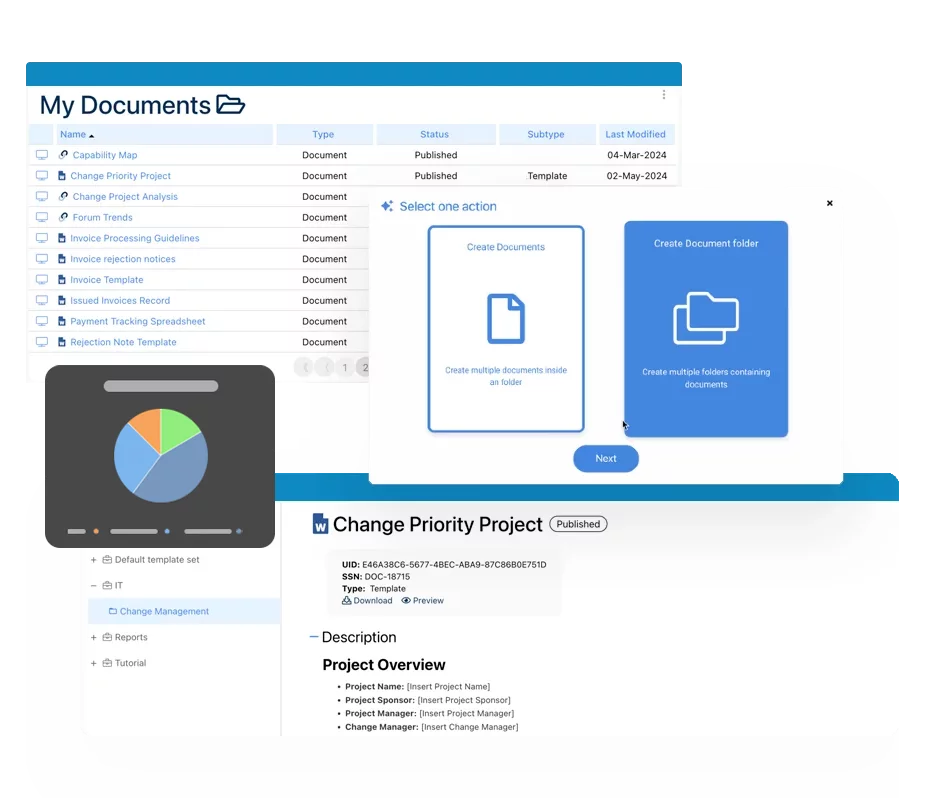
Interfacing supports controlled document lifecycle management including review, approval, publication, periodic review, version history, change governance, attestation and employee confirmation. Its process-based approach also allows documents and SOPs to remain linked to the operating processes they support.
That means an AI-assisted change does not need to stop at “this SOP may be outdated.”
The organization can evaluate the broader operational impact.
A procedure change may affect a business process, a regulatory requirement, an associated control, employee responsibilities or training obligations. Interfacing’s connected repository is designed to make those dependencies visible rather than treating the document as an isolated file.
This becomes especially valuable when AI is used for impact analysis. AI can help identify potential downstream relationships, while governance workflows determine which changes are accepted, who approves them and how they are communicated.
Apply the Same Governance Logic to Quality Events and CAPA
Interfacing’s QMS capabilities bring quality events, deviations, nonconformities, audit findings, CAPA, root cause analysis, effectiveness checks and corrective actions into the same governed environment as processes, risks and documents.
This creates an important advantage for AI agent governance.
An AI agent investigating a quality event does not need to reason only from the incident record. It can work with related process information, previous CAPAs, risk assessments, controlled documents, responsibilities and supporting evidence.
The organization can then define exactly where AI participation is appropriate.
AI may assist with identifying similar events, suggesting possible root causes, preparing investigation summaries or recommending potential actions. Final quality decisions, approvals and effectiveness determinations can remain with the authorized human roles defined by the organization’s governance model.
This is the difference between adding AI to a QMS and embedding AI-assisted work inside a governed quality operating model.
Connect Risk and Controls to the Process Where They Actually Operate
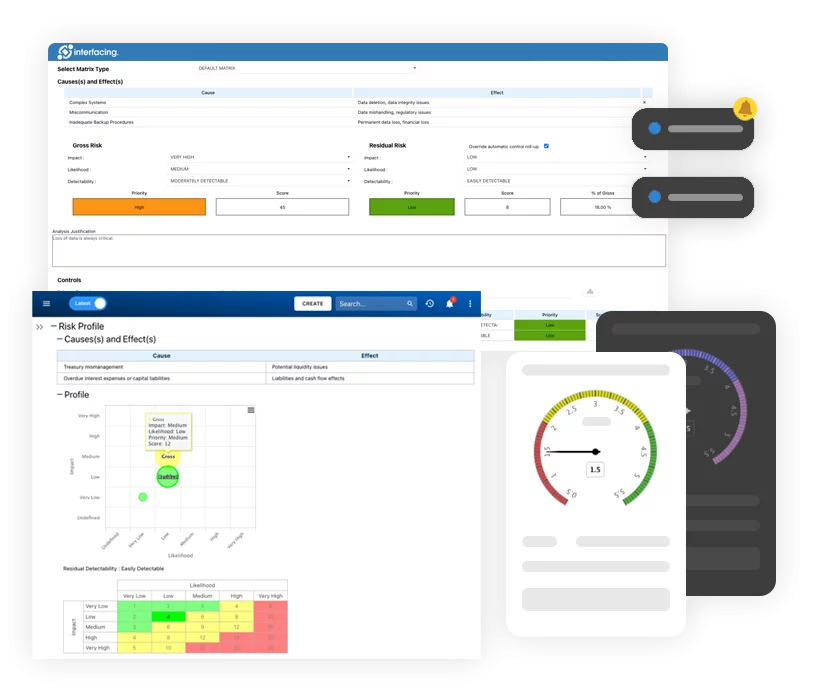
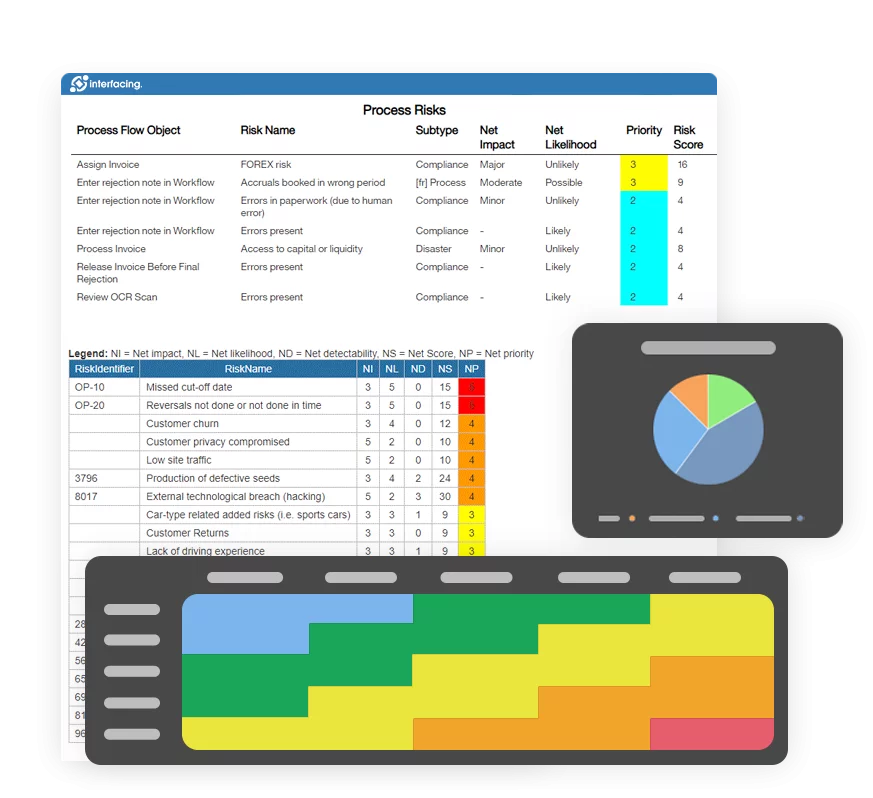
Interfacing’s GRC capabilities link risks and controls directly to processes, systems, organizational units and other operational elements. Risk assessments can be evaluated in context rather than only at an enterprise-average level, and the platform supports risk indicators, control indicators, thresholds and monitoring structures.
That matters because an AI recommendation may change the organization’s risk posture.
If an agent proposes a process change, modifies a workflow or recommends a new operating approach, the relevant question is not only whether the recommendation is efficient. The organization also needs to understand whether the change affects existing controls, introduces a new exposure or changes residual risk.
Connecting AI-assisted decisions to the risk model makes that analysis possible.
Govern Training and Responsibility After Change
Operational change often creates training obligations.
Interfacing’s training management capabilities can connect employees and roles to processes, documents and confirmation requirements. Its governance lifecycle also supports notifying impacted employees and requiring acknowledgement that they have read and understood published changes.
This becomes especially important when AI accelerates process or document change.
The faster an organization can identify and implement changes, the more important it becomes to ensure that affected people are not left behind. Governance must extend from the AI-assisted recommendation through approval, publication, communication and training.
A governed operating model closes that loop.
Move From AI Policy to Executable Governance
Many organizations already have an AI policy. Fewer have translated that policy into operational rules at the process level.
Interfacing helps close that gap by combining process governance, risk and control management, document lifecycle management, quality workflows, training, audit trails, approval cycles and low-code automation in one IMS environment. The platform’s DTO capabilities add the relationship model needed to understand how those elements depend on one another.
That creates a stronger foundation for defining AI agent governance in practical terms:
what the agent can access, what it may recommend, what it may initiate, which actions require human approval, which roles remain accountable and what evidence must be retained.
The goal is not to restrict AI unnecessarily.
It is to make sure that AI-assisted work operates inside the same governance structure that already protects quality, compliance, risk and operational accountability.
For regulated and operationally complex organizations, that distinction may determine whether agentic AI becomes a controlled business capability or simply another source of operational risk.
Frequently Asked Questions
What is AI agent governance?
AI agent governance is the framework of policies, roles, permissions, controls, monitoring and accountability used to determine how AI agents may operate within an organization. Effective governance defines what an agent can access, recommend, initiate or execute and where human approval remains required.
How is AI agent governance different from general AI governance?
General AI governance often focuses on model risk, data use, explainability, security and regulatory compliance. AI agent governance adds an operational dimension because agents can interact with systems and initiate actions. Organizations therefore need to govern not only what AI produces, but what it is authorized to do with that output.
Why are access controls alone insufficient for AI agents?
Access controls determine which systems or information an agent can reach. They do not necessarily establish which business decisions the agent has authority to make. An AI agent may legitimately access a CAPA record while still being prohibited from approving, modifying or closing it.
Should AI agents be allowed to make decisions?
That depends on the risk, reversibility and consequence of the decision. Some low-risk actions may be appropriate for controlled AI execution, while regulated or consequential decisions may require human review or approval. The important point is to define the boundary explicitly rather than allowing technical capability to determine authority.
What does human-in-the-loop mean for AI governance?
Effective human-in-the-loop governance should specify which human role participates, when intervention occurs, what evidence must be reviewed, what authority that person holds and who remains accountable for the final outcome.
How does an operating model help govern AI agents?
An operating model connects processes, roles, systems, documents, risks, controls, regulations and decision responsibilities. This context helps organizations determine where AI can assist, which controls apply, what downstream effects may occur and where human authority remains necessary.
What role can a Digital Twin of an Organization play in AI governance?
A Digital Twin of an Organization models relationships among processes, risks, controls, roles, systems, documents and other operational elements. This connected context can help AI-assisted systems understand the organizational implications surrounding a recommendation or action.
Can AI agents be used in regulated industries?
AI agents can support regulated work when organizations establish appropriate governance, validation, human oversight, security, traceability and controls based on the use case and applicable regulatory requirements.
What should organizations define before deploying an AI agent?
Organizations should establish the agent’s purpose, information access, permitted actions, prohibited actions, accountable owner, human approval points, escalation conditions, monitoring requirements and evidence-retention requirements before operational deployment.
Why Choose Interfacing?
With over two decades of AI, Quality, Process, and Compliance software expertise, Interfacing continues to be a leader in the industry. To-date, it has served over 500+ world-class enterprises and management consulting firms from all industries and sectors. We continue to provide digital, cloud & AI solutions that enable organizations to enhance, control and streamline their processes while easing the burden of regulatory compliance and quality management programs.
To explore further or discuss how Interfacing can assist your organization, please complete the form below.

Documentation: Driving Transformation, Governance and Control
• Gain real-time, comprehensive insights into your operations.
• Improve governance, efficiency, and compliance.
• Ensure seamless alignment with regulatory standards.

eQMS: Automating Quality & Compliance Workflows & Reporting
• Simplify quality management with automated workflows and monitoring.
• Streamline CAPA, supplier audits, training and related workflows.
• Turn documentation into actionable insights for Quality 4.0

Low-Code Rapid Application Development: Accelerating Digital Transformation
• Build custom, scalable applications swiftly
• Reducing development time and cost
• Adapt faster and stay agile in the face of
evolving customer and business needs.
AI to Transform your Business!
The AI-powered tools are designed to streamline operations, enhance compliance, and drive sustainable growth. Check out how AI can:
• Respond to employee inquiries
• Transform videos into processes
• Assess regulatory impact & process improvements
• Generate forms, processes, risks, regulations, KPIs & more
• Parse regulatory standards into requirements

Request Free Demo
Document, analyze, improve, digitize and monitor your business processes, risks, regulatory requirements and performance indicators within Interfacing’s Digital Twin integrated management system the Enterprise Process Center®!
Trusted by Customers Worldwide!
More than 400+ world-class enterprises and management consulting firms