

Interfacing

sales@interfacing.com

AI agents can access more enterprise information than ever, but access alone does not create business understanding. Without a connected operating model, an agent may retrieve the right document while misunderstanding the process, responsibility, risk, control, or decision surrounding it.

A Digital Twin of an Organization provides the structured operational context AI needs to support more relevant, traceable, and governed enterprise work.

Access to Business Data Is Not Business Understanding

Enterprise AI is quickly moving beyond chatbots that answer questions.

AI agents can search documents, access applications, call APIs, initiate workflows, prepare reports, and recommend actions. In some environments, they may also complete defined tasks using multiple systems.

That expanded access creates a tempting assumption: if an AI agent can reach enough business information, it will eventually understand how the organization works.

But access and understanding are not the same thing.

An agent may locate a current procedure without understanding which process it governs. It may summarize a regulatory requirement without knowing which controls, locations, products, or business units it affects. It may identify an overdue quality action without recognizing its relationship to a recurring deviation, supplier issue, operational risk, or upcoming audit.

The information may be accurate in isolation while the recommendation remains operationally incomplete.

The problem is not necessarily that the AI agent lacks data. It may lack a structured representation of how the information fits together.

Why More Documents Do Not Automatically Create More Context

Retrieval-augmented generation, enterprise search, vector databases, and document repositories have significantly improved the ability of AI systems to locate relevant information.

These technologies are valuable. They help an AI agent retrieve procedures, policies, records, reports, technical documents, and other unstructured content.

However, document retrieval still provides only part of the context needed for enterprise work.

A procedure may describe what should happen, but not whether the actual process follows it. A policy may establish a requirement, but not identify every operational dependency affected by a change. An organizational chart may list reporting relationships, but not show who is responsible, accountable, consulted, or informed within a specific workflow.

The limitations become more significant when information is distributed across multiple systems.

A customer complaint may be stored in a quality system. The relevant procedure may sit in a document repository. Process ownership may be maintained in a modeling platform. Supplier information may reside in an ERP. Training records may exist in another application. Risks and controls may be maintained in spreadsheets.

An AI agent can potentially access all these sources and still fail to understand their operational relationships.

A larger knowledge base can improve retrieval. It does not automatically create an operating model.

What Is an Operating Model for AI?

An operating model is a connected representation of how an organization delivers value and governs work.

It describes more than process steps. It connects the components that determine how work is performed, controlled, measured, and improved, including:

  • Processes, subprocesses, activities, and tasks
  • Roles, responsibilities, skills, and approval authorities
  • Systems, applications, equipment, and other resources
  • Policies, procedures, business rules, and work instructions
  • Risks, controls, regulatory requirements, and evidence
  • Products, services, suppliers, and stakeholders
  • Performance indicators, service levels, costs, and objectives
  • Quality events, changes, audits, CAPAs, and action items

For an AI agent, these relationships provide essential meaning.

The agent does not merely see that a document contains the term “approval.” It can understand which role holds approval authority, where approval occurs in the process, which control requires it, what evidence must be retained, and what happens if approval is rejected or delayed.

That is the difference between retrieving information and interpreting it within the organization’s operational reality.

What Context Does an Enterprise AI Agent Need?

An enterprise AI agent needs several layers of context before it can provide operationally relevant support.

Process context

The agent must understand where a task sits within the broader process.

A delayed activity may appear unimportant when viewed alone. Within an end-to-end process, the same delay could affect a regulatory submission, product release, customer commitment, maintenance schedule, or audit deadline.

Process context helps the agent understand upstream causes and downstream consequences.

Responsibility context

The agent must know who owns the process, who performs the task, who approves the outcome, and who must be informed.

Without responsibility context, an AI agent may recommend an action to someone who lacks the authority, knowledge, or segregation-of-duties clearance to perform it.

Governance context

Enterprise actions are constrained by policies, rules, risks, controls, standards, and regulatory obligations.

An efficient recommendation is not necessarily a compliant recommendation. The agent must understand which requirements apply before suggesting that a step be removed, automated, bypassed, or reassigned.

Performance context

The agent needs to understand what the organization is trying to achieve.

Reducing process time may look beneficial until it increases quality risk, weakens a control, creates rework, or moves costs into another department. Performance must be evaluated across connected objectives rather than a single isolated metric.

Change context

Business changes rarely remain contained within one document or system.

A regulatory update may affect processes, procedures, forms, controls, training, software configurations, suppliers, and reporting requirements. An agent needs relationship context to identify these downstream implications.

Historical and execution context

The documented process may not reflect how work actually occurs.

Operational records, event logs, quality events, audit findings, exceptions, and performance results help reveal the difference between the intended operating model and real execution.

A Digital Twin of an Organization Provides the Context Layer

A Digital Twin of an Organization is a dynamic digital representation of how an organization operates.

According to Gartner’s definition, a DTO uses operational and contextual data to understand how an organization operationalizes its business model, connects to its current state, responds to change, deploys resources, simulates future states, and delivers customer value.

That definition is important because a DTO is not simply a collection of process diagrams or a dashboard placed over enterprise data.

A meaningful DTO connects the organization’s operating components and keeps those relationships aligned with the current state of the business.

This can include:

  • How processes are decomposed from value streams to individual tasks
  • Which people, systems, resources, and AI agents perform the work
  • Which deliverables create value for internal and external stakeholders
  • How risks, controls, requirements, and quality obligations affect execution
  • How operational performance is measured
  • How changes propagate across connected business components
  • How actual execution differs from the designed process
  • How proposed changes may perform under different scenarios

Gartner describes DTO platforms as supporting the prioritization, planning, monitoring, simulation, analysis, and scaling of complex initiatives.

This makes the DTO more than a visualization layer. It can become the organizational context layer through which an AI agent interprets enterprise information.

Knowledge Base Versus Digital Twin of an Organization

A knowledge base helps an AI agent answer:

What information do we have about this subject?

A Digital Twin of an Organization helps it consider:

Where does this information belong, what does it affect, who is responsible, and what should happen next?

The two approaches are complementary rather than interchangeable.

A knowledge base may provide the contents of a corrective action procedure. A DTO can connect that procedure to the quality event process, responsible roles, applicable regulations, associated risks, approval workflow, training obligations, and performance indicators.

A knowledge base may retrieve a business continuity plan. A DTO can connect that plan to the critical process, applications, locations, suppliers, recovery objectives, assets, controls, and stakeholders that depend on it.

A knowledge base may find a revised regulatory requirement. A DTO can help identify the procedures, controls, training materials, systems, and business units potentially affected by that change.

The knowledge base provides information. The DTO provides operational relationships.

An AI agent needs both to support serious enterprise work.

From Generic Responses to Operationally Relevant Recommendations

Consider an AI agent asked to help reduce the time required to close a quality event.

Without operating-model context, the agent might recommend:

  • Removing an approval
  • Combining investigation steps
  • Shortening the review period
  • Automatically closing lower-severity events
  • Reducing the number of required participants

Some of those recommendations may sound reasonable. They may even reduce cycle time.

But the agent may not know that the approval enforces segregation of duties, that the investigation step is required by a regulated procedure, or that lower-severity events must be evaluated collectively to identify recurring patterns.

An operating model changes the quality of the analysis.

The agent can consider the process hierarchy, roles, rules, quality classifications, historical events, risk assessments, controls, approval requirements, performance data, and downstream implications before producing a recommendation.

The result is not guaranteed to be correct. It is, however, based on a more complete representation of the business problem.

This principle applies well beyond quality management.

A procurement agent needs supplier, contractual, risk, approval, and budget context. An audit agent needs requirements, controls, evidence, ownership, findings, and remediation context. A compliance agent needs regulatory, jurisdictional, procedural, and impact context.

An enterprise AI agent becomes more useful when it can reason within the organization’s operating structure rather than treating every request as an isolated information problem.

Context Engineering Is Becoming an Enterprise Discipline

Prompt engineering focuses on how a user asks an AI system to perform a task.

Context engineering is broader. It focuses on designing and managing the informational environment in which an AI agent interprets a request and decides what to do.

Recent research describes prompt engineering as necessary but insufficient for multi-step enterprise agents. The agent’s context must include relevant information, sufficient operational detail, appropriate isolation, efficient retrieval, and clear provenance.

Other research has explored digital-twin-based context engineering to improve enterprise agents facing limited data, complex reasoning demands, and unreliable feedback.

These studies do not mean every AI agent needs a complete DTO before it can perform a useful task. A narrowly scoped agent can succeed with a well-defined process, restricted data, clear instructions, and strong controls.

But the need for structured organizational context increases as the agent’s responsibilities expand.

An agent that summarizes a document needs relatively little operational context. An agent that recommends a process change, assigns work, evaluates risk, or initiates an enterprise workflow needs much more.

A DTO Does Not Make an AI Agent Autonomous or Infallible

Connecting an AI agent to an operating model does not eliminate AI risk.

It does not guarantee that every recommendation will be accurate, complete, compliant, or appropriate. It does not replace validation, human judgment, or accountable process ownership.

A DTO provides better context. Governance determines how that context may be used.

Organizations still need to define:

  • Which information the agent can access
  • Which actions it can recommend or execute
  • Which decisions require human approval
  • How outputs will be validated
  • How actions and evidence will be recorded
  • How exceptions will be escalated
  • Who remains accountable for the outcome

Agent architectures continue to face issues such as hallucinated actions, prompt injection, improper tool use, and uncontrolled loops.

This is why agentic AI permission controls and human oversight remain necessary even when an agent has strong operational context.

The goal is not to give an AI agent unrestricted knowledge of the enterprise and let it operate independently.

The goal is to provide governed access to the context required for a specific task, within clearly defined permissions, controls, and accountability boundaries.

How Interfacing Connects AI to the Operating Model

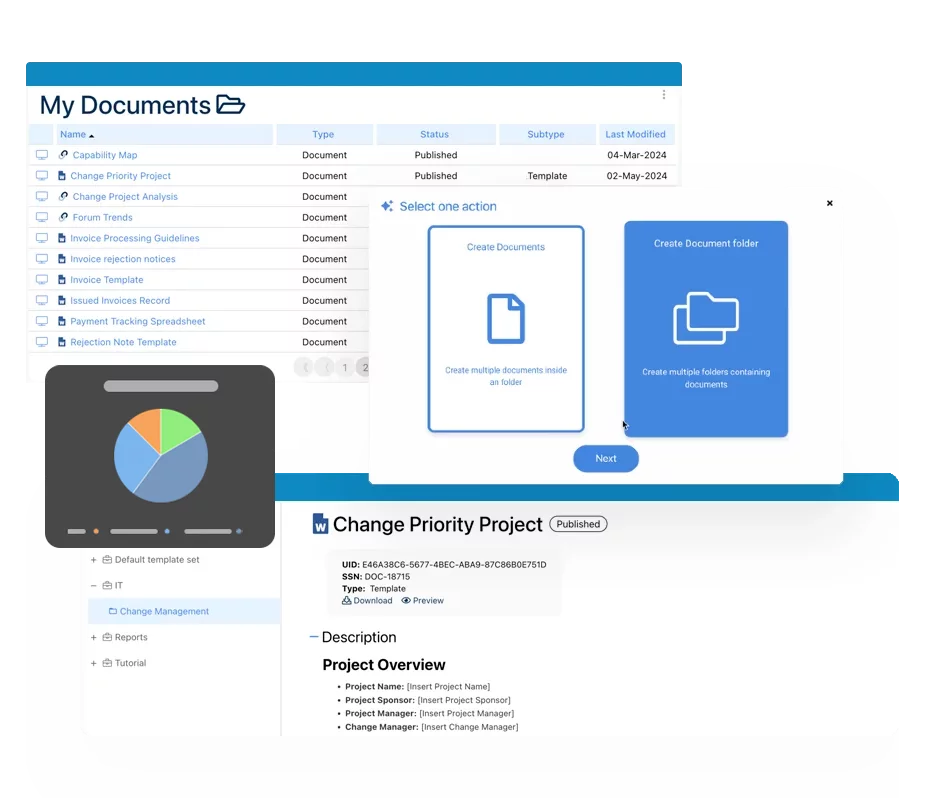
Interfacing’s AI-powered Integrated Management System brings process management, quality management, risk, compliance, document control, performance management, and low-code workflow automation into a connected environment.

Rather than treating enterprise content as unrelated files and records, the platform can connect processes with roles, systems, risks, controls, policies, procedures, regulations, documents, training, quality events, CAPAs, audits, KPIs, and approval workflows.

Interfacing’s DTO approach is designed to represent how these operational components depend on one another. Its broader platform supports modeling, process mining, analysis, simulation, governance workflows, and operational execution within the same organizational context.

Interfacing also provides AI-assisted capabilities for extracting structured content from documents and images, locating governed information, identifying potential downstream impacts, and supporting process and quality analysis.

This establishes an important boundary: AI provides assistance and recommendations, while accountable people remain responsible for review, approval, and action.

The objective is not to replace human understanding with artificial intelligence. It is to give people and AI systems a more accurate, connected, and governed representation of the organization they are working within.

Preparing AI Agents for Real Enterprise Work

Organizations do not need to model the entire enterprise before introducing an AI agent.

They do need to match the depth of context and governance to the significance of the task.

A practical approach is to begin with one well-defined use case:

  1. Identify the process in which the agent will operate.
  2. Define the desired outcome and performance measures.
  3. Connect the relevant roles, systems, documents, risks, controls, and requirements.
  4. Establish the agent’s access and action permissions.
  5. Define human approval and escalation points.
  6. Record the evidence required for review and audit.
  7. Measure actual outcomes and refine the operating model.

This creates a controlled foundation that can be extended as the use case matures.

The question is therefore not simply whether an organization is ready for AI agents.

The more useful question is:

Does the agent have a governed representation of the business environment it is being asked to understand?

Without that context, the agent may be fast, articulate, and technically capable while remaining operationally unaware.

With a connected operating model and a Digital Twin of an Organization, AI can support work using a clearer understanding of processes, responsibilities, risks, controls, dependencies, and business outcomes.

That is the difference between giving an AI agent access to the organization and helping it understand how the organization actually works.

How Interfacing Helps

Interfacing helps regulated organizations prepare for faster, more connected oversight by bringing quality, process, risk, compliance, documentation and workflow evidence into a governed Integrated Management System.

Rather than treating an SOP, deviation, CAPA, audit finding, risk assessment and training record as unrelated files, the platform connects them within a common operating model.

Interfacing IMS supports organizations in:

  • Connecting processes, procedures, regulations, risks and controls
  • Managing document review, approval, publication and periodic revision
  • Linking deviations and quality events to CAPA and root cause analysis
  • Assigning and monitoring role-based training
  • Maintaining audit trails, version histories and electronic approvals
  • Identifying downstream impacts when regulated content changes
  • Managing supplier, audit and regulatory information
  • Applying AI-assisted capabilities within controlled governance workflows
  • Creating dashboards that expose overdue actions, recurring issues and compliance gaps


Interfacing’s life sciences QMS capabilities are designed to support GxP-regulated operations, including traceability across documentation, quality workflows and compliance evidence. The platform’s life sciences and healthcare QMS positioning specifically connects SOPs, risks, controls, CAPA, training, audits and regulatory requirements within one secure environment.

The goal is not to predict every question ELSA may help an FDA reviewer ask.

The goal is to ensure the organization can answer those questions from controlled, connected and defensible records.

Why Choose Interfacing?


With over two decades of AI, Quality, Process, and Compliance software expertise, Interfacing continues to be a leader in the industry. To-date, it has served over 500+ world-class enterprises and management consulting firms from all industries and sectors. We continue to provide digital, cloud & AI solutions that enable organizations to enhance, control and streamline their processes while easing the burden of regulatory compliance and quality management programs.

To explore further or discuss how Interfacing can assist your organization, please complete the form below.

Documentation: Driving Transformation, Governance and Control

• Gain real-time, comprehensive insights into your operations.
• Improve governance, efficiency, and compliance.
• Ensure seamless alignment with regulatory standards.

eQMS: Automating Quality & Compliance Workflows & Reporting

• Simplify quality management with automated workflows and monitoring.
• Streamline CAPA, supplier audits, training and related workflows.
• Turn documentation into actionable insights for Quality 4.0

Low-Code Rapid Application Development: Accelerating Digital Transformation

• Build custom, scalable applications swiftly
• Reducing development time and cost
• Adapt faster and stay agile in the face of evolving customer and business needs.


AI to Transform your Business!

The AI-powered tools are designed to streamline operations, enhance compliance, and drive sustainable growth. Check out how AI can:
• Respond to employee inquiries
• Transform videos into processes
• Assess regulatory impact & process improvements
• Generate forms, processes, risks, regulations, KPIs & more
• Parse regulatory standards into requirements


Learn more about EPC's AI Use Cases
CONTACT US

Request Free Demo

Document, analyze, improve, digitize and monitor your business processes, risks, regulatory requirements and performance indicators within Interfacing’s Digital Twin integrated management system the Enterprise Process Center®!
Trusted by Customers Worldwide!

More than 400+ world-class enterprises and management consulting firms