





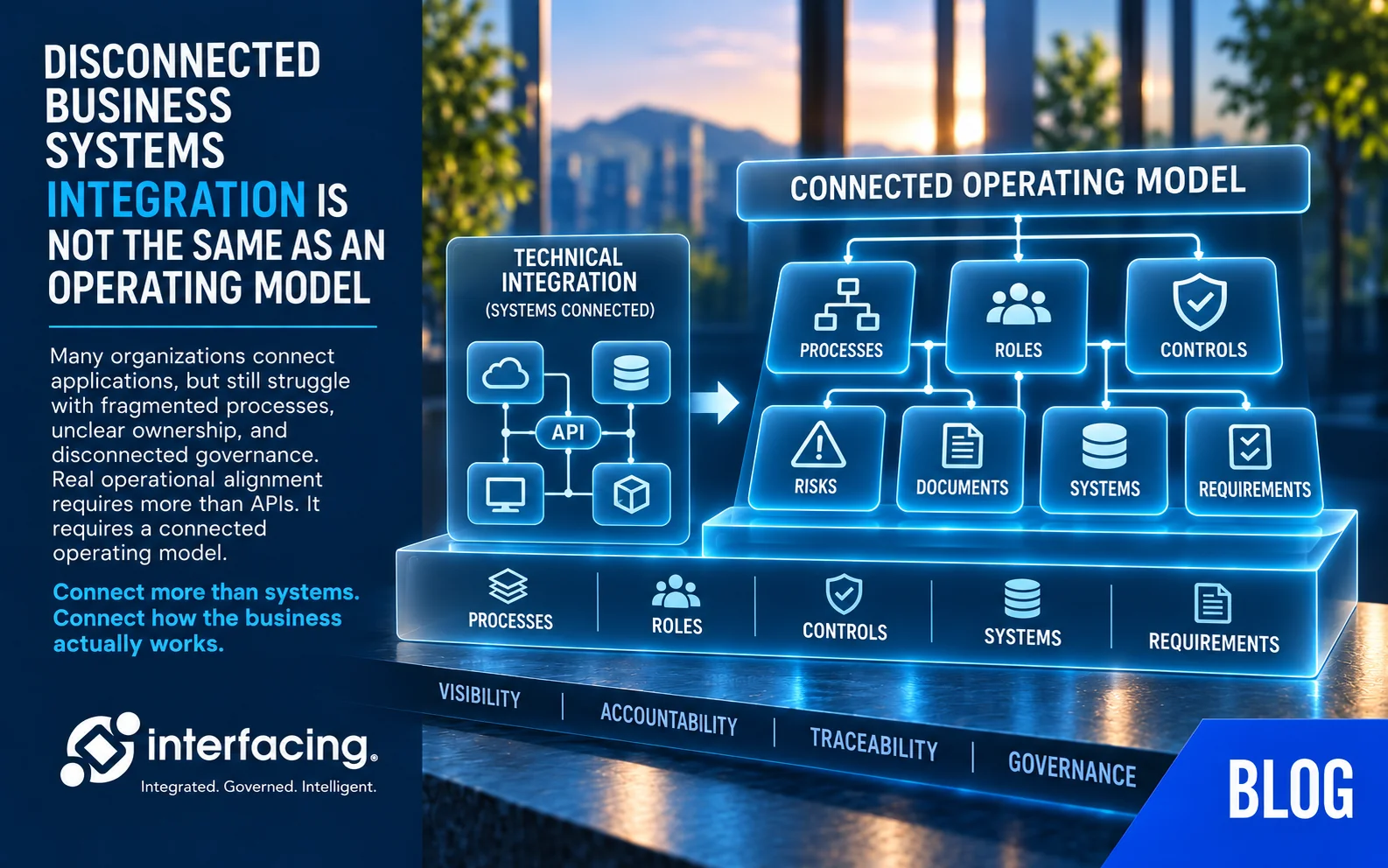
Disconnected business systems are applications and operational tools that may exchange information but do not necessarily share the processes, responsibilities, controls and decisions needed to run the organization as one coordinated whole.
Connecting applications can improve the movement of data. It does not automatically clarify who owns a process, which requirement governs a decision, or what must change when an upstream dependency shifts.
This distinction matters because the success of digital transformation depends not only on information flowing between systems, but also on the organization's ability to govern the work those systems support.
When Integration Succeeds but the Business Still Feels Fragmented
Consider an organization that has invested heavily in enterprise integration. Customer information moves between its CRM and service platform. Quality events are transferred into reporting tools. Financial and operational data feed executive dashboards. From an architectural perspective, the applications are connected.
Yet when a new regulatory requirement affects a customer-facing process, the response becomes surprisingly manual. One team updates the procedure, another evaluates system changes, a quality manager checks the applicable controls, and an operations leader tries to determine which employees need additional training.
The information may be available somewhere, but the relationships between those obligations are not consistently maintained. The integration program may have achieved exactly what it was designed to achieve. Data moves between applications. The difficulty is that data integration and operational governance solve different problems.
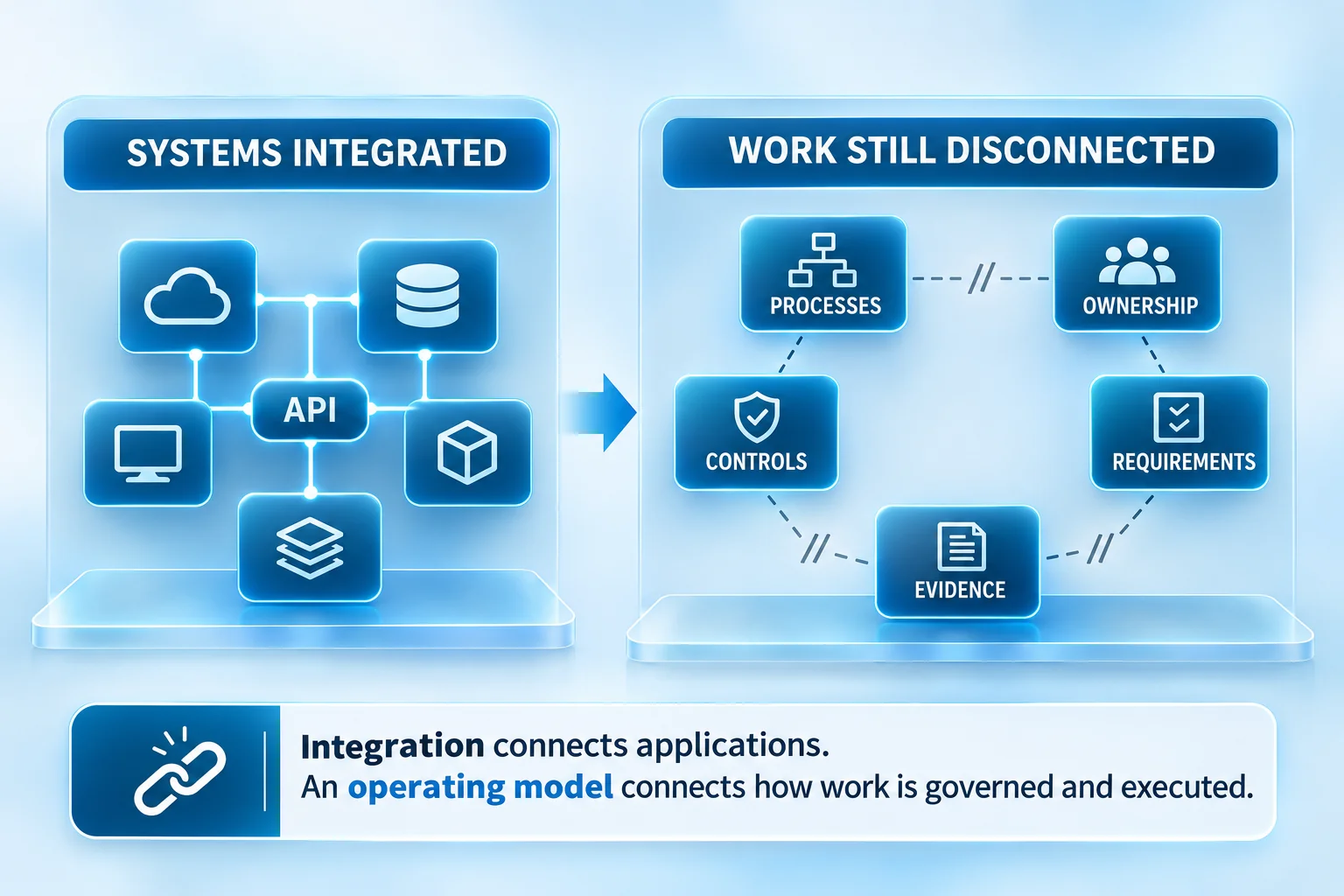
A connected technology environment is not necessarily a connected organization.
Integration Connects Applications. An Operating Model Connects the Business.
System Integration
Technical connectivity
Primary question: Can systems exchange information and trigger transactions?
Primary focus: Interfaces, APIs, synchronization, interoperability and data movement.
Typical measures: Successful transactions, reduced duplicate entry and reliable information exchange.
Limitation: Technical connections do not automatically establish process ownership, decision authority or control obligations.
Connected Operating Model
Organizational alignment and governance
Primary question: How does work operate across roles, systems, policies, risks and controls?
Primary focus: Processes, responsibilities, dependencies, requirements and decision-making.
Typical measures: Accountability, visibility, traceability and governed change.
Advantage: Operational relationships provide context for understanding how changes affect the enterprise.
The appeal of integration is straightforward. Shared information can reduce duplicate entry, improve consistency and allow processes to cross application boundaries more efficiently. These are legitimate achievements.
The assumption becomes problematic when organizations treat connectivity as a substitute for a defined operating model. An API can transmit a status change without knowing whether the change requires approval. A workflow can route a task without showing which regulation justifies it. A dashboard can aggregate performance data without establishing who is responsible for correcting an underlying process weakness.
These are not necessarily software integration failures. They are missing relationships in how the business defines and governs its own operations.
What a Connected Operating Model Actually Represents
A connected enterprise operating model represents more than systems and interfaces. It brings together the processes through which value is delivered, the roles accountable for performing and governing work, the supporting systems, the policies and requirements that apply, and the risks and controls that influence how decisions are made.
These relationships provide context that an individual application record rarely contains on its own. A business process is no longer just a workflow diagram. It can be understood in relation to its owner, supporting procedures, control activities, training obligations, performance indicators and technology dependencies.
This does not require every enterprise application to be replaced or every operational activity to be executed in one product. It requires an intentional way of representing and maintaining the relationships that define how the enterprise operates.
How work flows across functions, where decisions occur, and who is responsible for outcomes.
Which obligations govern activities and which control measures support responsible execution.
Which applications enable work and how documents and records support visibility and traceability.
Connectivity moves information. A connected operating model helps explain what that information means for the business.
Moving from Application Integration to Operational Alignment
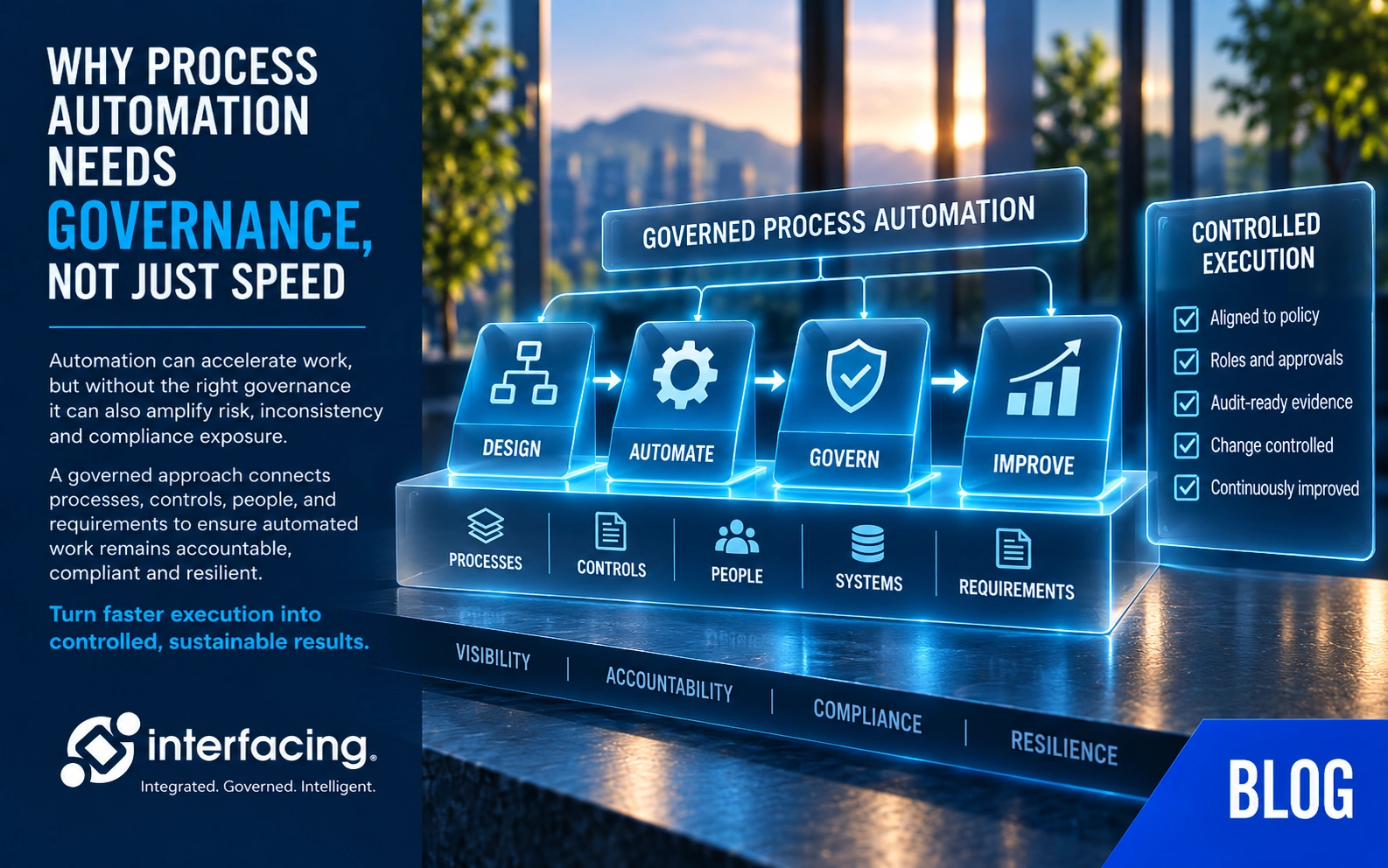
Integration and operating-model development should not be presented as competing investments. They are complementary. Integration makes information and transactions accessible across technical boundaries. An operating model establishes the business relationships and governance needed to interpret and act on that information responsibly.
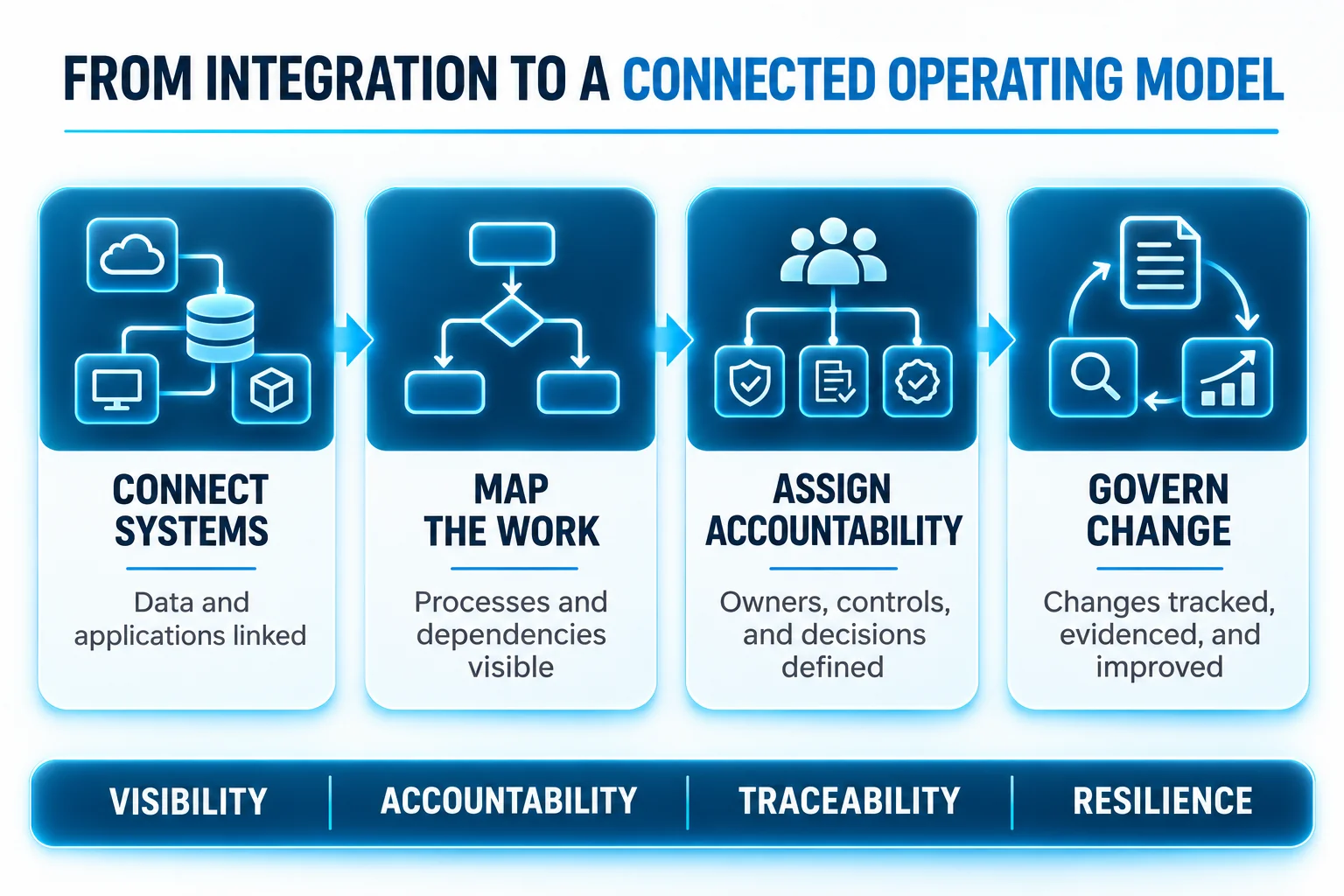
Connect Systems
Make relevant data and transactions available across the applications supporting important business activities.
Map the Work
Define the end-to-end processes, handoffs, decisions and dependencies that individual applications may not reveal.
Assign Accountability
Establish clear ownership, decision authority, control responsibilities, approvals and escalation paths.
Govern Change
Review affected relationships, involve authorized decision-makers and retain appropriate evidence of approved changes.
The first step is to connect the applications and information that support important business activities. Connectivity must then be related to a maintained understanding of how work moves across functions.
Accountability must also be explicit. A process may involve several departments, but governance still requires defined ownership, decision authority, control responsibilities and escalation paths. These responsibilities should remain understandable even when work is supported by automation.
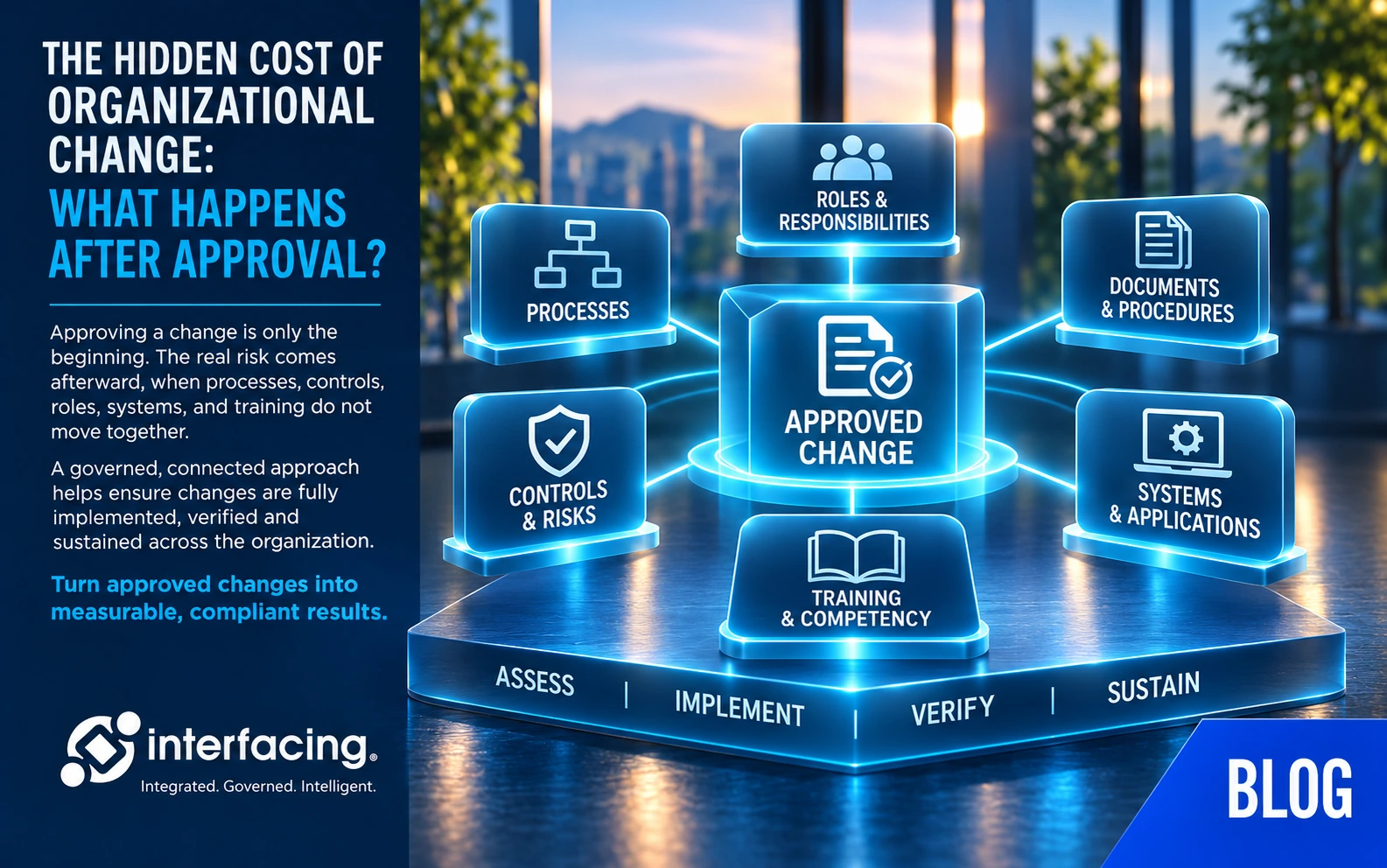
Finally, the model must support change. When a requirement, process, system or control changes, the organization needs a consistent way to identify affected relationships, involve the right reviewers, approve necessary updates and retain appropriate evidence.
Why the Difference Matters Most During Change
Stable operations can hide structural weaknesses. Teams may know where to find information, who to contact and which unofficial workarounds keep activities moving. The limitations become more visible when the organization changes quickly.
A regulatory update may require revisions across policies, procedures, controls, training and system configurations. A business acquisition may introduce overlapping process definitions and inconsistent ownership. A digital transformation program may automate activities before their approval rules or dependencies are fully understood.
In each case, disconnected operational knowledge creates additional coordination work. Teams must reconstruct relationships that should already be documented and maintained.
The risk is not simply that the wrong data appears in a report. It is that the organization may act on an incomplete understanding of the operational consequences.
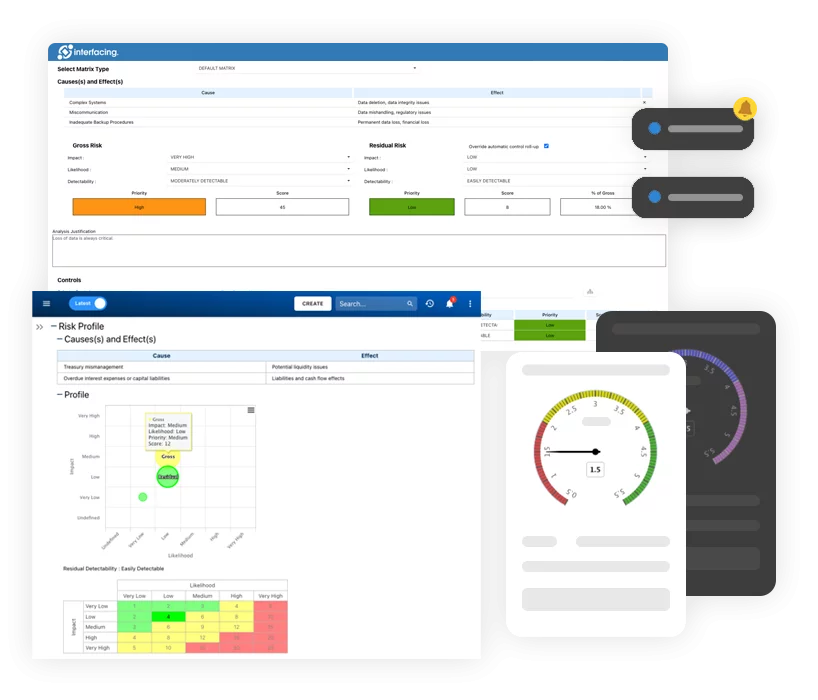
In regulated environments, connecting requirements to processes, controls, roles and evidence gives compliance activities operational context. A requirement should be understood in relation to the actual work it governs, not only as an item in a separate register.
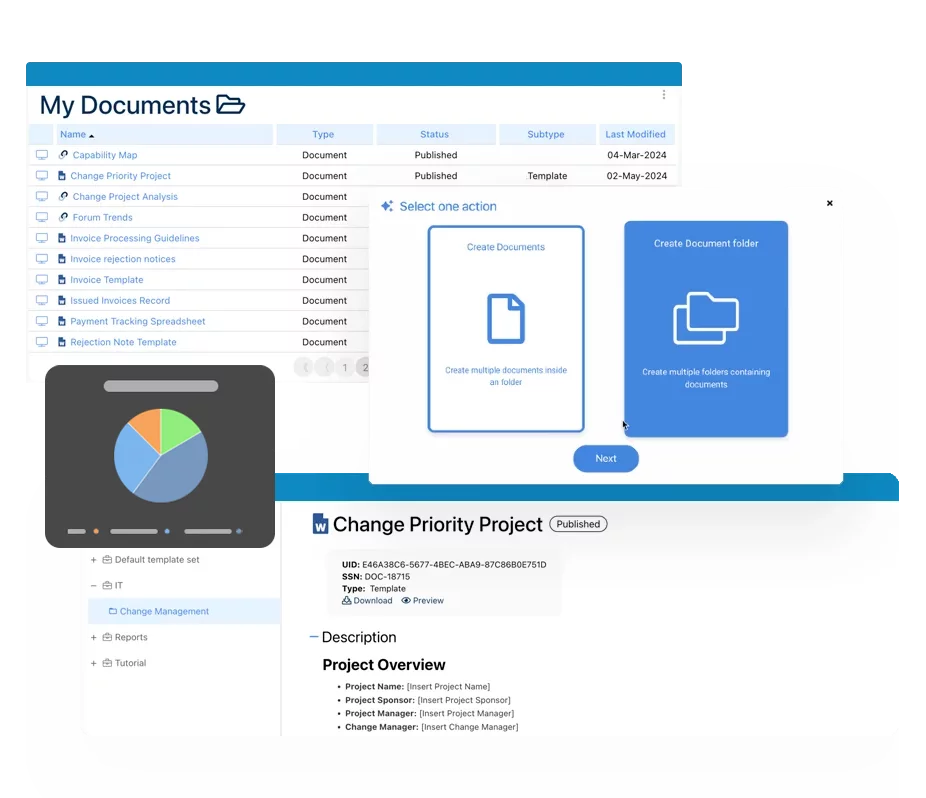
Similarly, connecting documents and records to operational activities makes it easier to understand where a procedure applies and which related information may need review when that procedure is revised.
AI Makes Operating-Model Quality More Important, Not Less
AI-assisted analysis increases the importance of connected organizational context. An AI capability may summarize a procedure, compare documents or identify a pattern in operational data. Those activities can be valuable. But a useful management recommendation may depend on relationships that are not available in the source material being examined.
For example, suggesting a process change responsibly may require understanding the relevant risk, control, approval authority, regulatory obligation and training impact. Without these connections, analysis can appear convincing while leaving important dependencies unexplored.
A connected operating model offers a stronger information foundation for AI-assisted impact analysis and recommendations. It does not eliminate the need for validation. Consequential changes still require appropriate human review, documented decisions and governed implementation.
That distinction is central to human-in-the-loop governance within a Digital Twin of an Organization. The purpose is to make analysis more useful while keeping accountability with authorized decision-makers.
AI can help interpret operational information. The organization must still govern the decisions made from it.
Connecting the Enterprise Operating Model
Interfacing approaches this challenge through its Integrated Management System (IMS), which connects business process management with quality, risk and control management, documents, regulatory requirements, training, workflows and related operational information within a governed environment.
Rather than treating these disciplines as unrelated repositories, the platform provides a process-centered foundation for linking organizational objects and understanding their dependencies. A process can be associated with its accountable roles, supporting documents, applicable requirements, risks, controls and improvement activities.
This relationship-driven approach helps organizations maintain a clearer view of how changes may affect connected activities. It also supports the broader Digital Twin of an Organization concept, in which operational and performance information can be interpreted in relation to a maintained representation of how the organization works.
The objective is not simply to connect more software. It is to build a governed understanding of how the organization actually works.
The practical value is not the assertion that every integration or governance problem disappears. Existing applications, data quality, implementation scope, process ownership and organizational discipline still matter. The advantage is an approach that treats governance and operational relationships as part of the management architecture rather than as information to reconstruct after a problem occurs.
For organizations seeking greater consistency across BPM, QMS, GRC and document governance, that is a more useful objective than application connectivity alone.
The Next Integration Question Is About the Business
Organizations should continue integrating systems. APIs, data exchange and workflow connections remain essential parts of modern enterprise architecture. But technical connectivity should not be confused with operational alignment.
A business becomes more connected when its processes, responsibilities, controls, requirements and evidence can be understood together, maintained through change and used to support informed decisions.
The next question for digital transformation leaders is therefore not only which systems need to communicate. It is whether the organization has a dependable model of the work those systems are supposed to support.
Questions About Disconnected Business Systems
What are disconnected business systems?
Disconnected business systems are applications and operational tools that do not consistently share the information, processes, responsibilities or governance relationships needed to coordinate work. Even technically integrated applications can remain operationally disconnected when ownership, controls and requirements are managed separately.
What is the difference between system integration and an operating model?
System integration enables applications to exchange data or trigger actions across technical boundaries. An operating model defines how the organization performs work, assigns accountability, applies controls and manages change. Integration supports information flow, while an operating model provides business context and governance.
Can an organization have integrated applications but disconnected processes?
Yes. Applications may synchronize records successfully while process ownership, approvals, controls, training and regulatory requirements remain managed in separate tools or documents. Technical connectivity does not automatically establish end-to-end process accountability.
Does a connected operating model require replacing existing enterprise systems?
Not necessarily. A connected operating model can provide a shared representation of processes, roles, requirements, risks, controls and system dependencies while existing enterprise applications continue supporting specific activities. The appropriate architecture depends on the organization's technology landscape and governance needs.
How does a Digital Twin of an Organization relate to an operating model?
A Digital Twin of an Organization provides a connected digital representation of how an enterprise operates. It links processes, roles, systems, resources, risks, controls and other operational relationships so organizations can analyze dependencies, assess changes and support decisions within a governed context.
Why is governance important when business systems are integrated?
Governance establishes who is accountable, which policies and controls apply, how changes are approved and what evidence must be retained. Without these relationships, integrated systems can move information efficiently while leaving important operational decisions and obligations unclear.

Documentation: Driving Transformation, Governance and Control
• Gain real-time, comprehensive insights into your operations.
• Improve governance, efficiency, and compliance.
• Ensure seamless alignment with regulatory standards.

eQMS: Automating Quality & Compliance Workflows & Reporting
• Simplify quality management with automated workflows and monitoring.
• Streamline CAPA, supplier audits, training and related workflows.
• Turn documentation into actionable insights for Quality 4.0

Low-Code Rapid Application Development: Accelerating Digital Transformation
• Build custom, scalable applications swiftly
• Reducing development time and cost
• Adapt faster and stay agile in the face of
evolving customer and business needs.
AI to Transform your Business!
The AI-powered tools are designed to streamline operations, enhance compliance, and drive sustainable growth. Check out how AI can:
• Respond to employee inquiries
• Transform videos into processes
• Assess regulatory impact & process improvements
• Generate forms, processes, risks, regulations, KPIs & more
• Parse regulatory standards into requirements