Please Select contact form.
Connect Process, Quality, Risk, Compliance and Automation in One Governed Platform

Fragmented systems create fragmented operations.
Interfacing’s Integrated Management System, IMS, connects business processes, documents, quality events, risks, controls, regulatory requirements, training, performance data and workflow automation within one governed digital environment.
Replace disconnected BPM, QMS, GRC, document control and workflow tools with a shared operating model that improves operational visibility, accountability, audit readiness and continuous improvement.
An Integrated Management System brings multiple management disciplines together through shared processes, responsibilities, controls, information and governance.
A digital IMS moves this framework out of disconnected applications, documents and spreadsheets and into one connected software platform.
Interfacing combines:
This gives organizations one environment in which to document, analyze, govern, execute and continuously improve how work is performed.
Quality, process, compliance and risk are usually managed as separate software categories.
Operationally, however, they are inseparable.
A deviation occurs within a process. That process is performed by specific roles, depends on systems and documents, is governed by controls, and may be subject to regulatory requirements. The resulting investigation may identify a training gap, initiate a CAPA, modify an SOP and require employees to confirm that they understand the change.
When each part of that lifecycle is managed in a different application, teams must manually reconstruct the relationships.
Interfacing’s IMS maintains those relationships within a shared repository. Processes, documents, roles, systems, risks, controls, quality events, regulations, performance indicators and improvement actions are managed as connected business objects.
The result is more than a common menu of software modules. It is a connected model of how the organization operates.
Interfacing places the business process at the centre of the management system.
Each process can be connected to its:
These relationships create end-to-end visibility across the organization.
When a process, regulation, document, control or system changes, teams can identify related content and affected stakeholders before implementing the change.
This relationship-driven model supports better decisions because users can understand both the individual object and its broader operational context.
Interfacing’s Electronic Quality Management System connects quality planning, execution, investigation and improvement with the processes where quality issues actually occur.
Capture and manage quality events including:
Each event can be associated with the affected process, document, product, supplier, site, risk, control or regulatory requirement.

Plan, schedule, conduct and report on internal, external, supplier and regulatory audits.
Findings can initiate quality events, CAPAs, change requests, risk assessments or action plans without manually recreating information in another system.

Maintain supplier documentation, specifications, risks, scorecards and corrective actions alongside product, equipment and quality records.

Bring quality performance, audit results, risks, CAPA status, training, supplier performance and improvement priorities into consolidated management review workflows and dashboards.

Interfacing connects process management with document control so that procedures are not separated from the work they govern.
Organizations can model and manage:
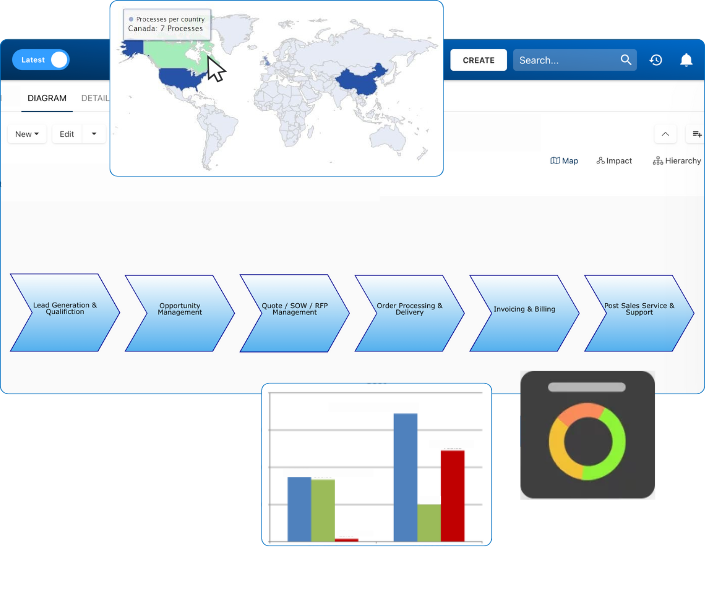
Process information can be displayed through different views for business users, technical users and operational employees.
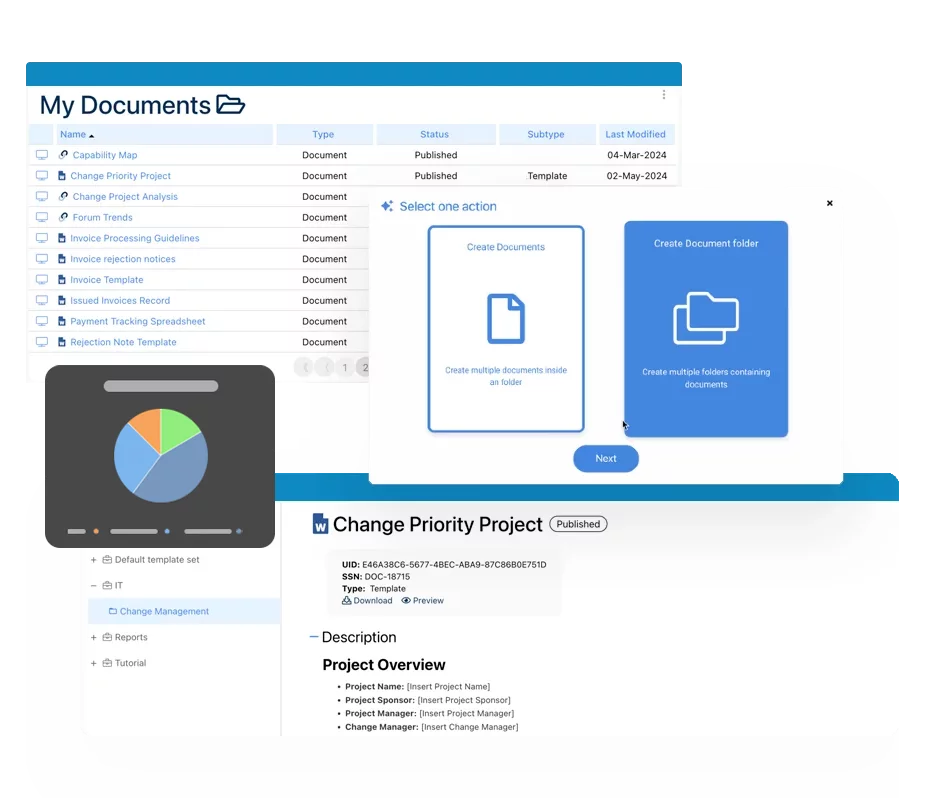
Controlled documents can then be linked directly to the relevant process, role, regulation, product, site or system.
Manage controlled documents from creation through retirement, including:
Instead of asking employees to search through document libraries, the IMS can present the processes, procedures and knowledge relevant to their responsibilities.
Learn more about Document Control and Records Management.
Interfacing embeds governance, risk and compliance into the operating model rather than managing them as disconnected registers.
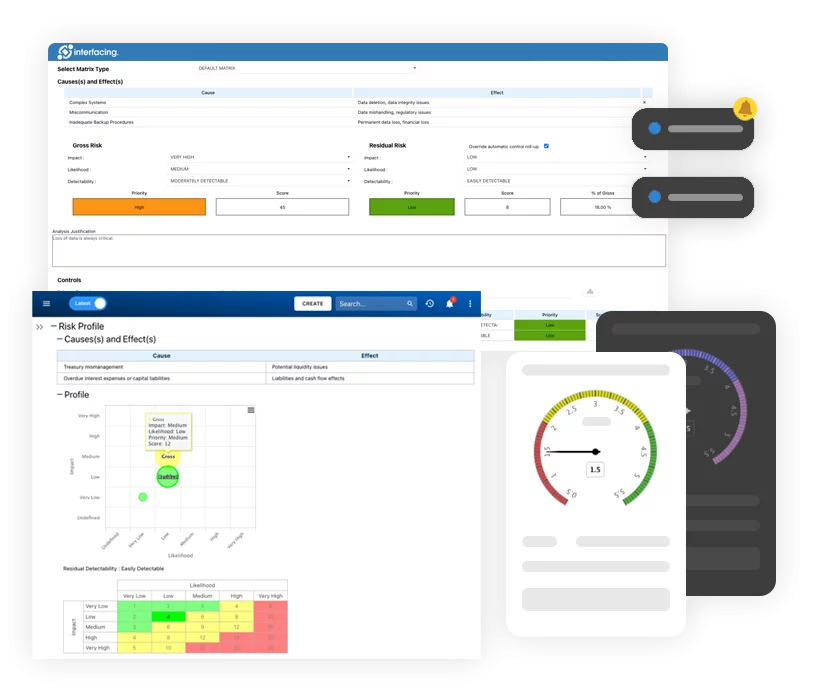
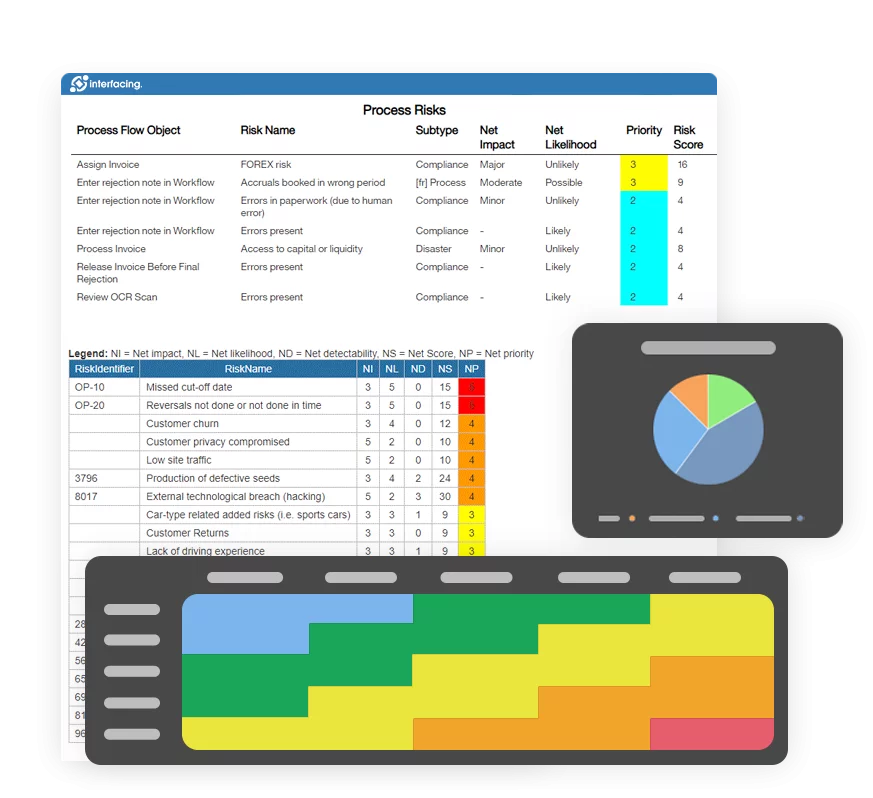
Identify and assess risks within the processes, systems, capabilities, assets and organizational units where they occur.
Organizations can manage:
The same risk can be evaluated differently based on its operational context. A supplier failure, data loss or regulatory breach may have different likelihood and impact depending on the process, site or business unit affected.

Convert regulations, standards, policies and contractual obligations into manageable requirements that can be linked to affected processes, documents, risks and controls.
When a requirement changes, the IMS can support a governed lifecycle to:
This creates a traceable connection between an external obligation and how it is implemented internally.
Learn more about Regulatory Compliance Management.

Interfacing uses AI to accelerate discovery, analysis, documentation and improvement while maintaining human review and accountability.
AI-assisted capabilities support use cases such as:
AI-generated output should not bypass operational governance.
Responsible users remain involved in validating recommendations, confirming applicability and approving controlled changes. Review workflows, access permissions, electronic signatures and audit histories help preserve accountability.
This human-in-the-loop approach allows organizations to use AI to reduce manual effort without treating automated recommendations as unquestioned decisions.
Learn more about Human-in-the-Loop AI and AI Content Creation and Improvement.

A management system should do more than document how work is supposed to happen. It should help employees execute that work.
Interfacing’s integrated Low-Code Automation Platform enables organizations to create and adapt forms, tasks, business rules and workflows using the information already maintained within the IMS.
Common applications include:
Applications can reuse the same processes, roles, resources, documents and master data maintained in the repository.
This reduces the risk of creating isolated low-code applications that automate work without preserving governance, traceability or ownership.
Documented processes show how work is intended to operate.
Process mining helps organizations understand how work is actually being executed by using system event data to identify process paths, variations and delays.
Interfacing connects mining and analysis with the broader operating model so teams can assess execution within its quality, risk, control and compliance context.
Organizations can examine:
Simulation can then be used to test potential changes before implementation.
Teams can compare scenarios involving process redesign, resource allocation, activity timing, cost, workload or other operating conditions.
Learn more about Process Mining and Business Process Simulation.
A connected management system provides visibility across operational disciplines rather than limiting reporting to individual applications.
Interfacing supports centralized dashboards and reports for:
Role-based dashboards can provide different views for executives, managers, process owners, quality teams, risk leaders and operational employees.
Because information is connected through a shared repository, users can move from a performance indicator or quality issue to its related process, owner, risk, control, document and corrective action.
This reduces the manual reconciliation normally required to create enterprise-level reports from separate systems.
Change is where fragmented management systems create the greatest operational risk.
A process may be updated without revising its SOP. A regulatory change may not reach every affected owner. Employees may continue using an obsolete document. A new control may be approved without assigning the required training.
Interfacing supports a governed lifecycle that can include:
The same governance principles can be applied across processes, documents, risks, controls, regulations and other managed objects.

Business continuity is more effective when plans are connected to the processes, roles, assets, systems, suppliers and facilities that support critical operations.
Interfacing’s Business Continuity Management capabilities support:
By connecting continuity planning to the broader IMS, organizations can assess how disruptions may affect operations, quality, compliance and customer commitments.
An IMS does not need to replace every transactional application.
It should provide the governed context that connects those applications to processes, roles, controls and responsibilities.
Interfacing supports integration with enterprise systems through capabilities such as:
Migration services can help organizations transfer processes, documents, metadata, historical versions and related information from legacy platforms into the connected repository.
Learn more about Data Migration and Integration.
Interfacing’s IMS provides the governed operational foundation for a Digital Twin of an Organization.
A DTO is not simply a process diagram or dashboard. It is a connected digital model of how the organization delivers value, deploys resources, manages risk, responds to change and measures performance.
The IMS connects:
Operational and performance data can then be applied to this model to understand dependencies, investigate problems, test scenarios and support decisions.
The IMS governs the organization’s operating model. The DTO makes that model measurable, analyzable and responsive to change.
Interfacing supports organizations that must balance operational improvement with governance, quality and regulatory accountability.
Common industries include:
The platform can support multiple standards, frameworks, business units, languages, sites and regional variations within one governed environment.
Configuration, implementation and validation requirements will depend on the organization’s industry, intended use and regulatory obligations.
Bring BPM, QMS, GRC, document management, business continuity, enterprise architecture and low-code automation into one management environment.
Connect requirements, quality and risk directly to the processes where obligations are implemented and work is performed.
Maintain information once and reuse it across processes, documents, workflows, dashboards and applications.
Follow the relationship from a regulation or quality event to the affected process, owner, document, risk, control, action and evidence.
Adapt forms, rules, approvals, dashboards and applications to the organization’s operating and regulatory requirements.
Accelerate discovery, documentation and impact analysis while preserving human review and controlled approval.
Connect process analysis, quality events, CAPA, risks, controls, performance indicators and improvement actions within one closed-loop system.
Connect processes, quality, risk, compliance, documents and performance data to provide one clear view of how the organization operates. This fits naturally in the bottom-right position and avoids repeating the existing “One Connected Platform” message.
An Integrated Management System should do more than place separate modules under one product name.
It should connect the processes, people, systems, documents, controls and decisions required to operate the organization.
Interfacing provides a shared digital environment for managing process, quality, risk, compliance and improvement as one connected system.
Generate a Process Map in a Few Clicks
Discover the power of our feature as it effortlessly generates detailed end-to-end process map.
What do we mean by “end-to-end”? The A.I. takes care of automatically creating processes that include:
This streamlined process ensures a comprehensive representation of your workflow, saving you time and effort.

Elevate Your Operations: Bridging Gaps, Enhancing Efficiency
Immerse your organization in the transformative capabilities of our AI system. It delves deep into your existing processes, unveiling previously unnoticed gaps, inefficiencies, and errors.
With the power of AI, your documentation takes on a dynamic life, consistently evolving and adapting to the ever-changing business landscape. It’s not just documentation; it’s a living entity that grows with your business.
Imagine effortlessly obtaining fresh, tailor-made documentation to meet your specific needs, infused with your unique best practices, operating systems, and country-specific requirements.
Organizations can automate the creation of:
Step into a new standard in documentation creation, where customization converges with automation.
Explore the incredible capability of our AI to smartly enhance your outdated content, creating a strong foundation for fresh and improved documentation.
Our AI ensures you don’t need to reinvest when making the move from the old to the new, saving time and resources without compromising quality.
Extend the capabilities of Interfacing’s AI system beyond process creation to ensure precision automation in regulatory compliance, risk management, and control libraries.
Automatically identify regional and industry-specific compliance needs, create comprehensive risk registries for assessment, and generate dynamic control libraries for enhanced governance.
With precision and automation, our AI system paves the way for a robust and resilient business environment.
Unlock the power of Interfacing’s AI system as a proactive shield for risks and controls. In a world where manual procedures often lead to non-compliance risks, our AI acts as a shield against such issues.
By proactively advising users of potential compliance conflicts, it ensures your processes adhere to regulatory standards.
The AI not only digitizes activities, eliminating redundancies but also becomes a guiding force in risk management and control libraries.
With over two decades of AI, Quality, Process, and Compliance software expertise, Interfacing continues to be a leader in the industry. To-date, it has served over 500+ world-class enterprises and management consulting firms from all industries and sectors. We continue to provide digital, cloud & AI solutions that enable organizations to enhance, control and streamline their processes while easing the burden of regulatory compliance and quality management programs.
To explore further or discuss how Interfacing can assist your organization, please complete the form below.

• Gain real-time, comprehensive insights into your operations.
• Improve governance, efficiency, and compliance.
• Ensure seamless alignment with regulatory standards.

• Simplify quality management with automated workflows and monitoring.
• Streamline CAPA, supplier audits, training and related workflows.
• Turn documentation into actionable insights for Quality 4.0

• Build custom, scalable applications swiftly
• Reducing development time and cost
• Adapt faster and stay agile in the face of
evolving customer and business needs.
The AI-powered tools are designed to streamline operations, enhance compliance, and drive sustainable growth. Check out how AI can:
• Respond to employee inquiries
• Transform videos into processes
• Assess regulatory impact & process improvements
• Generate forms, processes, risks, regulations, KPIs & more
• Parse regulatory standards into requirements

Document, analyze, improve, digitize and monitor your business processes, risks, regulatory requirements and performance indicators within Interfacing’s Digital Twin integrated management system the Enterprise Process Center®!
More than 400+ world-class enterprises and management consulting firms